


 Africana55 Radio

This website uses cookies so that we can provide you with the best user experience possible. Cookie information is stored in your browser and performs functions such as recognising you when you return to our website and helping our team to understand which sections of the website you find most interesting and useful.
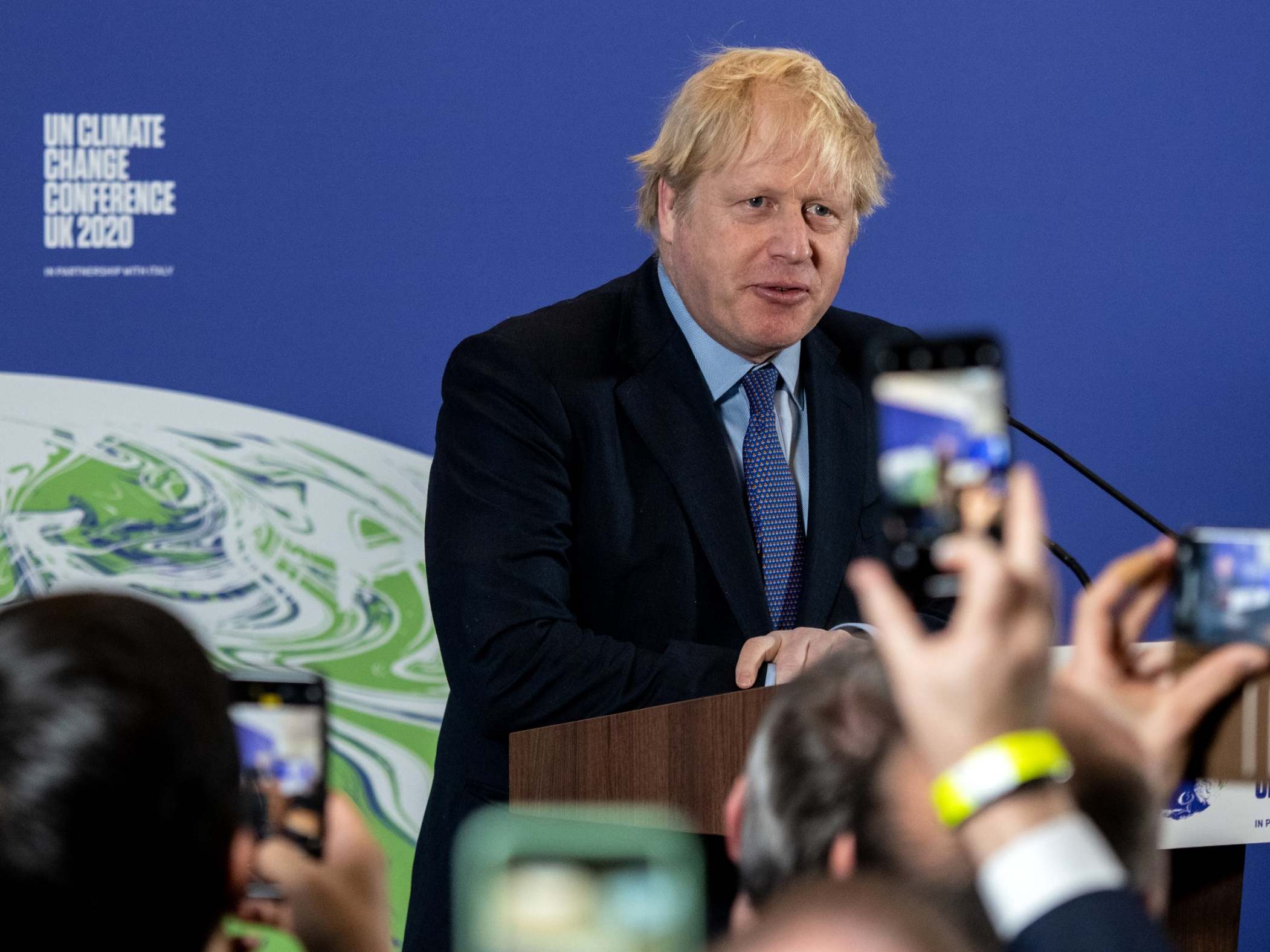
Boris Johnson has been accused of making “unrealistic” claims about the prospect of electric planes at the launch of COP26, the UN’s latest climate change summit.
It comes after the woman he sacked as president of the talks, the former energy minister Claire Perry O’Neill, claimed the prime minister had told her he did not “really get” the urgency of global warming.
The prime minister shared a stage at the Science Museum in London with Sir David Attenborough and Giuseppe Conte, the Italian prime minister, as he launched the COP26 talks which are to be held in Glasgow in November.
Following a long discourse about Walter Bersey, a 19th-century inventor who pioneered the electric taxi, Mr Johnson said that “as a species, we must now act” to reduce carbon emissions, and insisted it could be done.
”As we set out our plans to hit our ambitious 2050 net zero target across this year, so we shall urge others to join us in pledging net zero emissions,” he said, telling guests that Britain would lead the way.
He said: “Even the aviation industry has now committed to being carbon-neutral by 2050. We are on the verge, I am assured, within a couple of years, of having viable electric passenger aircraft. And we will get there. That is the lesson of that electric taxi. The sceptics are wrong to doubt the Promethean genius of humanity to solve these problems.”
Created with Sketch.
Created with Sketch.
1/20 California
In this decade, humans have become ever more aware of climate change. Calls for leaders to act echo around the globe as the signs of a changing climate become ever more difficult to ignore
Getty
2/20 Athens, Greece
Fierce wildfires have flared up in numerous countries. The damage being caused is unprecedented: 103 people were killed in wildfires last year in California, one of the places best prepared, best equipped to fight such blazes in the world
AFP/Getty
3/20 Redding, California
Entire towns have been razed. The towns of Redding and Paradise in California were all but eliminated in the 2018 season
AP
4/20 Athens, Greece
While wildfires in Greece (pictured), Australia, Indonesia and many other countries have wrought chaos to infrastructure, economies and cost lives
AFP/Getty
5/20 Carlisle, England
In Britain, flooding has become commonplace. Extreme downpours in Carlisle in the winter of 2015 saw the previous record flood level being eclipsed by two feet
AFP/Getty
6/20 Hebden Bridge, England
Hebden Bridge in West Yorkshire has flooded repeatedly in the past decade, with the worst coming on Christmas Day 2015. Toby Smith of Climate Visuals, an organisation focused on improving how climate change is depicted in the media, says: "Extreme weather and flooding, has and will become more frequent due to climate change. An increase in the severity and distribution of press images, reports and media coverage across the nation has localised the issue. It has raised our emotions, perception and personalised the effects and hazards of climate change."
Getty
7/20 Somerset, England
Out west in Somerset, floods in 2013 led to entire villages being cut off and isolated for weeks
Getty
8/20 Dumfries, Scotland
"In summer 2012, intense rain flooded over 8000 properties. In 2013, storms and coastal surges combined catastrophically with elevated sea levels whilst December 2015, was the wettest month ever recorded. Major flooding events continued through the decade with the UK government declaring flooding as one of the nation's major threats in 2017," says Mr Smith of Climate Visuals
Getty
9/20 London, England
Weather has been more extreme in Britain in recent years. The 'Beast from the East' which arrived in February 2018 brought extraordinarily cold temperatures and high snowfall. Central London (pictured), where the city bustle tends to mean that snow doesn't even settle, was covered in inches of snow for day
PA
10/20 London, England
Months after the cold snap, a heatwave struck Britain, rendering the normally plush green of England's parks in Summer a parched brown for weeks
AFP/Getty
11/20 New South Wales, Australia
Worsening droughts in many countries have been disastrous for crop yields and have threatened livestock. In Australia, where a brutal drought persisted for months last year, farmers have suffered from mental health problems because of the threat to their livelihood
Reuters
12/20 Tonle Sap, Cambodia
Even dedicated climate skeptic Jeremy Clarkson has come to recognise the threat of climate change after visiting the Tonle Sap lake system in Cambodia. Over a million people rely on the water of Tonle Sap for work and sustinence but, as Mr Clarkson witnessed, a drought has severley depleted the water level
Carlo Frem/Amazon
13/20 Addis Ababa, Ethiopia
In reaction to these harbingers of climate obliteration, some humans have taken measures to counter the impending disaster. Ethiopia recently planted a reported 350 million trees in a single day
AFP/Getty
14/20 Morocco
Morocco has undertaken the most ambitious solar power scheme in the world, recently completing a solar plant the size of San Francisco
AFP/Getty
15/20 London, England
Electric cars are taking off as a viable alternative to fossil fuel burning vehicles and major cities across the world are adding charging points to accomodate
AFP/Getty
16/20 Purmerend, The Netherlands
Cities around the world are embracing cycling too, as a clean (and healthy) mode of transport. The Netherlands continues to lead the way with bikes far outnumbering people
Jeroen Much/Andras Schuh
17/20 Xiamen, China
Cycling infrastructure is taking over cities the world over, in the hope of reducing society's dependency on polluting vehicles
Ma Weiwei
18/20 Chennai, India
Despite positive steps being taken, humans continue to have a wildly adverse effect on the climate. There have been numerous major oil spills this decade, the most notable being the BP oil spill in the Gulf of Mexico in 2010
AFP/Getty
19/20 Amazon rainforest, Brazil
More recently, large swathes of the Amazon rainforest were set alight by people to clear land for agriculture
AFP/Getty
20/20 California
This decade may have seen horrors but it has led to an understanding that the next decade must see change if human life is to continue
Getty
1/20 California
In this decade, humans have become ever more aware of climate change. Calls for leaders to act echo around the globe as the signs of a changing climate become ever more difficult to ignore
Getty
2/20 Athens, Greece
Fierce wildfires have flared up in numerous countries. The damage being caused is unprecedented: 103 people were killed in wildfires last year in California, one of the places best prepared, best equipped to fight such blazes in the world
AFP/Getty
3/20 Redding, California
Entire towns have been razed. The towns of Redding and Paradise in California were all but eliminated in the 2018 season
AP
4/20 Athens, Greece
While wildfires in Greece (pictured), Australia, Indonesia and many other countries have wrought chaos to infrastructure, economies and cost lives
AFP/Getty
5/20 Carlisle, England
In Britain, flooding has become commonplace. Extreme downpours in Carlisle in the winter of 2015 saw the previous record flood level being eclipsed by two feet
AFP/Getty
6/20 Hebden Bridge, England
Hebden Bridge in West Yorkshire has flooded repeatedly in the past decade, with the worst coming on Christmas Day 2015. Toby Smith of Climate Visuals, an organisation focused on improving how climate change is depicted in the media, says: "Extreme weather and flooding, has and will become more frequent due to climate change. An increase in the severity and distribution of press images, reports and media coverage across the nation has localised the issue. It has raised our emotions, perception and personalised the effects and hazards of climate change."
Getty
7/20 Somerset, England
Out west in Somerset, floods in 2013 led to entire villages being cut off and isolated for weeks
Getty
8/20 Dumfries, Scotland
"In summer 2012, intense rain flooded over 8000 properties. In 2013, storms and coastal surges combined catastrophically with elevated sea levels whilst December 2015, was the wettest month ever recorded. Major flooding events continued through the decade with the UK government declaring flooding as one of the nation's major threats in 2017," says Mr Smith of Climate Visuals
Getty
9/20 London, England
Weather has been more extreme in Britain in recent years. The 'Beast from the East' which arrived in February 2018 brought extraordinarily cold temperatures and high snowfall. Central London (pictured), where the city bustle tends to mean that snow doesn't even settle, was covered in inches of snow for day
PA
10/20 London, England
Months after the cold snap, a heatwave struck Britain, rendering the normally plush green of England's parks in Summer a parched brown for weeks
AFP/Getty
11/20 New South Wales, Australia
Worsening droughts in many countries have been disastrous for crop yields and have threatened livestock. In Australia, where a brutal drought persisted for months last year, farmers have suffered from mental health problems because of the threat to their livelihood
Reuters
12/20 Tonle Sap, Cambodia
Even dedicated climate skeptic Jeremy Clarkson has come to recognise the threat of climate change after visiting the Tonle Sap lake system in Cambodia. Over a million people rely on the water of Tonle Sap for work and sustinence but, as Mr Clarkson witnessed, a drought has severley depleted the water level
Carlo Frem/Amazon
13/20 Addis Ababa, Ethiopia
In reaction to these harbingers of climate obliteration, some humans have taken measures to counter the impending disaster. Ethiopia recently planted a reported 350 million trees in a single day
AFP/Getty
14/20 Morocco
Morocco has undertaken the most ambitious solar power scheme in the world, recently completing a solar plant the size of San Francisco
AFP/Getty
15/20 London, England
Electric cars are taking off as a viable alternative to fossil fuel burning vehicles and major cities across the world are adding charging points to accomodate
AFP/Getty
16/20 Purmerend, The Netherlands
Cities around the world are embracing cycling too, as a clean (and healthy) mode of transport. The Netherlands continues to lead the way with bikes far outnumbering people
Jeroen Much/Andras Schuh
17/20 Xiamen, China
Cycling infrastructure is taking over cities the world over, in the hope of reducing society's dependency on polluting vehicles
Ma Weiwei
18/20 Chennai, India
Despite positive steps being taken, humans continue to have a wildly adverse effect on the climate. There have been numerous major oil spills this decade, the most notable being the BP oil spill in the Gulf of Mexico in 2010
AFP/Getty
19/20 Amazon rainforest, Brazil
More recently, large swathes of the Amazon rainforest were set alight by people to clear land for agriculture
AFP/Getty
20/20 California
This decade may have seen horrors but it has led to an understanding that the next decade must see change if human life is to continue
Getty
But one expert said the idea of having fleets of passenger aircraft running on batteries in just two years was not realistic.
Tim Williamson, customer director of sustainable holiday company Responsible Travel, told The Independent: “I think that’s unrealistic. I see, certainly, in that not-too-distant time of my lifetime, that we will see short-haul electric or sustainable-fuel-based or another power source.
“I can certainly see that working for the low-passenger-density planes, domestic routes, short-haul European routes. Long-haul is going to be much more difficult. I think Boris is unrealistic in two years, but who’s to say what you can achieve if you put money and effort towards it?”
Responsible Travel is calling for extra taxes on flights to reduce demand and slash emissions, with receipts going toward research and development of alternative flying technologies. It also says carbon offsetting is a “greenwashing con”.
EasyJet, which is working with Airbus and Wright Electric to develop a 186-seater battery-powered passenger jet, does not expect to run it commercially for at least another 10 years. The aircraft’s seat capacity will be comparable to an Airbus A320’s.
Jeffrey Engler, chief executive of Wright Electric, told the BBC’s Victoria Derbyshire on Tuesday that “our goal is flights that are about an hour, so London to Amsterdam or London to Paris”. Confirming the consortium’s 2030 target date, he added: ”[Electric planes] are certainly a part of the future. It’s a daunting task but we’re working hard to get there.”
In her scathing attack on the prime minister early on Tuesday morning, Ms O’Neill also warned “anybody to whom Boris is making promises” that they should “get it in writing, get a lawyer to look at it – and make sure the money is in the bank”.
Asked about her claims, Mr Johnson’s spokesperson said the PM had “positioned the UK as a world leader on tackling climate change with the most ambitious environmental programme of any country on earth’.’
At Tuesday’s event in London Mr Johnson also dodged reporters’ questions about the UK’s hosting of COP26 – just a day after his advisors tried to block certain journalists from a civil service briefing about Brexit.
Journalists were told the PM would not participate in a question-and-answer session about his climate promises, even as he admitted that humanity had “had a catastrophic period of global addiction to hydrocarbons that got totally out of control” and that the situation was now urgent.
After his speech and in response to a shouted question on how he would prevent COP26 becoming the “disaster” that last year’s COP25 was, Mr Johnson said only: “It’s going to be great.”
A number of fundamental decisions on climate action were deferred to this year’s conference when countries failed to make agreements and leaders were accused of displaying a “profound disconnect” with their citizens.
On Tuesday the PM ignored a further shouted question about why he had sacked Ms O’Neill and when her replacement would be announced. He was then swiftly shepherded out of the Science Museum’s Smith Centre by security staff.
Speaking to The Independent on the sidelines of the launch, the environment secretary was asked how the UK could lead the way on climate change while also allowing Heathrow to build a third runway.
Theresa Villiers said: “Parliament has given outline planning permission for Heathrow expansion and now it’s for the promoters of the scheme to demonstrate that they can meet the really tough environmental conditions.
“If they can’t deliver on the conditions, obviously the future of the project is in question. But parliament has voted on it.”
The prime minister was absent for the 2018 vote on Heathrow expansion, which came while he was foreign secretary, despite having previously pledged to “lie down in front of the bulldozers” to prevent a third runway being constructed.
Heathrow’s boss said on Tuesday morning that flying was “not the enemy” in the battle against global warming, and said synthetic fuel “needs a real push on investment”. John Holland-Kaye told the BBC’s Today programme: “The enemy is carbon, not aviation. We need to protect the ability to fly in a world without carbon.”
Mr Johnson’s address followed the government’s announcement that its ban on new diesel and petrol-powered vehicles would be brought forward by five years to 2035. Hybrid cars will be included in the ban.
He told guests at the Science Museum: “We know as a country, as a society, as a planet, as a species, we must now act. We must reverse the appalling loss of habitats and species, it’s only by repairing the damage to the natural world and restoring the balance between humanity and nature, that is now so grotesquely out of kilter, we can address the problem of climate change.”
Sir David Attenborough praised the government’s promise that 2020 would be a year of action on global warming, adding: “It’s a huge encouragement for those of us who’ve been worrying about this problem for a very long time.
“It’s now up to us to put before the nations of the world what has to be done. We don’t need to emphasise to them or to you the longer we leave it, not doing things but going on talking about it, the worse it’s going to get. And in the end unless we do something, it becomes insoluble.”