


 Africana55 Radio

This website uses cookies so that we can provide you with the best user experience possible. Cookie information is stored in your browser and performs functions such as recognising you when you return to our website and helping our team to understand which sections of the website you find most interesting and useful.
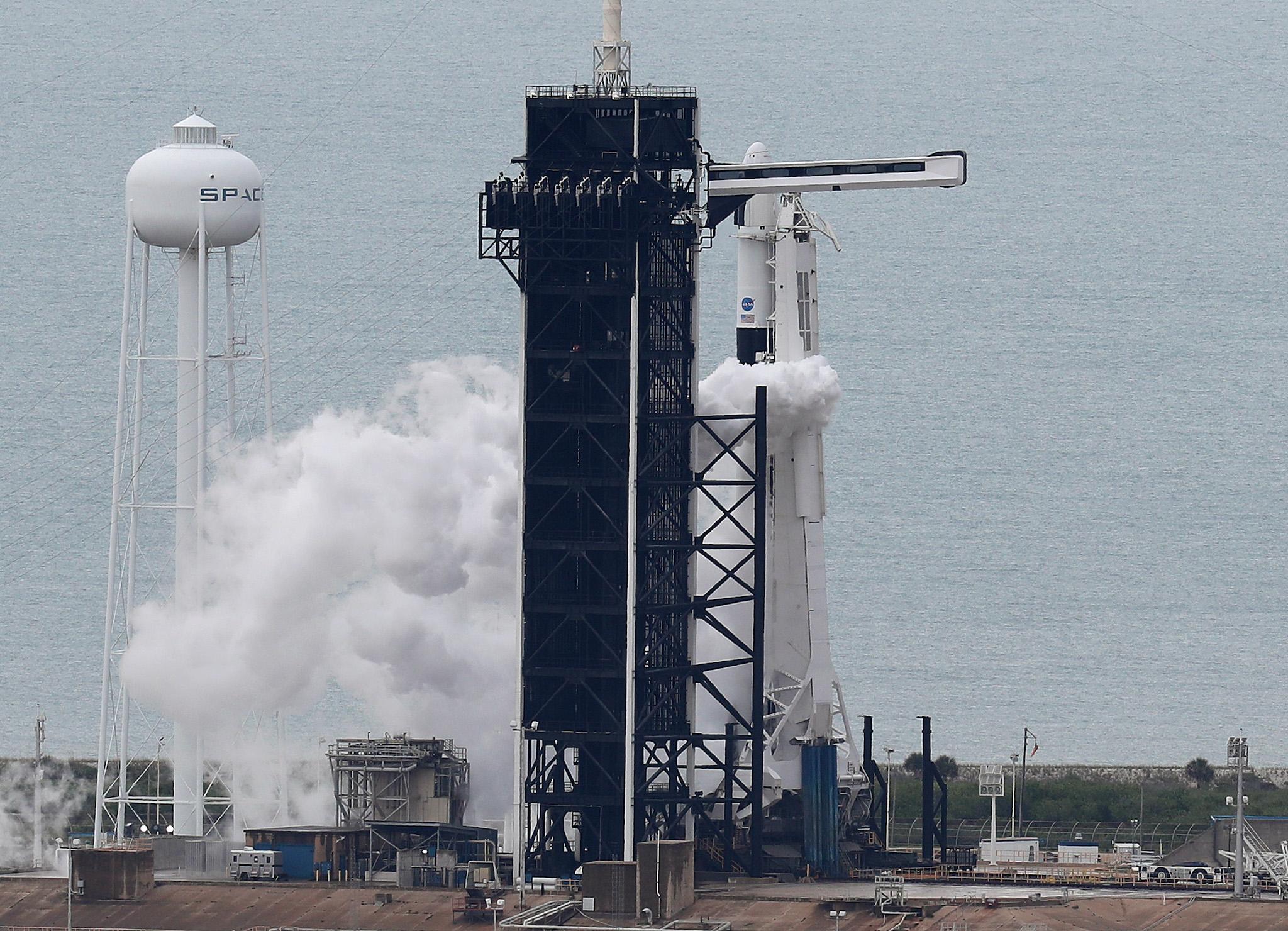
A historic SpaceX and Nasa launch has been cancelled minutes before liftoff because of bad weather.
The mission would have been the first time astronauts have launched from US soil in almost a decade.
But poor weather across Florida stopped the launch from Kennedy Space Center. The countdown was halted less than 17 minutes before the SpaceX Falcon 9 rocket was due to lift off.
The strength of the electric fields in the atmosphere made it unsafe for mission control to continue with the launch, SpaceX said. The company said that it expected those problem conditions would have cleared if it had 10 more minutes, but the nature of the "instantaneous" launch meant that the launch had to happen at its scheduled time or not at all.
SpaceX and Nasa will now try again to launch on Saturday, with another possible launch window on Sunday. Saturday's launch will take place slightly earlier, at 15.22 local time [20.22 BST].
But both of those days also threaten to have poor weather. The official forecast from the US Air Force 45th Weather Squadron shows that there is a 40 per cent chance that weather could stop those launch attempts.
Space veterans Doug Hurley and Bob Behnken were scheduled to ride into orbit aboard the brand-new Dragon capsule on top of a Falcon 9 rocket, taking off for the International Space Station from the same launch pad used during the Apollo moon missions a half-century ago.
Smiling, waving and giving the traditional thumbs-up, the two men said farewell to their families – exchanging blown kisses and pantomiming hugs for their young sons from a coronavirus-safe distance – before setting out for the pad in a gull-wing Tesla SUV, another product from SpaceX's visionary founder, Elon Musk.
Created with Sketch.
Created with Sketch.
1/10
Mystic Mountain, a pillar of gas and dust standing at three-light-years tall, bursting with jets of gas from fledgling stars buried within, was captured by Nasa's Hubble Space Telescope in February 2010
Nasa/ESA/STScI
2/10
The first ever selfie taken on an alien planet, captured by Nasa's Curiosity Rover in the early days of its mission to explore Mars in 2012
Nasa/JPL-Caltech/MSSS
3/10
Death of a star: This image from Nasa's Chandra X-ray telescope shows the supernova of Tycho, a star in our Milky Way galaxy
Nasa
4/10
Arrokoth, the most distant object ever explored, pictured here on 1 January 2019 by a camera on Nasa's New Horizons spaceraft at a distance of 4.1 billion miles from Earth
Getty
5/10
An image of the Large Magellanic Cloud galaxy seen in infrared light by the Herschel Space Observatory in January 2012. Regions of space such as this are where new stars are born from a mixture of elements and cosmic dust
Nasa
6/10
The first ever image of a black hole, captured by the Event Horizon telescope, as part of a global collaboration involving Nasa, and released on 10 April 2019. The image reveals the black hole at the centre of Messier 87, a massive galaxy in the nearby Virgo galaxy cluster. This black hole resides about 54 million light-years from Earth
Getty
7/10
Pluto, as pictured by Nasa's New Horizons spacecraft as it flew over the dwarf planet for the first time ever in July 2015
Nasa/APL/SwRI
8/10
A coronal mass ejection as seen by the Chandra Observatory in 2019. This is the first time that Chandra has detected this phenomenon from a star other than the Sun
Nasa
9/10
Dark, narrow, 100 meter-long streaks running downhill on the surface Mars were believed to be evidence of contemporary flowing water. It has since been suggested that they may instead be formed by flowing sand
Nasa/JPL/University of Arizona
10/10
Morning Aurora: Nasa astronaut Scott Kelly captured this photograph of the green lights of the aurora from the International Space Station in October 2015
Nasa/Scott Kelly
1/10
Mystic Mountain, a pillar of gas and dust standing at three-light-years tall, bursting with jets of gas from fledgling stars buried within, was captured by Nasa's Hubble Space Telescope in February 2010
Nasa/ESA/STScI
2/10
The first ever selfie taken on an alien planet, captured by Nasa's Curiosity Rover in the early days of its mission to explore Mars in 2012
Nasa/JPL-Caltech/MSSS
3/10
Death of a star: This image from Nasa's Chandra X-ray telescope shows the supernova of Tycho, a star in our Milky Way galaxy
Nasa
4/10
Arrokoth, the most distant object ever explored, pictured here on 1 January 2019 by a camera on Nasa's New Horizons spaceraft at a distance of 4.1 billion miles from Earth
Getty
5/10
An image of the Large Magellanic Cloud galaxy seen in infrared light by the Herschel Space Observatory in January 2012. Regions of space such as this are where new stars are born from a mixture of elements and cosmic dust
Nasa
6/10
The first ever image of a black hole, captured by the Event Horizon telescope, as part of a global collaboration involving Nasa, and released on 10 April 2019. The image reveals the black hole at the centre of Messier 87, a massive galaxy in the nearby Virgo galaxy cluster. This black hole resides about 54 million light-years from Earth
Getty
7/10
Pluto, as pictured by Nasa's New Horizons spacecraft as it flew over the dwarf planet for the first time ever in July 2015
Nasa/APL/SwRI
8/10
A coronal mass ejection as seen by the Chandra Observatory in 2019. This is the first time that Chandra has detected this phenomenon from a star other than the Sun
Nasa
9/10
Dark, narrow, 100 meter-long streaks running downhill on the surface Mars were believed to be evidence of contemporary flowing water. It has since been suggested that they may instead be formed by flowing sand
Nasa/JPL/University of Arizona
10/10
Morning Aurora: Nasa astronaut Scott Kelly captured this photograph of the green lights of the aurora from the International Space Station in October 2015
Nasa/Scott Kelly
Both Donald Trump and vice president Mike Pence arrived to watch the liftoff.
The flight would have marked the first time a private company sent humans into orbit.
It would also have been the first time in nearly a decade that the United States launched astronauts into orbit from US soil. Ever since the space shuttle was retired in 2011, Nasa has relied on Russian spaceships launched from Kazakhstan to take US astronauts to and from the space station.
The preparations took place in the shadow of the coronavirus outbreak that has killed an estimated 100,000 US citizens.
"We're launching American astronauts on American rockets from American soil. We haven't done this really since 2011, so this is a unique moment in time," Nasa Administrator Jim Bridenstine said.
With this launch, he said, "Everybody can look up and say, 'Look, the future is so much brighter than the present.' And I really hope that this is an inspiration to the world."
Mr Musk, wearing a mask and keeping his distance, chatted with the two Nasa astronauts just before they left for the launch pad. The mission would put Mr Musk and SpaceX in the same league as only three countries – Russia, the US and China, which sent astronauts into orbit in that order.
"What today is about is reigniting the dream of space and getting people fired up about the future," he said in a NASA interview.
A solemn-sounding Musk said he felt his responsibilities most strongly when he saw the astronauts' wives and sons just before launch. He said he told them: "We've done everything we can to make sure your dads come back OK."
NASA pushed ahead with the launch despite the viral outbreak but kept the guest list at Kennedy extremely limited and asked spectators to stay at home. Still, beaches and parks along Florida's Space Coast are open again, and hours before the launch, cars and RVs already were lining the causeway in Cape Canaveral.
The space agency also estimated 1.7 million people were watching the launch preparations online during the afternoon.
Among the sightseers was Erin Gatz, who came prepared for both rain and pandemic. Accompanied by her 14-year-old daughter and 12-year-old son, she brought face masks and a small tent to protect against the elements.
She said the children had faint memories of watching in person one of the last shuttle launches almost a decade ago when they were preschoolers.
"I wanted them to see the flip side and get to see the next era of space travel," said Gatz, who lives in Deltona, Florida. "It's exciting and hopeful."
Hurley, 53, and Behnken, 49, are both two-time shuttle fliers.
NASA hired SpaceX and Boeing in 2014 to transport astronauts to the space station in a new kind of public-private partnership. Development of SpaceX's Dragon and Boeing's Starliner capsules took longer than expected, however. Boeing's ship is not expected to fly astronauts into space until early 2021.
"We're doing it differently than we've ever done it before," Bridenstine said. "We're transforming how we do spaceflight in the future."
Additional reporting by agencies