


 Africana55 Radio

This website uses cookies so that we can provide you with the best user experience possible. Cookie information is stored in your browser and performs functions such as recognising you when you return to our website and helping our team to understand which sections of the website you find most interesting and useful.
With quarantine for travellers to destinations outside these islands officially in place until next summer, many holidaymakers are looking at staying within the UK and Ireland this year.
The five nations are opening up to tourism – but all at different speeds. This is the picture right now.
How soon can I take a domestic holiday?
In Northern Ireland, from 26 June. The Northern Ireland Executive has brought forward the opening date of holiday and caravan parks, camping sites and self-catering properties to next Friday, from when visitors can stay overnight.
It will also be the first UK nation in which it is possible to have a “normal” holiday. From 3 July, visitor attractions will be able to reopen, along with pubs (with table service only), restaurants, hotels, hostels and B&Bs. But spa facilities at hotels will remain closed.
When will England open for tourism?
Probably on 4 July. Visit England says: “Businesses up and down the land are prepping tirelessly and putting lots of measures in place in readiness to open – which could be as early as 4 July.”
Many hotels have said they will open on that Saturday, including the Macdonald group. In north Cornwall, the St Moritz Hotel & Spa says it intends to re-open all the hotel rooms, self-catering apartments and villas “with all operations in line with, or surpassing, all expected government requirements”.
Attractions are also focusing on 4 July, including Blackpool Pleasure Beach and Alton Towers – though the latter says: “Tickets will need to be pre-booked in advance before visiting.”
When will Wales be open for visitors?
The country has been adopting a cautious approach. A limit of 5 miles for journeys has had the effect of quashing tourism. The government in Cardiff has now announced: “The requirement to stay local will be lifted, if conditions allow, on 6 July.”
That will allow travellers from the rest of the UK to enter Wales, and permit free travel during the daytime.
Initially it was thought that the accommodation industry would start on the same day. But It now looks as though holiday cottages, static caravans and hotels “organised on a self-contained basis” will be open for bookings from 13 July onwards.
Created with Sketch.
Created with Sketch.
1/8 Ben Macdui, Cairngorms National Park
Swap busy Ben Nevis for the scarcely-smaller Ben Macdui, Scotland’s second highest peak at 4,295ft, and scale CairnGorm – which ranks sixth – for good measure. Twelve miles long and likely to take eight to nine hours, a rollercoaster of a hike bagging both begins from the Cairngorm Ski Centre car park. You’ll shadow a run down Cairn Gorm, cross heathery moors and flank the small Coire an Lochain water (walkhighlands.co.uk).
Getty Images/iStockphoto
2/8 Sandwood Bay Loop, Sutherland
One of Britain’s great beaches, Sandwood Bay’s wind-blasted white sand is inaccessible by road; you must walk a four-mile track from Blairmore – in remotest northwestern Scotland – past small lochs. Its lagoon, supposedly-haunted bothy, crashing waves and spindly sea stack look even better from above. So zigzag up the southern cliff before taking the faint coast path and then crossing bumpy, boggy peat moorland back to the main track (ramblers.org.uk).
Getty Images/iStockphoto
3/8 Bochlwyd Horseshoe, Snowdonia
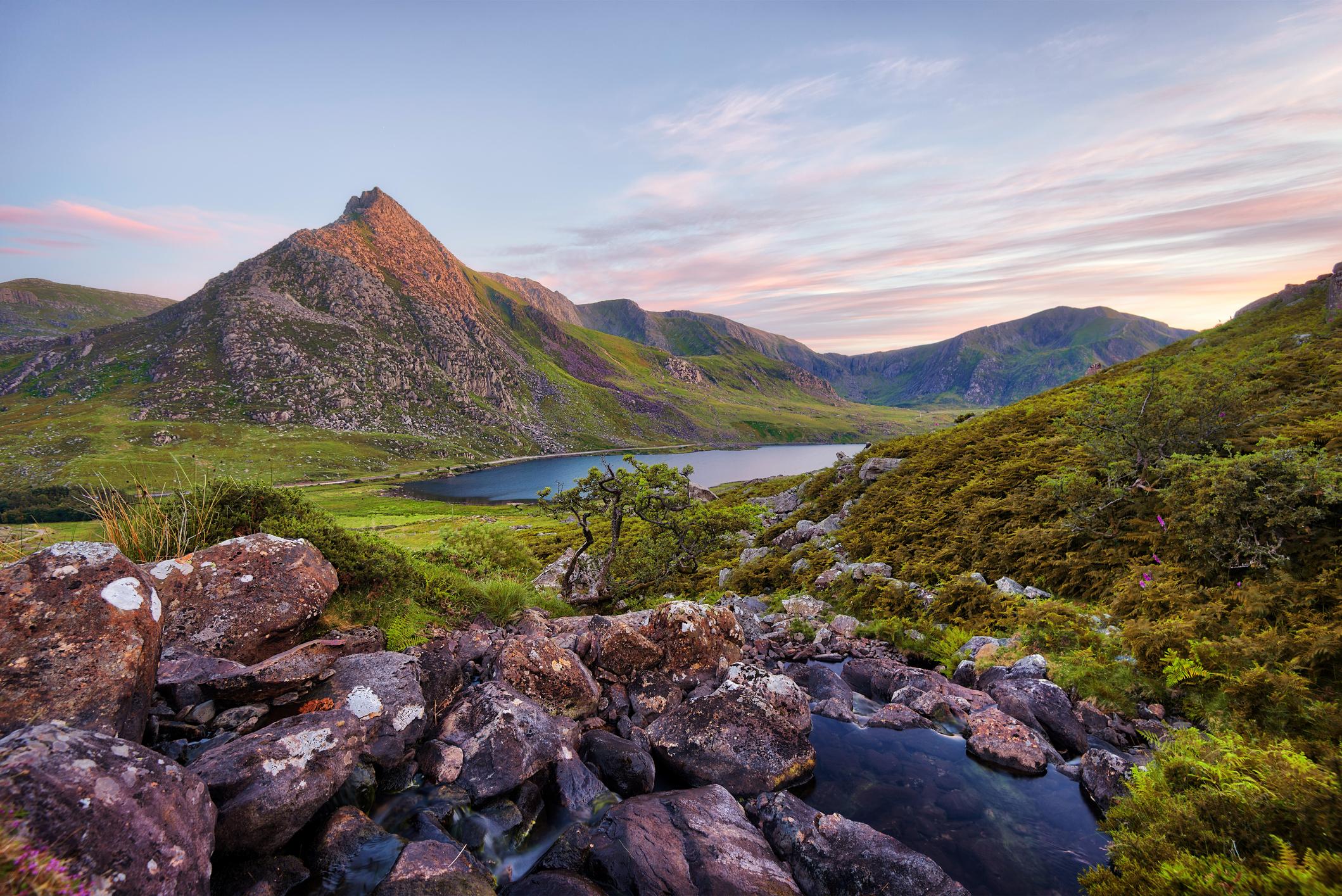
Snowdon is Wales’ most famous bluff, but nearby Tryfan is more eye-catching thanks to a shark-fin shape. It forms part of the Bochlwyd Horseshoe, which involves much scrambling over scree fields and – due to some wispy ridges – a head for heights. Veteran hikers are rewarded with scintillating, panoramic Snowdonia vistas and photo-ops on the overhanging Cantilever stone. The slow-going route is only eight miles, but will feel longer (mudandroutes.com).
Getty Images/iStockphoto
4/8 Scafell Pike via Corridor Route, Lake District
The ways up England’s highest mountain vary in popularity. Leaving the Lakeland hordes to follow an easy path from Wasdale, use instead the Corridor Route to steeply approach Scafell Pike’s quieter north side. After attaining its boulder-strewn, 3,209ft summit, loop back to start-point Seathwaite via burly Broad Crag. Almost ten miles long, this tough circular promises riversides, ravines, a waterfall and four Hewitts – hills over 2,000 feet (mudandroutes.com).
Getty Images for PCA
5/8 Slieve Binnian Trail, County Down
A challenging circular through Northern Ireland’s Mourne Mountains which starts off gently before plunging up alongside the attractive Mourne Wall: an early 20th-century dry-stone dyke built to separate cattle from a reservoir below. Though some scrambling is required to reach Slieve Binnian’s 2,449-foot crest, its views – to the Isle of Man on clear days – easily merit the effort, as does a diverse descent past the Blue Lough and Annalong Wood (walkni.com).
Getty Images/iStockphoto
6/8 Byrness to Kirk Yetholm, Northumberland, Scottish Borders
It can take 16 days to complete the 268-mile Pennine Way, but if you only have one to spare then combine the last (and usually least-crowded, due to a lack of accommodation) two stages for a real wilderness walk. Traversing the wild Cheviot Hills and hugging the Scottish border, it’s a lonely 27-mile trudge characterised by bog-hopping boardwalks and slab paths (nationaltrail.co.uk/pennine-way).
Getty Images/iStockphoto
7/8 The Broomway, Essex
It’s only six miles long, yet the Broomway is reckoned to have killed 100 people. From Great Wakering, it heads straight out to sea at low tide, eventually reaching the marshy island of Foulness. Why so perilous? Because the path is mostly unmarked, the tide returns faster than humans can and there is a lot of quicksand on the route. But in good weather, and traversed safely, this can be one of the most bracing beach walks Britain has on offer (broomway.org.uk).
Getty
8/8 Yorkshire Three Peaks
What do Pen y Ghent, Whernside and Ingleborough have in common? Well, they’re Yorkshire’s highest mountains, they each offer fine views and all three are surmountable during a gruelling 24-mile trek. Along with over 5,000 feet worth of ascent, you’re promised the Ribblehead viaduct, picturesque Dales High Way sections and, of interest to geologists, distinct limestone-gritstone overlaps. Begin and end at Horton in Ribblesdale, where pubs are happily on standby (threepeakschallenge.uk).
Getty Images/iStockphoto
1/8 Ben Macdui, Cairngorms National Park
Swap busy Ben Nevis for the scarcely-smaller Ben Macdui, Scotland’s second highest peak at 4,295ft, and scale CairnGorm – which ranks sixth – for good measure. Twelve miles long and likely to take eight to nine hours, a rollercoaster of a hike bagging both begins from the Cairngorm Ski Centre car park. You’ll shadow a run down Cairn Gorm, cross heathery moors and flank the small Coire an Lochain water (walkhighlands.co.uk).
Getty Images/iStockphoto
2/8 Sandwood Bay Loop, Sutherland
One of Britain’s great beaches, Sandwood Bay’s wind-blasted white sand is inaccessible by road; you must walk a four-mile track from Blairmore – in remotest northwestern Scotland – past small lochs. Its lagoon, supposedly-haunted bothy, crashing waves and spindly sea stack look even better from above. So zigzag up the southern cliff before taking the faint coast path and then crossing bumpy, boggy peat moorland back to the main track (ramblers.org.uk).
Getty Images/iStockphoto
3/8 Bochlwyd Horseshoe, Snowdonia
Snowdon is Wales’ most famous bluff, but nearby Tryfan is more eye-catching thanks to a shark-fin shape. It forms part of the Bochlwyd Horseshoe, which involves much scrambling over scree fields and – due to some wispy ridges – a head for heights. Veteran hikers are rewarded with scintillating, panoramic Snowdonia vistas and photo-ops on the overhanging Cantilever stone. The slow-going route is only eight miles, but will feel longer (mudandroutes.com).
Getty Images/iStockphoto
4/8 Scafell Pike via Corridor Route, Lake District
The ways up England’s highest mountain vary in popularity. Leaving the Lakeland hordes to follow an easy path from Wasdale, use instead the Corridor Route to steeply approach Scafell Pike’s quieter north side. After attaining its boulder-strewn, 3,209ft summit, loop back to start-point Seathwaite via burly Broad Crag. Almost ten miles long, this tough circular promises riversides, ravines, a waterfall and four Hewitts – hills over 2,000 feet (mudandroutes.com).
Getty Images for PCA
5/8 Slieve Binnian Trail, County Down
A challenging circular through Northern Ireland’s Mourne Mountains which starts off gently before plunging up alongside the attractive Mourne Wall: an early 20th-century dry-stone dyke built to separate cattle from a reservoir below. Though some scrambling is required to reach Slieve Binnian’s 2,449-foot crest, its views – to the Isle of Man on clear days – easily merit the effort, as does a diverse descent past the Blue Lough and Annalong Wood (walkni.com).
Getty Images/iStockphoto
6/8 Byrness to Kirk Yetholm, Northumberland, Scottish Borders
It can take 16 days to complete the 268-mile Pennine Way, but if you only have one to spare then combine the last (and usually least-crowded, due to a lack of accommodation) two stages for a real wilderness walk. Traversing the wild Cheviot Hills and hugging the Scottish border, it’s a lonely 27-mile trudge characterised by bog-hopping boardwalks and slab paths (nationaltrail.co.uk/pennine-way).
Getty Images/iStockphoto
7/8 The Broomway, Essex
It’s only six miles long, yet the Broomway is reckoned to have killed 100 people. From Great Wakering, it heads straight out to sea at low tide, eventually reaching the marshy island of Foulness. Why so perilous? Because the path is mostly unmarked, the tide returns faster than humans can and there is a lot of quicksand on the route. But in good weather, and traversed safely, this can be one of the most bracing beach walks Britain has on offer (broomway.org.uk).
Getty
8/8 Yorkshire Three Peaks
What do Pen y Ghent, Whernside and Ingleborough have in common? Well, they’re Yorkshire’s highest mountains, they each offer fine views and all three are surmountable during a gruelling 24-mile trek. Along with over 5,000 feet worth of ascent, you’re promised the Ribblehead viaduct, picturesque Dales High Way sections and, of interest to geologists, distinct limestone-gritstone overlaps. Begin and end at Horton in Ribblesdale, where pubs are happily on standby (threepeakschallenge.uk).
Getty Images/iStockphoto
The Welsh Government said that it will consider on 9 July “a range of specific options for opening” for self-contained holiday accommodation, as well as a “phased reopening of pubs, cafes and restaurants while maintaining strict social distancing”.
In a statement, the first minister said: “I know the wider tourism industry is keen to reopen and to salvage some of this summer’s season.
“I am therefore signalling owners of self-contained accommodation should use the next three weeks to prepare to re-open, working with their local communities.”
When can I holiday in Scotland?
The country will be the last part of the UK to open, which is hoped to be on 15 July – though Fergus Ewing, the cabinet secretary for Rural Economy and Tourism, calls it “an indicative date from which we hope the sector can begin to operate”.
He said: “This cannot be definitive. The science and health advice must be in the right place.
“The virus must have been suppressed, the Test and Protect system must be used effectively, and our route-map must be on course.”
This date will be confirmed only on 9 July.
Will the islands be open? Some residents of Scotland’s Western and Northern Isles hope not. Donald Macsween, who runs crofting tours on the Isle of Lewis, wrote in The Scotsman: “I think it would be madness to accept visitors into the islands, which could potentially undo the work of the lockdown.
“Anyone seen to be risking the lives of their friends and neighbours, for their own short-term financial gain, would have to live with the consequences.”
But Visit Outer Hebrides called the 15 July date “welcome news for us”.
Jonathan Hinkles, chief executive of Loganair, Scotland’s airline, said: “We will be flying, as we have been, right the way through.
“By September, the vast majority of our routes will be flying again.”
When can tourists stay in Ireland?
Unlike the UK, very early on in the Covid-19 crisis the republic set out a detailed road map explaining that tourism was expected to resume on 20 July, with the offshore islands opening only on 10 August. But the government in Dublin now says that hotels and restaurants in Ireland can open sooner than previously planned, on 29 June. Therefore tourists can explore the whole mainland of the island of Ireland from that date.
What about the Channel Islands?
Closed to tourists for now, with no date set for re-opening.
The Bailiwick of Guernsey, which includes Alderney and Sark, has no active cases of coronavirus. The official advice says: “Sadly, we will have to wait a while longer to welcome you back to our shores.
“Currently travel restrictions remain in place with those coming into the Bailiwick being required, by law, to self-isolate for 14 days on arrival.”
The government of Jersey says: “Travel across Jersey's border is restricted to necessary travel only.”
Created with Sketch.
Created with Sketch.
1/20 Edinburgh Festival Fringe
Edinburgh Festival Fringe
David Monteith Hodge
2/20 Giant's Causeway
Giant's Causeway
Stuart Stevenson photography/Ge
3/20 Stonehenge
Stonehenge
William Toti/500px
4/20 British Museum
British Museum
Chaokai Shen/500px
5/20 St Paul's Cathedral
St Paul's Cathedral
Mark Chilvers/Lonely Planet
6/20 Borough Market
Borough Market
Circle Creative Studio/Shutters
7/20 Hadrian's Wall
Hadrian's Wall
Dave Head/Shutterstock
8/20 Lake Windermere
Lake Windermere
Daniel_Kay/Shutterstock
9/20 Yorkshire Dales
Yorkshire Dales
ravellight/Shutterstock
10/20 Glencoe
Glencoe
Helen Hotson/Shutterstock
11/20 Punting in Cambridge
Punting in Cambridge
Premier Photo/Shutterstock
12/20 Bath
Bath
alice-photo/Shutterstock
13/20 Tate Modern
Tate Modern
chrisdorney/Shutterstock
14/20 Stratford-upon-Avon
Stratford-upon-Avon
Royal Shakespeare Theatre River Festival
15/20 The Scilly Isles
The Scilly Isles
Julian Love/Lonely Planet
16/20 Glastonbury
Glastonbury
Jason Bryant
17/20 South Bank
South Bank
Tony C French/Getty Images
18/20 Pembrokeshire Coast National Park
Pembrokeshire Coast National Park
Michael Roberts/Getty Images
19/20 Pub roast
Pub roast
Diana Miller/Getty Images
20/20 Arthur's Seat
Arthur's Seat
Martin McCarthy/Getty Images
1/20 Edinburgh Festival Fringe
Edinburgh Festival Fringe
David Monteith Hodge
2/20 Giant's Causeway
Giant's Causeway
Stuart Stevenson photography/Ge
3/20 Stonehenge
Stonehenge
William Toti/500px
4/20 British Museum
British Museum
Chaokai Shen/500px
5/20 St Paul's Cathedral
St Paul's Cathedral
Mark Chilvers/Lonely Planet
6/20 Borough Market
Borough Market
Circle Creative Studio/Shutters
7/20 Hadrian's Wall
Hadrian's Wall
Dave Head/Shutterstock
8/20 Lake Windermere
Lake Windermere
Daniel_Kay/Shutterstock
9/20 Yorkshire Dales
Yorkshire Dales
ravellight/Shutterstock
10/20 Glencoe
Glencoe
Helen Hotson/Shutterstock
11/20 Punting in Cambridge
Punting in Cambridge
Premier Photo/Shutterstock
12/20 Bath
Bath
alice-photo/Shutterstock
13/20 Tate Modern
Tate Modern
chrisdorney/Shutterstock
14/20 Stratford-upon-Avon
Stratford-upon-Avon
Royal Shakespeare Theatre River Festival
15/20 The Scilly Isles
The Scilly Isles
Julian Love/Lonely Planet
16/20 Glastonbury
Glastonbury
Jason Bryant
17/20 South Bank
South Bank
Tony C French/Getty Images
18/20 Pembrokeshire Coast National Park
Pembrokeshire Coast National Park
Michael Roberts/Getty Images
19/20 Pub roast
Pub roast
Diana Miller/Getty Images
20/20 Arthur's Seat
Arthur's Seat
Martin McCarthy/Getty Images
It is the only place in the British Isles that has a testing programme as an alternative to 14 days of self-isolation.
Arrivals who are permitted to travel to the island can agree to be tested for Covid-19 on the date of arrival at Jersey airport and undergo subsequent tests four days and seven days after touching down.
And the Isle of Man?
Flights from Heathrow to the island in the Irish Sea continue, and the first flight for months from London City airport will depart on Sunday 21 June to the Isle of Man.
But the island’s state of emergency was renewed on 16 June and will continue in force until 15 July 2020 at the earliest.
Anyone arriving must be in possession of a Letter of Exemption issued by the Government Chief Secretary, which tourists are unlikely to have.
Non-exempt travellers “will be refused entry and will be required to return to their point of origin at their own expense,” says the government.