


 Africana55 Radio

This website uses cookies so that we can provide you with the best user experience possible. Cookie information is stored in your browser and performs functions such as recognising you when you return to our website and helping our team to understand which sections of the website you find most interesting and useful.
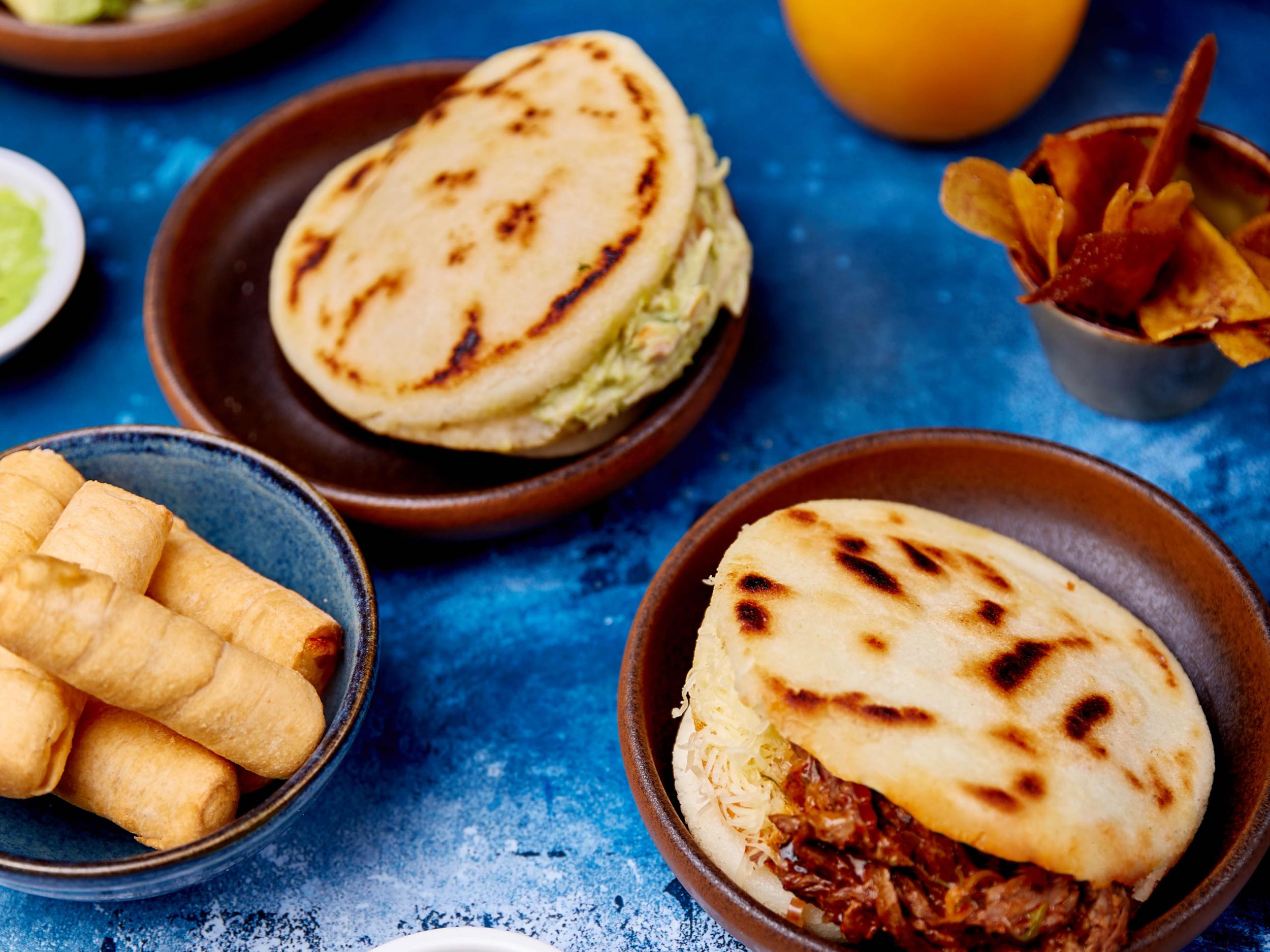
Venezuela, once one of Latin America’s richest and most animated countries, is grappling now with the unfolding Covid-19 crisis in which it is estimated to be one of the world’s least medically prepared nations – and, much like the restaurant industry worldwide, the arrival of Venezuelan cooking on the international scene is on indefinite hold.
It’s not often that a national dish comes with a side order of geopolitics and scuffling demonstrators, as is the case with the Venezuelan corn bun’s bracing arrival on the London food scene. In January, a crowd of protesters with placards denouncing “imperialist stooges” surrounded the Bethnal Green cafe Arepa and Co, and people attending a function inside emerged to trade insults and throw beer.
The cause of the demonstration was the visit of a politician from Caracas: the suave 36-year-old opposition leader Juan Guaido, fresh from a meeting with Boris Johnson. Guaido led the singing of the Venezuelan national anthem and thanked London for welcoming him as it had Simon Bolivar, “The Liberator”, two centuries earlier.
The presence of Guaido and Venezuelan food’s growth around the world are in fact linked, as both are consequences of the collapse of a country whose vast oil wealth made it one of Latin America’s richest and most cosmopolitan countries.
In 1999, Venezuela’s then president, Hugo Chavez, installed the socialist regime whose current leader, Nicolas Maduro, has accelerated the ruin of the country’s economy, driving 2.5 million citizens into exile.
Maduro hangs on to power, backed by the army and a rump of nations led by Russia, China and Cuba. Meanwhile, Guaido claims to be the legitimate president and has the support of many countries, including the UK. So London, like most other capitals, now has two competing Venezuelan ambassadors.
Clouds and silver linings, though: the great Venezuelan diaspora has spread the country’s food far and wide, with the arepa – while not exactly threatening the pizza – becoming increasingly visible. The dish has overtaken its more simple Colombian cousin – which is mostly filled with cheese or egg – of the same name, and is already familiar to Latin music lovers in the UK thanks to the food stalls at London concerts.
Unlike the plain Colombian arepa, the Venezuelan version is stuffed with fillings such as ground beef, chicken, the ubiquitous grated cow’s milk cheese from the llanos (plains), the guacamole equivalent guasaca, and aji pepper sauce. Other common Venezuelan dishes include tequenos (cheese-filled fried batons), cachapas (cornflour pancakes), and, especially around Christmas, the leaf-wrapped, steamed parcels known as hallacas, a version of the pan-Latin tamales.
A couple of months ago, arepas took a step into the British mainstream with the opening of Sabroso, the first areparia in a mass-market food court, at Westfield in Shepherd’s Bush. Sabroso is the creation of two Venezuelan brothers, Gabriel and Jose-Luis Gonzalez, exiles from the early Chavez years, who started their catering career by surfing the wave of a fashion for Peruvian food, opening Lima Floral in Covent Garden, before noting that the geo-food climate was ripe for a fully commercial Venezuelan enterprise.
London may be coming on nicely, but the rest of the UK is still a junior member of the Venezuelan food diaspora, with neighbouring Colombia the first to make a go of it. Imports have almost quadrupled for the special harina PAN – a brand of the unique yellow cornflour, related to polenta – which has become as much a Venezuelan cultural symbol as Bolivar’s white horse.
Created with Sketch.
Created with Sketch.
1/20 India
A street food vendor waits for customers seated next to a row of brightly-coloured syrup bottles at his street gola (shaved ice) stall, at Girgaon Chowpaty in Mumbai. Gola or barf ka gola or chuski are the most popular street desserts. The ice-based dessert is made by shaving an ice-block and pouring various flavored syrups on to the snow-like crushed ice
EPA
2/20 Nepal
A woman prepares yomari, or Nepalese steamed dumplings, in Lalitpur. Yomari consists of an external cover of rice flour and an inner content of sweets known as chaku and the mild-based khuwa. They sell for about 65 Nepali rupees or 60 US cents per dumpling. The yomari were traditionally prepared as a specialty dish by members of the ethnic Newari community in Nepal for their festival, but demand became so great that they are now sold throughout the year. According to myth Kubera, the Hindu god of wealth and prosperity, liked the yomari so much upon tasting it that he foretold anyone who makes it will be blessed with wealth and prosperity
EPA
3/20 India
A vendor selling seekh kebabs and other non-vegetarian food on Mira Road, in the outskirts of Mumbai. Seekh kebabs are popular, especially among Muslim people. They are made of meat, most often mutton, lamb, beef or chicken, and served with various accompaniments. Kebabs are often cooked on a skewer over a fire like a grill or baked in an oven
EPA
4/20 Vietnam
An elderly street cook cuts lap xuong or Chinese sausage, a traditional ingredient when ordering xoi or sticky rice, at a street food stall in Hanoi. Sticky rice is usually served with meat or egg, but there are many variations, such as sticky rice with steamed chicken, sticky rice with mung beans, sticky rice steamed with peanut, and sticky rice with sliced coconut
EPA
5/20 Philippines
People take a meal at a food stall along a street in Manila. Amid Manila's dense population, ambulant food vendors earn a good profit selling rice porridge mixed with meat, chicken feet, pork intestines, eggs on sticks, and beef stew with rice. Price ranges from 20 cents euro to 50 cents euro
EPA
6/20 Cambodia
Men cook snail soup at the Omega street food restaurant in Koh Pich (Diamond Island) in Phnom Penh. The snail soup is made with lake snails, caught by hand by farmers in the provinces around Phnom Penh. The dish offers customers a traditional provincial style of food compared to the majority of restaurants in Cambodia that offer Chinese, western or neighboring Asian nations cuisine, only a few offer traditional Cambodian fare. The restaurant specialises in cooking snail soup and steamed frog with small rocks
EPA
7/20 Myanmar
A woman puts a betel package, called quid, into her mouth made and sold at a street stall in Naypyitaw. Betel quids, known as Kunya, are very popular in Myanmar, made of tobacco and small pieces of betel nut wrapped in a betel leaf and spread with a lime paste that are placed into the mouth to suck and chew. Betel is the seed of the Areca palm, and while it's consumption is common in Asia and the Pacific, it is banned in many western countries due to its negative health effects. It also leads to the red stained teeth and mouths, and the red pavement spit that goes along with the experience
EPA
8/20 Philippines
La Loma district, in Manila, is famous for its roasted pig stores known as Lechon, a popular Filipino delicacy. Lechon is the Spanish word for a young suckling pig, that is then slowly roasted over charcoal. Lechon is often cooked during national festivities, the holiday season, and other special occasions such as weddings, graduations, birthdays and baptisms, or family get-togethers
EPA
9/20 Indonesia
Women sit as they eat bakso at a street in Depok. Bakso consists of meatballs and noodles mixed with tofu, mustard greens, fried onions and chili sauce. It is one of the most popular street foods in Indonesia
EPA
10/20 China
A street vendor prepares deep-fried curry fish balls, a street snack especially loved by young people, in Mong Kok, a busy night life district of Kowloon in Hong Kong. Since the so-called ' fish ball revolution' riot in Mong Kok in 2016, where a crowd of New Year revellers tried to push a cart of boiling oil towards health officials who were checking for unlicensed street hawkers, the snack has also become a symbol of identity of the Hong Kong people's resistance to perceived creeping authoritarianism from China. Traditionally, fish balls were made of local fish species once widely available in Hong Kong waters. However, due to over-fishing and the industrialisation of food production, the iconic snack is now said to contain only 20 per cent fish or less, with substitute ingredients such as flour, chemical enhancers, pork and lard sometimes making up the bulk of the product. Despite this, in 2012, local media Apple Daily reported that 375,000,000 fish balls were consumed per day
EPA
11/20 Thailand
A vendor arranges fried insects on her street food cart on Khao San Road in Bangkok. The road houses many kinds of food but the most popular are fresh fruits, fried insects and pad thai. Fried insects attract the attention of tourists from all over the world. Bugs have been on the menu in Thailand for ages but a few years ago they have migrated from the forests to commercial farms and factories. The most popular method of preparation is to deep-fry crickets in oil and then sprinkle them with lemongrass slivers and chilis. They are crunchy and taste like fried shrimp. Pad thai is a stir-fried rice noodle dish commonly served as street food and at most restaurants in Thailand
EPA
12/20 China
A man sells baozi, or Chinese steamed meat buns, at a business district in Beijing. The traditional Chinese dish is commonly eaten as breakfast. The baozi are steamed over high heat in a bamboo steamer. According to the legend, baozi has a long history, as it was invented by the Chinese military strategist Zhuge Liang during the Three Kingdoms period (third century AD)
EPA
13/20 Singapore
A vendor cooking satay meat skewers at her stall in the Lau Pa Sat food centre. Singapore has announced that it will be nominating its hawker culture, comprising over 6,000 hawkers who provide street food local dishes, for a Unesco's Representative List of the Intangible Cultural Heritage of Humanity. Hawker centres were started in the 1970s in Singapore by moving street vendors into purpose-built facilities. There are over 110 such hawker centres in the country. The announcement is reported to have angered some Malaysians, as both nations share a long street food culture heritage and similar dishes
EPA
14/20 Indonesia
A bowl of bakso
EPA
15/20 Nepal
A woman makes yomari in Lalitpur
EPA
16/20 India
A street food vendor sells a variety of common street snacks in Kolkata
EPA
17/20 Philippines
A vendor fries duck at a street stall in Binangonan, Rizal province. The duck is deep fried after a boiling process with garlic, onions and other spices, resulting in its trademark of crispy duck skin and meat
EPA
18/20 China
A seller prepares chuan on a skewer at the Wangfujing food market in Beijing. Chuan, pronounced as chwan, are small pieces of meat, but on rare occasions can be seafood, roasted on skewers. The food originated from the Xinjiang region of China and has been spread all across China's cities, where street food is popular. Usually, it is cooked with spices like dried red or black pepper, salt, cumin seeds, and with sesame oil, and sometimes served with small round bread
EPA
19/20 Malaysia
Nasi lemak is a Malay fragrant rice dish cooked in coconut milk and pandan leaf. Traditionally, Nasi lemak is served with a sambal (hot spicy sauce) and usually includes various garnishes, including fresh cucumber slices, small fried anchovies, roasted peanuts, and hard-boiled or fried egg
EPA
20/20 Vietnam
A street food chef prepares bang trang nuong or Vietnamese pizza at a street food stall in Hanoi. Vietnamese pizza is a thin sheet of rice paper with many kinds of toppings, such as beaten egg, sausage, cheese, dried pork, and is a popular Vietnamese street food
EPA
1/20 India
A street food vendor waits for customers seated next to a row of brightly-coloured syrup bottles at his street gola (shaved ice) stall, at Girgaon Chowpaty in Mumbai. Gola or barf ka gola or chuski are the most popular street desserts. The ice-based dessert is made by shaving an ice-block and pouring various flavored syrups on to the snow-like crushed ice
EPA
2/20 Nepal
A woman prepares yomari, or Nepalese steamed dumplings, in Lalitpur. Yomari consists of an external cover of rice flour and an inner content of sweets known as chaku and the mild-based khuwa. They sell for about 65 Nepali rupees or 60 US cents per dumpling. The yomari were traditionally prepared as a specialty dish by members of the ethnic Newari community in Nepal for their festival, but demand became so great that they are now sold throughout the year. According to myth Kubera, the Hindu god of wealth and prosperity, liked the yomari so much upon tasting it that he foretold anyone who makes it will be blessed with wealth and prosperity
EPA
3/20 India
A vendor selling seekh kebabs and other non-vegetarian food on Mira Road, in the outskirts of Mumbai. Seekh kebabs are popular, especially among Muslim people. They are made of meat, most often mutton, lamb, beef or chicken, and served with various accompaniments. Kebabs are often cooked on a skewer over a fire like a grill or baked in an oven
EPA
4/20 Vietnam
An elderly street cook cuts lap xuong or Chinese sausage, a traditional ingredient when ordering xoi or sticky rice, at a street food stall in Hanoi. Sticky rice is usually served with meat or egg, but there are many variations, such as sticky rice with steamed chicken, sticky rice with mung beans, sticky rice steamed with peanut, and sticky rice with sliced coconut
EPA
5/20 Philippines
People take a meal at a food stall along a street in Manila. Amid Manila's dense population, ambulant food vendors earn a good profit selling rice porridge mixed with meat, chicken feet, pork intestines, eggs on sticks, and beef stew with rice. Price ranges from 20 cents euro to 50 cents euro
EPA
6/20 Cambodia
Men cook snail soup at the Omega street food restaurant in Koh Pich (Diamond Island) in Phnom Penh. The snail soup is made with lake snails, caught by hand by farmers in the provinces around Phnom Penh. The dish offers customers a traditional provincial style of food compared to the majority of restaurants in Cambodia that offer Chinese, western or neighboring Asian nations cuisine, only a few offer traditional Cambodian fare. The restaurant specialises in cooking snail soup and steamed frog with small rocks
EPA
7/20 Myanmar
A woman puts a betel package, called quid, into her mouth made and sold at a street stall in Naypyitaw. Betel quids, known as Kunya, are very popular in Myanmar, made of tobacco and small pieces of betel nut wrapped in a betel leaf and spread with a lime paste that are placed into the mouth to suck and chew. Betel is the seed of the Areca palm, and while it's consumption is common in Asia and the Pacific, it is banned in many western countries due to its negative health effects. It also leads to the red stained teeth and mouths, and the red pavement spit that goes along with the experience
EPA
8/20 Philippines
La Loma district, in Manila, is famous for its roasted pig stores known as Lechon, a popular Filipino delicacy. Lechon is the Spanish word for a young suckling pig, that is then slowly roasted over charcoal. Lechon is often cooked during national festivities, the holiday season, and other special occasions such as weddings, graduations, birthdays and baptisms, or family get-togethers
EPA
9/20 Indonesia
Women sit as they eat bakso at a street in Depok. Bakso consists of meatballs and noodles mixed with tofu, mustard greens, fried onions and chili sauce. It is one of the most popular street foods in Indonesia
EPA
10/20 China
A street vendor prepares deep-fried curry fish balls, a street snack especially loved by young people, in Mong Kok, a busy night life district of Kowloon in Hong Kong. Since the so-called ' fish ball revolution' riot in Mong Kok in 2016, where a crowd of New Year revellers tried to push a cart of boiling oil towards health officials who were checking for unlicensed street hawkers, the snack has also become a symbol of identity of the Hong Kong people's resistance to perceived creeping authoritarianism from China. Traditionally, fish balls were made of local fish species once widely available in Hong Kong waters. However, due to over-fishing and the industrialisation of food production, the iconic snack is now said to contain only 20 per cent fish or less, with substitute ingredients such as flour, chemical enhancers, pork and lard sometimes making up the bulk of the product. Despite this, in 2012, local media Apple Daily reported that 375,000,000 fish balls were consumed per day
EPA
11/20 Thailand
A vendor arranges fried insects on her street food cart on Khao San Road in Bangkok. The road houses many kinds of food but the most popular are fresh fruits, fried insects and pad thai. Fried insects attract the attention of tourists from all over the world. Bugs have been on the menu in Thailand for ages but a few years ago they have migrated from the forests to commercial farms and factories. The most popular method of preparation is to deep-fry crickets in oil and then sprinkle them with lemongrass slivers and chilis. They are crunchy and taste like fried shrimp. Pad thai is a stir-fried rice noodle dish commonly served as street food and at most restaurants in Thailand
EPA
12/20 China
A man sells baozi, or Chinese steamed meat buns, at a business district in Beijing. The traditional Chinese dish is commonly eaten as breakfast. The baozi are steamed over high heat in a bamboo steamer. According to the legend, baozi has a long history, as it was invented by the Chinese military strategist Zhuge Liang during the Three Kingdoms period (third century AD)
EPA
13/20 Singapore
A vendor cooking satay meat skewers at her stall in the Lau Pa Sat food centre. Singapore has announced that it will be nominating its hawker culture, comprising over 6,000 hawkers who provide street food local dishes, for a Unesco's Representative List of the Intangible Cultural Heritage of Humanity. Hawker centres were started in the 1970s in Singapore by moving street vendors into purpose-built facilities. There are over 110 such hawker centres in the country. The announcement is reported to have angered some Malaysians, as both nations share a long street food culture heritage and similar dishes
EPA
14/20 Indonesia
A bowl of bakso
EPA
15/20 Nepal
A woman makes yomari in Lalitpur
EPA
16/20 India
A street food vendor sells a variety of common street snacks in Kolkata
EPA
17/20 Philippines
A vendor fries duck at a street stall in Binangonan, Rizal province. The duck is deep fried after a boiling process with garlic, onions and other spices, resulting in its trademark of crispy duck skin and meat
EPA
18/20 China
A seller prepares chuan on a skewer at the Wangfujing food market in Beijing. Chuan, pronounced as chwan, are small pieces of meat, but on rare occasions can be seafood, roasted on skewers. The food originated from the Xinjiang region of China and has been spread all across China's cities, where street food is popular. Usually, it is cooked with spices like dried red or black pepper, salt, cumin seeds, and with sesame oil, and sometimes served with small round bread
EPA
19/20 Malaysia
Nasi lemak is a Malay fragrant rice dish cooked in coconut milk and pandan leaf. Traditionally, Nasi lemak is served with a sambal (hot spicy sauce) and usually includes various garnishes, including fresh cucumber slices, small fried anchovies, roasted peanuts, and hard-boiled or fried egg
EPA
20/20 Vietnam
A street food chef prepares bang trang nuong or Vietnamese pizza at a street food stall in Hanoi. Vietnamese pizza is a thin sheet of rice paper with many kinds of toppings, such as beaten egg, sausage, cheese, dried pork, and is a popular Vietnamese street food
EPA
In a recent visit to the city of Cartagena in Colombia, I sat outside a cafe – staffed by Venezuelan chefs and waiters – talking to a Venezuelan food researcher about the entrepreneurial flair of expatriate Venezuelans in supplying the extra tonnes of flour and other products. “I was never personally attacked by regime militiamen”, the researcher said. “The reason I left was that I’m a sociable guy and I realised one day that practically all my friends had gone.”
After Colombia and the great Latin melting pot of Miami, European destinations have also attracted Venezuelans who have had to leave the country. Chief among them is Madrid, where focal points include the Mercado de Maravillas, a big covered market in the somewhat Brixton-like district of Tetuan. Here I met stallholder Angel Mora, an anti-Maduro activist who left after a beating by militiamen and now sells imported products both to exiles and to the Maduro government’s ambassador, who keeps a low profile but apparently sends his chauffeur for shopping.
The dozens of Venezuelan restaurants in Madrid now include interesting newcomers such as Apartaco and El Atelier de Dina, where the menu has gone far beyond arepas into the realms of regional specialities such as patacon – plantain – in a cheese, pepper and tomato sauce from the Caribbean coast, and dishes from the owner’s native state such as cachalupa (a sort of pie of lasagne), pepito Larense (a bread pizza topped with veal, chicken and other ingredients), and breadcrumbed, fried llanera cheese with red-pepper jam that has nostalgic clients “crying with emotion”. Even the venerable Complutense University of Madrid has entered the fray, with a research programme designing a carrot-enhanced, extra-nutritious arepa for the impoverished neighbourhoods of Caracas.
In the UK, we haven’t yet got the regional specialities, never mind university-honed super-buns. Here the classic arepa still rules. Gabriel Gonzalez is fine tuning and slimming down his menu in Sabroso, introducing trios of mini-arepas, and a Latinised version of Hawaiian poke bowls – a sort of fusion of the poke’s raw-fish ceviche and the Venezuelan national dish, pabellon criollo (a platter of rice, beans, plantains, meats and the spicy aji dipping sauce). Sabroso has also introduced a British touch, with cheddar or halloumi as alternatives to the Venezuelan cheese.
So what about exporting the concept back to its homeland? Not such a daft idea, in fact, as the upper end of the surprisingly complex Venezuelan catering scene has begun to recover.
Part of the reason is that – in a new echo of Cuba, Venezuela’s role model – Venezuelan citizens with access to US dollars are able to order a decent range of goods, while the hoi polloi have to queue to buy toilet paper with barrow-loads of bolivars, the almost worthless national currency.
The Venezuelan rum industry – which makes several internationally prized brands, notably Santa Teresa and Diplomatico – is in good health, however, as its citizens are obliged to abandon the increasingly expensive favourite, whisky.
Might things one day reverse direction, with a restored country, a functioning government, and the opening of the first Caracas branch of Sabroso of London? “Never say never,” replies Gabriel Gonzalez, sounding simultaneously optimistic and incredulous. As indeed many Venezuelans might feel.