


 Africana55 Radio

This website uses cookies so that we can provide you with the best user experience possible. Cookie information is stored in your browser and performs functions such as recognising you when you return to our website and helping our team to understand which sections of the website you find most interesting and useful.
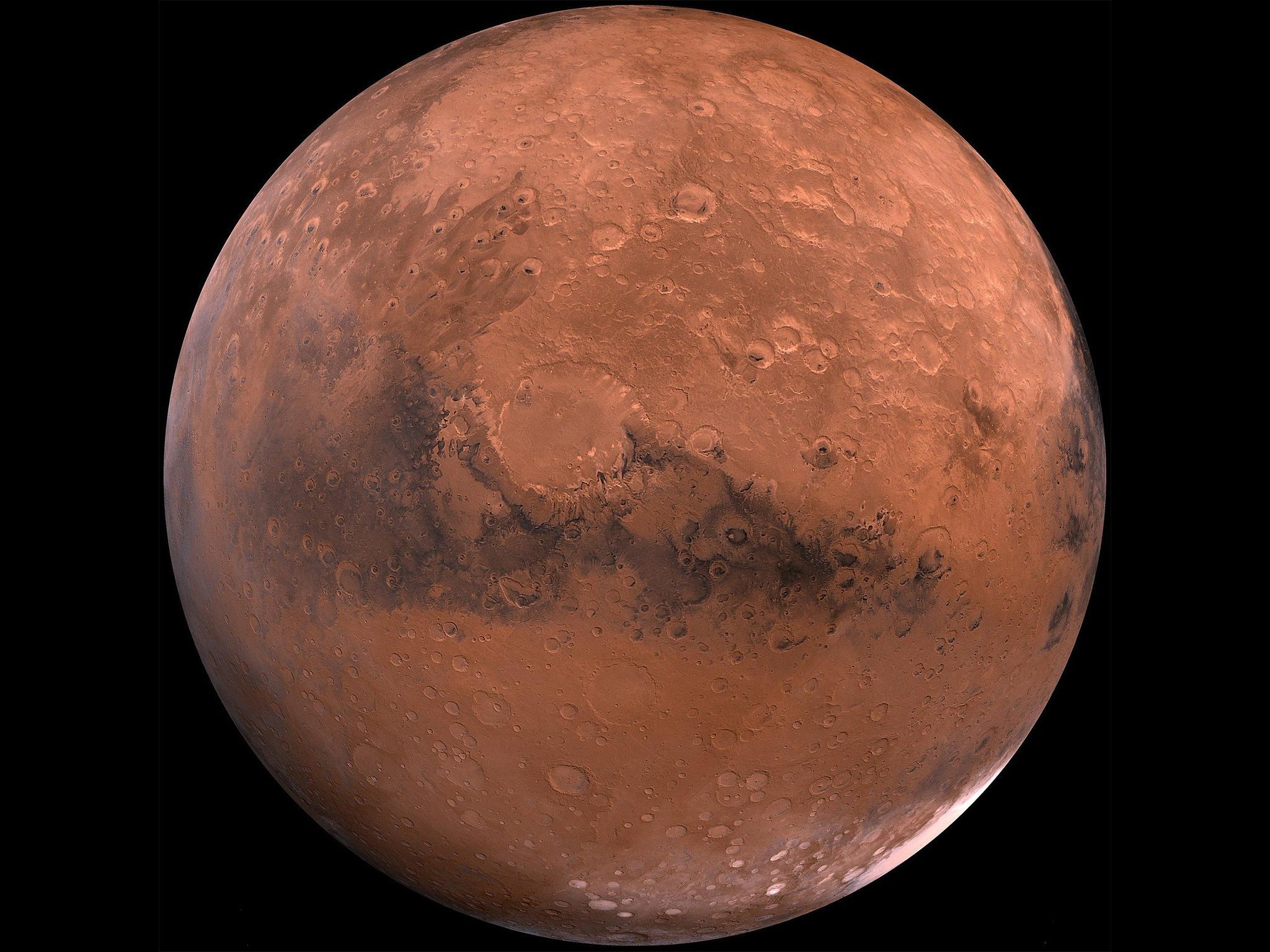
Mars may once have been covered in ice sheets like those in the Arctic, rather than flowing rivers, according to a new study.
When the valleys that cross across Mars's surface were spotted and further explored, they led to hope that rivers once flowed across its surface. That helped contribute to the idea that the planet was once wet and warm, with rainfall and oceans.
But the water that previously existed on the planet might actually have been there in a similar way to the ice that formed similar channels in the Canadian Arctic Archipelago, according to the new study.
That could actually be more helpful to any alien life that might once have lived on the ancient Mars, the researchers say, since the ice sheets would offer protection, allowing the water underneath to stay stable as well as serving as a barrier against the solar radiation that is thought to have once bombarded the Martian surface.
Researchers examined thousands of Martian valleys, which allowed them to generate detailed information on their construction. They then compared those channels found on Mars's surface with those channels, helping to understand what conditions might have given rise to them.
They found that they looked remarkably similar, with only a small number of the valley networks appearing as if they had been formed by surface water erosion. Instead, they seem to have come about as a result of extensive erosion from water draining beneath an ancient ice sheet, they found.
"For the last 40 years, since Mars's valleys were first discovered, the assumption was that rivers once flowed on Mars, eroding and originating all of these valleys," said Grau Galofre, who led the research published in Nature Geoscience, in a statement.
"But there are hundreds of valleys on Mars, and they look very different from each other. If you look at Earth from a satellite you see a lot of valleys: some of them made by rivers, some made by glaciers, some made by other processes, and each type has a distinctive shape. Mars is similar, in that valleys look very different from each other, suggesting that many processes were at play to carve them."
Created with Sketch.
Created with Sketch.
1/10
Mystic Mountain, a pillar of gas and dust standing at three-light-years tall, bursting with jets of gas from fledgling stars buried within, was captured by Nasa's Hubble Space Telescope in February 2010
Nasa/ESA/STScI
2/10
The first ever selfie taken on an alien planet, captured by Nasa's Curiosity Rover in the early days of its mission to explore Mars in 2012
Nasa/JPL-Caltech/MSSS
3/10
Death of a star: This image from Nasa's Chandra X-ray telescope shows the supernova of Tycho, a star in our Milky Way galaxy
Nasa
4/10
Arrokoth, the most distant object ever explored, pictured here on 1 January 2019 by a camera on Nasa's New Horizons spaceraft at a distance of 4.1 billion miles from Earth
Getty
5/10
An image of the Large Magellanic Cloud galaxy seen in infrared light by the Herschel Space Observatory in January 2012. Regions of space such as this are where new stars are born from a mixture of elements and cosmic dust
Nasa
6/10
The first ever image of a black hole, captured by the Event Horizon telescope, as part of a global collaboration involving Nasa, and released on 10 April 2019. The image reveals the black hole at the centre of Messier 87, a massive galaxy in the nearby Virgo galaxy cluster. This black hole resides about 54 million light-years from Earth
Getty
7/10
Pluto, as pictured by Nasa's New Horizons spacecraft as it flew over the dwarf planet for the first time ever in July 2015
Nasa/APL/SwRI
8/10
A coronal mass ejection as seen by the Chandra Observatory in 2019. This is the first time that Chandra has detected this phenomenon from a star other than the Sun
Nasa
9/10
Dark, narrow, 100 meter-long streaks running downhill on the surface Mars were believed to be evidence of contemporary flowing water. It has since been suggested that they may instead be formed by flowing sand
Nasa/JPL/University of Arizona
10/10
Morning Aurora: Nasa astronaut Scott Kelly captured this photograph of the green lights of the aurora from the International Space Station in October 2015
Nasa/Scott Kelly
1/10
Mystic Mountain, a pillar of gas and dust standing at three-light-years tall, bursting with jets of gas from fledgling stars buried within, was captured by Nasa's Hubble Space Telescope in February 2010
Nasa/ESA/STScI
2/10
The first ever selfie taken on an alien planet, captured by Nasa's Curiosity Rover in the early days of its mission to explore Mars in 2012
Nasa/JPL-Caltech/MSSS
3/10
Death of a star: This image from Nasa's Chandra X-ray telescope shows the supernova of Tycho, a star in our Milky Way galaxy
Nasa
4/10
Arrokoth, the most distant object ever explored, pictured here on 1 January 2019 by a camera on Nasa's New Horizons spaceraft at a distance of 4.1 billion miles from Earth
Getty
5/10
An image of the Large Magellanic Cloud galaxy seen in infrared light by the Herschel Space Observatory in January 2012. Regions of space such as this are where new stars are born from a mixture of elements and cosmic dust
Nasa
6/10
The first ever image of a black hole, captured by the Event Horizon telescope, as part of a global collaboration involving Nasa, and released on 10 April 2019. The image reveals the black hole at the centre of Messier 87, a massive galaxy in the nearby Virgo galaxy cluster. This black hole resides about 54 million light-years from Earth
Getty
7/10
Pluto, as pictured by Nasa's New Horizons spacecraft as it flew over the dwarf planet for the first time ever in July 2015
Nasa/APL/SwRI
8/10
A coronal mass ejection as seen by the Chandra Observatory in 2019. This is the first time that Chandra has detected this phenomenon from a star other than the Sun
Nasa
9/10
Dark, narrow, 100 meter-long streaks running downhill on the surface Mars were believed to be evidence of contemporary flowing water. It has since been suggested that they may instead be formed by flowing sand
Nasa/JPL/University of Arizona
10/10
Morning Aurora: Nasa astronaut Scott Kelly captured this photograph of the green lights of the aurora from the International Space Station in October 2015
Nasa/Scott Kelly
The research would also help answer the mystery of how the valleys could have formed on a planet so far from the Sun, as well as so long ago, at a time when it was less intense.
"Climate modelling predicts that Mars' ancient climate was much cooler during the time of valley network formation," said Galofre. "We tried to put everything together and bring up a hypothesis that hadn't really been considered: that channels and valleys networks can form under ice sheets, as part of the drainage system that forms naturally under an ice sheet when there's water accumulated at the base."