


 Africana55 Radio

This website uses cookies so that we can provide you with the best user experience possible. Cookie information is stored in your browser and performs functions such as recognising you when you return to our website and helping our team to understand which sections of the website you find most interesting and useful.
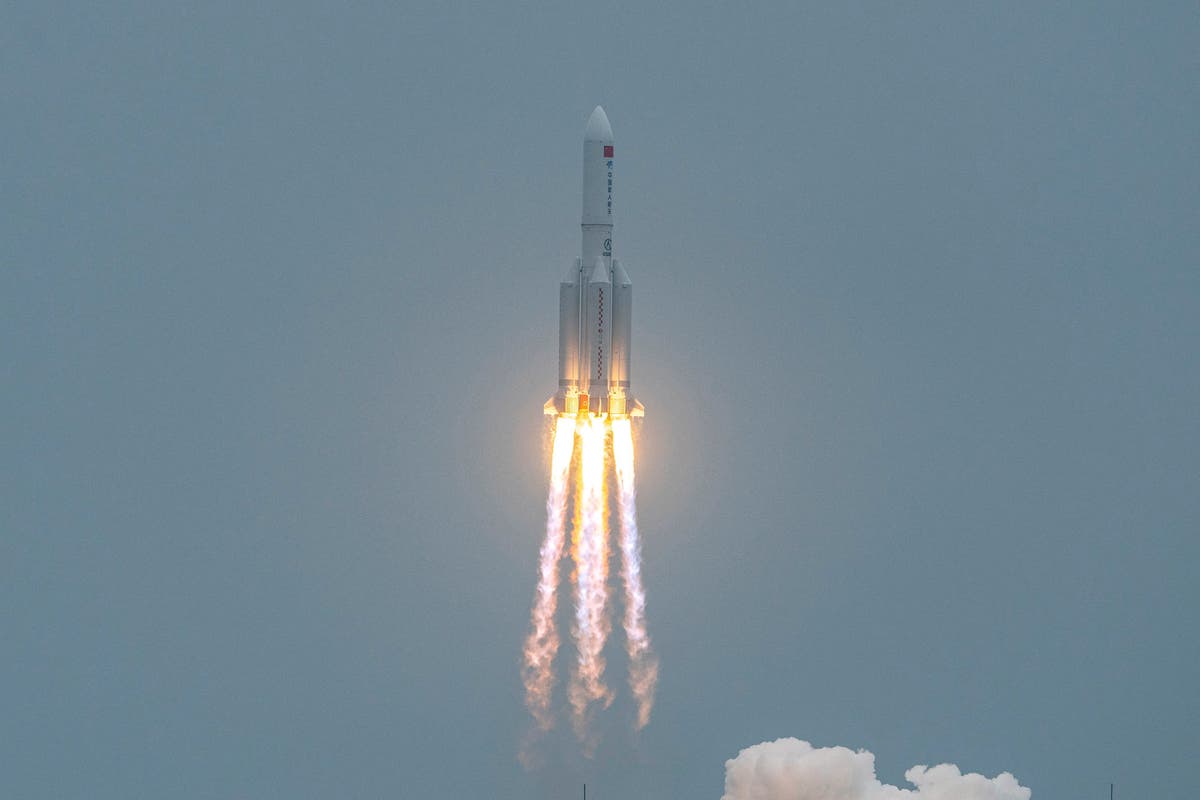
The Long March 5B rocket, which carried a Chinese space station module, has dropped into low Earth orbit and now risks crashing back down.
The rocket successfully launched the Tianhe module last week, which will become the living quarters of the future Chinese Space Station (CSS). Unfortunately, the 30-metre long rocket also reached orbit, and is now one of the largest ever launches to make an uncontrolled re-entry.
It is uncommon for rockets to reach the velocity necessary to reach orbit, but it is currently travelling around the world once every 90 minutes, or seven kilometres every second. It passes by just north of New York, Madrid, and Beijing, and as far south as Chile and New Zealand.
There are fears that the rocket could land on an inhabited area; the last time a Long March rocket was launched in May 2020, debris was reported falling on villages in the Ivory Coast. The speed of the rocket means scientists still do not yet know when it will fall, but it is likely to do so before 10 May 2021.
Read more:
To keep up to date with all the latest news and features from The Independent sign up to our wide range of free newsletters. Browse all of our free emails that available to sign up to by clicking here
1620490540
US government tracker still slightly earlier
The US government tracker – which can be found at Space-Track.org – is still showing the possible re-entry as slightly earlier.
It has a re-entry time at 2.27am UTC on Sunday morning, with a window of three hours either side.
Andrew Griffin8 May 2021 17:15
1620490375
Rocket re-entry still expected early Sunday
The latest predictions from the Aerospace Corporation are here.
They’ve not changed much; the window has just shifted back by eight minutes.
That means everything is still expected to happen early on Sunday; some time between 11.30am UTC and 7.30am UTC.
Andrew Griffin8 May 2021 17:12
1620485154
Latest possible impact locations suggest China is safe
The refining of the possible impact time also means that the location can be refined too. Not by much, since the rocket is moving so fast, but by enough to rule out an impact with China:
McDowell also notes that NYC and Elon Musk are out of the impact zone, too. “I apologise to everyone who was hoping for a more dramatic SNL tonight than usual,” he jokes.
Andrew Griffin8 May 2021 15:45
1620484133
The new Aerospace Corporation estimate is out – and puts the potential arrival somewhere between 11.22pm UTC on Saturday, and 7.22am UTC on Sunday.
Andrew Griffin8 May 2021 15:28
1620479167
The trackers at EU Space Surveillance and Tracking have narrowed down their estimate, giving a smaller window that puts a potential fall early in the morning UK time.
There is this caveat from Jonathan McDowell:
Andrew Griffin8 May 2021 14:06
1620477803
Space Force’s latest estimate shows rocket arriving on Sunday morning
The latest data from the Space Force has the rocket dropping just before 3am UTC. It could be six hours before or after that, though, because of the uncertainty.
As ever, that means there’s no real way of knowing where it might land: even a difference of minutes would lead to a vast change in where it would drop down, given the speed it is orbiting.
Andrew Griffin8 May 2021 13:43
1620463506
China says rocket will come down in a ‘timely manner’ and ‘harm’ is unlikely
Here’s the latest from the Associated Press on China’s assurances that the rocket’s arrival will probably be safe:
China says the upper stage of its Long March 5B rocket that launched the core module of its space station will mostly burn up on re-entry, posing little threat to people and property on the ground.
Foreign Ministry spokesman Wang Wenbing said Chinese authorities will release information about the re-entry of the rocket, expected over the weekend, in a “timely manner”.
He said China “pays great attention to the re-entry of the upper stage of the rocket into the atmosphere”.
“As far as I understand, this type of rocket adopts a special technical design, and the vast majority of the devices will be burnt up and destructed during the re-entry process, which has a very low probability of causing harm to aviation activities and the ground,” Mr Wang said.
The largest section of the rocket that launched the main module of China‘s first permanent space station is expected to plunge back to Earth as early as Saturday at an unknown location.
Discarded rocket stages usually re-enter the atmosphere soon after lift-off, normally over water, and do not go into orbit.
China‘s space agency has yet to say whether the main stage of the huge Long March 5B rocket is being controlled or will make an out-of-control descent.
Andrew Griffin8 May 2021 09:45
1620457051
Estimate of impact continues to narrow
The latest predictions are narrowed even more. The estimate for re-entry is now at 4.19am UTC on Sunday.
But there is still a big window; it could be eight hours before or after that.
(UTC is the same as GMT; add an hour for UK time, or remove four for EST, and so on.)
Andrew Griffin8 May 2021 07:57