


 Africana55 Radio

This website uses cookies so that we can provide you with the best user experience possible. Cookie information is stored in your browser and performs functions such as recognising you when you return to our website and helping our team to understand which sections of the website you find most interesting and useful.
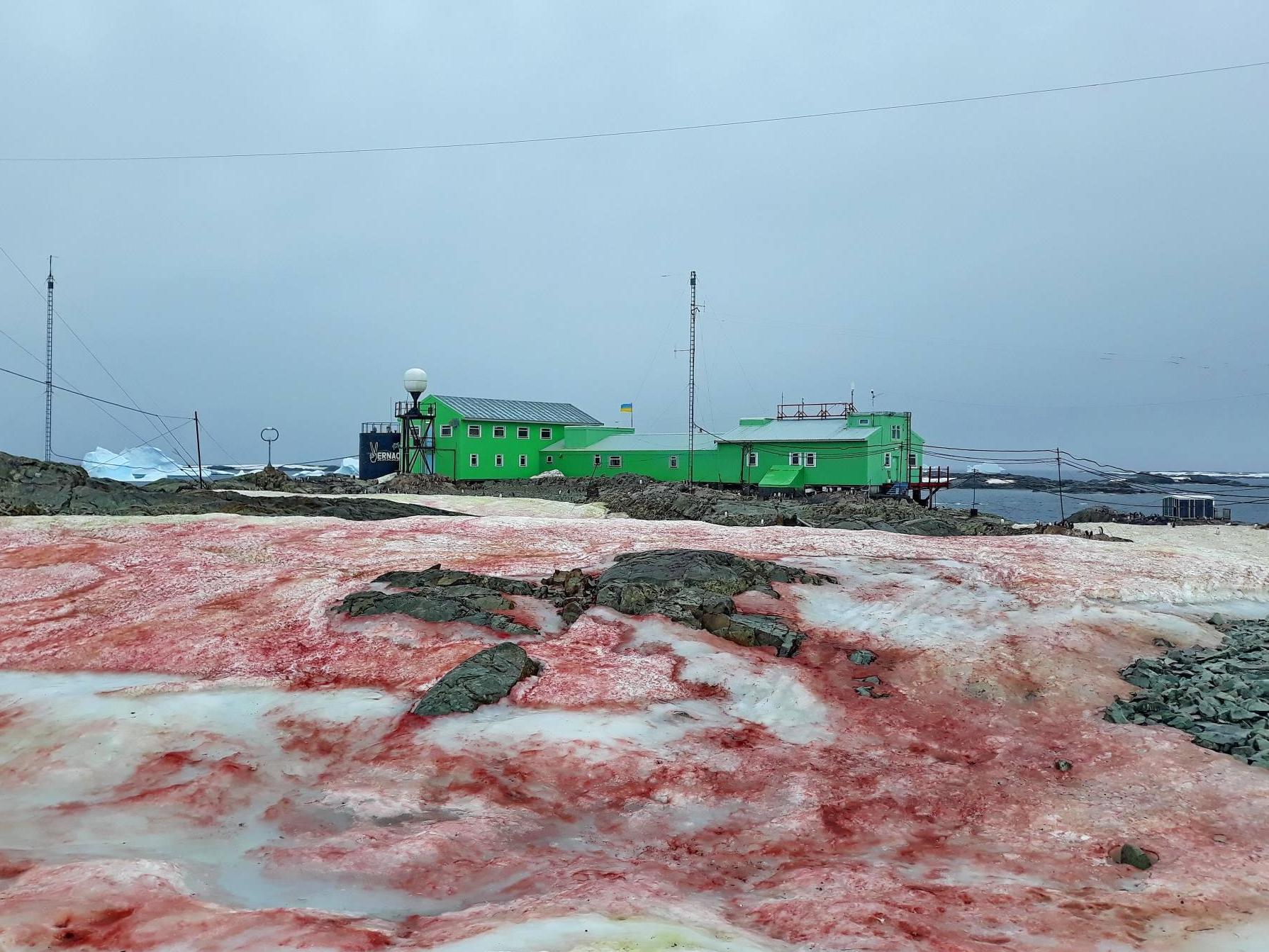
Snow has taken on a sinister-looking blood red colour at a Ukrainian research station due to a type of algae which contributes to climate change.
For several weeks, scientists working at the Vernadsky Research Base in Antarctica have been surrounded by what they call “raspberry snow”.
Images released by Ukraine’s Ministry of Education and Science on Monday showed the phenomenon, which is caused by microscope snow algae when weather conditions are favourable during Antarctica’s summer months.
The ministry explained that the algae is able to survive the extreme cold temperatures during the Antarctic winter and begins to sprout when warmer temperatures arrive in the summer (between October and February).
The algae’s cells have a red carotene layer which protects it from ultraviolet radiation and produces red spots in the snow like “raspberry jam”, the ministry said.
Created with Sketch.
Created with Sketch.
1/20
A Twin Otter airplane during a reconnaissance flight over the Antarctic Plateau and the Edson Glacier in the Ellsworth Mountains. This utility airplane, equipped with wheels or skis, adapts perfectly to the Antarctic environment with its rugged construction and short take off and landing performance
EPA
2/20
Military personnel move drums with kerosene for the airplanes during their daily maintenance activities
EPA
3/20
An explorer points the way to follow during a reconnaissance trip on the Edson Glacier, in the Ellsworth Mountains. The group moves in a straight line to minimize the risk of falling into hidden crevasse
EPA
4/20
A member of INACH, Pablo Espinoza, lays in his sleeping bag in the Glaciar Union camp. The temperature inside the living tents averages minus five degrees Celsius
EPA
5/20
An aerial view of the Glaciar Union camp in the Ellsworth Mountains. The Glaciar Union camp is a Chilean polar station operated by Chilean Antarctic Institute (INACH) and the three groups of the Armed Forces of Chile marking the beginning of all scientific activities planned in Antarctica for the summer season
EPA
6/20
Two medics treat an injured soldier in the small station hospital in Glaciar Union camp. The most common cases are minor work injuries, frostbite and hypothermia
EPA
7/20
A man walks through the Glaciar Union camp during a windstorm. Catabatic winds can reach up to 300 km/h and drop the thermal sensation to dangerous levels
EPA
8/20
Members of the expedition who hadn't crossed the Antarctic Circle (a parallel 66.5 degrees south of the equator) enjoy a 'snow baptism' by other veterans
EPA
9/20
A pilot of the Chilean Air Force tries to get signal on his satellite phone after landing on the Antarctic Plateau. Satellite communications is the only mean to keep in touch with the main operational base situated in Punta Arenas
EPA
10/20
Scientist Ricardo Jana leaves a mobile station for a GPS tracking field trip in the Glaciar Union camp. Location tracking tools like the Differential Global Positioning System (DGPS) help to improve the safety on field trips by locating hidden crevasses in exact way
EPA
11/20
A group of explorers extract blue ice blocks near the Glaciar Union camp. The ice will be used by scientists to keep their samples refrigerated
EPA
12/20
An explorer helps himself to a dessert of fruit and yoghurt during lunch time in a communal area that also works as the kitchen, in the camp
EPA
13/20
A group of scientists and explorers move on ski randonee to a sample spot on the Higgins Nunatak, in the Ellsworth Mountains. Snowmobiles, ski randonnee and short flights in Twin Otter airplanes are the most used travel options in field trips with scientists
EPA
14/20
A man walks out of buried living unit in the Glaciar Union camp. Snow accumulation occurs mostly by wind displacement rather than snowfall
EPA
15/20
Pablo Espinoza, gets ready for a field trip in his tent
EPA
16/20
Scientists and military personnel play football in Glaciar Union camp
EPA
17/20
Military personnel shovel dirty snow into an empty drum during a cleaning activity around the camp. Known as the 'chicken walk' the military personnel collect with shovels or by hand small debris or small patches of contaminated snow that can be found in the camp area. The expeditioners aim for a zero impact stay in this region
EPA
18/20
A group of explorers transport scientists and material on snowmobiles during a field trip near Rossman Cove
EPA
19/20
A member of INACH, Rene Quinan, in his tent. Up to three people can sleep in these clam tents designed for extreme weather conditions
EPA
20/20
A group of explorers during a reconnaissance trip on ski randonee on the Edson Glacier
EPA
1/20
A Twin Otter airplane during a reconnaissance flight over the Antarctic Plateau and the Edson Glacier in the Ellsworth Mountains. This utility airplane, equipped with wheels or skis, adapts perfectly to the Antarctic environment with its rugged construction and short take off and landing performance
EPA
2/20
Military personnel move drums with kerosene for the airplanes during their daily maintenance activities
EPA
3/20
An explorer points the way to follow during a reconnaissance trip on the Edson Glacier, in the Ellsworth Mountains. The group moves in a straight line to minimize the risk of falling into hidden crevasse
EPA
4/20
A member of INACH, Pablo Espinoza, lays in his sleeping bag in the Glaciar Union camp. The temperature inside the living tents averages minus five degrees Celsius
EPA
5/20
An aerial view of the Glaciar Union camp in the Ellsworth Mountains. The Glaciar Union camp is a Chilean polar station operated by Chilean Antarctic Institute (INACH) and the three groups of the Armed Forces of Chile marking the beginning of all scientific activities planned in Antarctica for the summer season
EPA
6/20
Two medics treat an injured soldier in the small station hospital in Glaciar Union camp. The most common cases are minor work injuries, frostbite and hypothermia
EPA
7/20
A man walks through the Glaciar Union camp during a windstorm. Catabatic winds can reach up to 300 km/h and drop the thermal sensation to dangerous levels
EPA
8/20
Members of the expedition who hadn't crossed the Antarctic Circle (a parallel 66.5 degrees south of the equator) enjoy a 'snow baptism' by other veterans
EPA
9/20
A pilot of the Chilean Air Force tries to get signal on his satellite phone after landing on the Antarctic Plateau. Satellite communications is the only mean to keep in touch with the main operational base situated in Punta Arenas
EPA
10/20
Scientist Ricardo Jana leaves a mobile station for a GPS tracking field trip in the Glaciar Union camp. Location tracking tools like the Differential Global Positioning System (DGPS) help to improve the safety on field trips by locating hidden crevasses in exact way
EPA
11/20
A group of explorers extract blue ice blocks near the Glaciar Union camp. The ice will be used by scientists to keep their samples refrigerated
EPA
12/20
An explorer helps himself to a dessert of fruit and yoghurt during lunch time in a communal area that also works as the kitchen, in the camp
EPA
13/20
A group of scientists and explorers move on ski randonee to a sample spot on the Higgins Nunatak, in the Ellsworth Mountains. Snowmobiles, ski randonnee and short flights in Twin Otter airplanes are the most used travel options in field trips with scientists
EPA
14/20
A man walks out of buried living unit in the Glaciar Union camp. Snow accumulation occurs mostly by wind displacement rather than snowfall
EPA
15/20
Pablo Espinoza, gets ready for a field trip in his tent
EPA
16/20
Scientists and military personnel play football in Glaciar Union camp
EPA
17/20
Military personnel shovel dirty snow into an empty drum during a cleaning activity around the camp. Known as the 'chicken walk' the military personnel collect with shovels or by hand small debris or small patches of contaminated snow that can be found in the camp area. The expeditioners aim for a zero impact stay in this region
EPA
18/20
A group of explorers transport scientists and material on snowmobiles during a field trip near Rossman Cove
EPA
19/20
A member of INACH, Rene Quinan, in his tent. Up to three people can sleep in these clam tents designed for extreme weather conditions
EPA
20/20
A group of explorers during a reconnaissance trip on ski randonee on the Edson Glacier
EPA
Such snow also contributes to climate change due to its darker colour, a Facebook post by the ministry added.
“Because of the red-crimson color, the snow reflects less sunlight and melts faster,” the post said.
“As a consequence, it produces more and more bright algae.”
When colder temperatures return in the winter, the algae, which is officially known as chlamydomonas nivalis, becomes dormant and the red tint disappears.
The natural phenomenon, which is also known as "watermelon snow", can be observed in the Arctic, the Alps and other high mountain ecosystems, as well as in Antarctica, the Ukraine ministry said.
Antarctica has experienced a nine-day heatwave this month and provisionally recorded its hottest temperature ever – a figure of 18.3C at Argentina’s Esperanza research station.
Last week, images released by NASA revealed nearly a quarter of one Antarctic island’s snow cover was melted during the heatwave, with one geologist noting that the melting was more typical for an area like Alaska than the Antarctic.
“I haven't seen melt ponds develop this quickly in Antarctica,” Mauri Pelto, a geologist at Nichols College in Massachusetts, told NASA's Earth Observatory.
“You see these kinds of melt events in Alaska and Greenland, but not usually in Antarctica.”