


 Africana55 Radio

This website uses cookies so that we can provide you with the best user experience possible. Cookie information is stored in your browser and performs functions such as recognising you when you return to our website and helping our team to understand which sections of the website you find most interesting and useful.
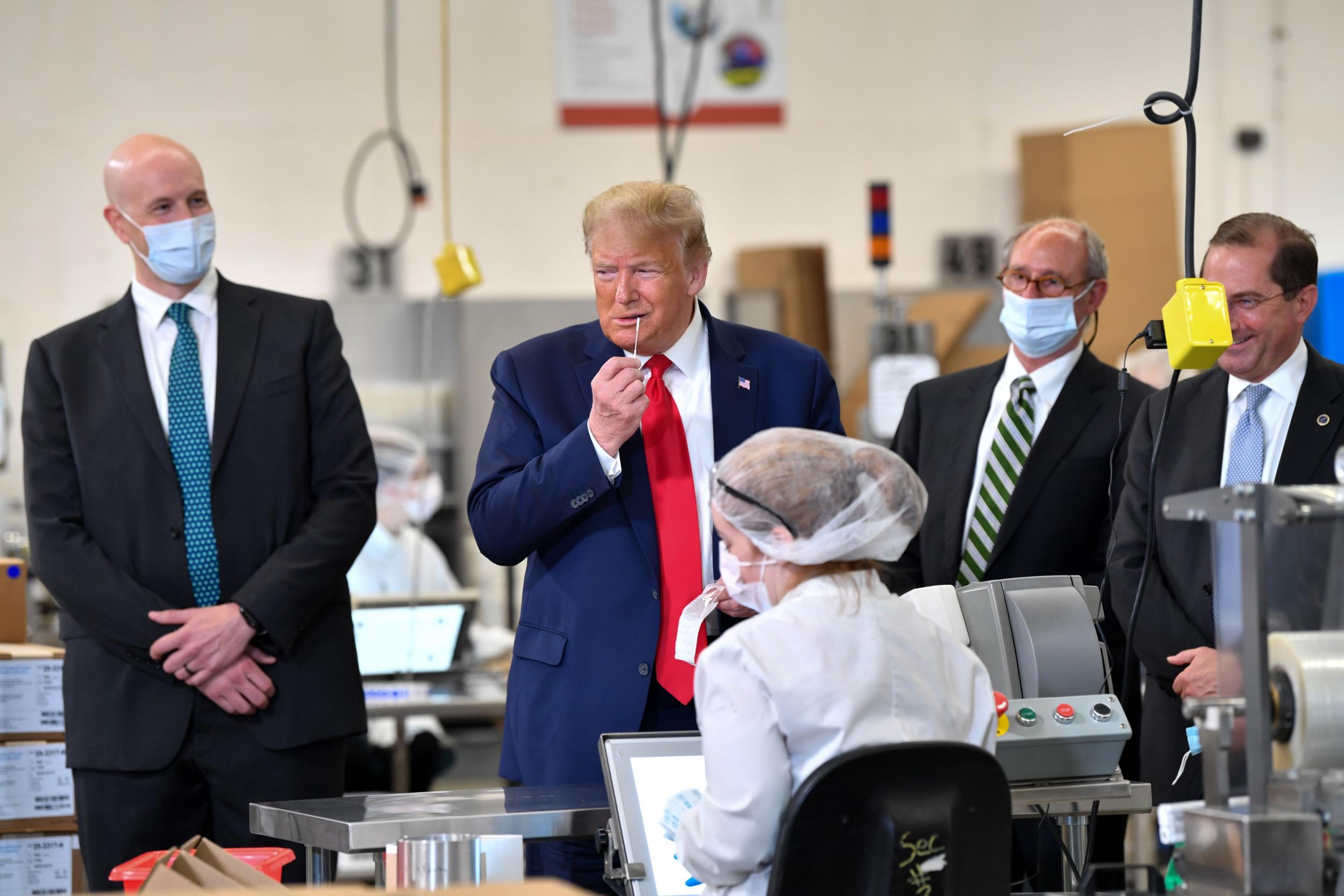
A medical swab manufacturer was forced to discard coronavirus tests following Donald Trump‘s visit to its Maine facility, according to USA Today.
While workers in lab coats and personal protective equipment worked on the factory floor during the president’s visit to Puritan Medical Products on Friday, Mr Trump — who did not wear a mask — walked through the facility and visited with workers.
Puritan’s marketing manager for the company told USA Today that the factory was in “limited” operation during the president’s tour and “swabs produced during that time will be discarded”.
It’s unclear how many testing swabs will be thrown out, and why, though the move follows reports of test shortages during the Covid-19 crisis as states begin to reopen and need to expand their testing capacity.
A company representative was not immediately available to respond to The Independent‘s request for comment.
The visit was among several White House trips to medical manufacturing facilities within the last several weeks as the president dismissed concerns that shortages in tests and other supplies at the onset of the outbreak in February and March have significantly stunted the US response.
During his Friday visit, he said: “When you have more tests, you have more cases. I say to my people: Every time we test, you find cases because we do more testing. So if we have more cases — if we wanted to do testing in China or in India, or other places, I promise you, there’d be more cases. But we’re doing a great job with the testing. And you’re doing a fantastic job in getting out the swabs.”
Mr Trump has insisted that “anyone” in the US is able to be tested, while his administration has recently accelerated production of tests as labs process as many as 400,000 tests a day. However technicians and health officials have expressed concerns about a lack of nationwide consistent strategies and inconsistent results from a patchwork response to the virus.
Created with Sketch.
Created with Sketch.
1/13
Cheryll Mack, 46, a registered nurse in the emergency department, poses for a photograph after a 12-hour shift outside the hospital where she works. "The Covid-19 spread has affected a lot of livelihood, a lot of people's lives. It has created a crisis, death in general. So I would like to ask not one single person, but all people worldwide, to converge and join the platform that this is something that nobody can fight individually," said Mack.
Reuters
2/13
Dr Laura Bontempo, 50, an emergency medicine doctor wears her personal protective equipment she uses when she sees patients, while posing for a photograph after a nine-hour shift, outside the hospital. "The hardest moments have actually been separating families from patients, there is a no-visitor policy now and taking people away from their loved ones is very challenging," Bontempo said. "I'm used to treating sick patients. I treat sick patients all the time. It's very different knowing that the patient you are treating, is actually a risk to you as well. That's the main difference here. No one who works in hospitals is afraid of treating sick people. Just want to keep staff safe and the patients safe at the same time."
Reuters
3/13
Ernest Capadngan, 29, a registered nurse who works at a biocontainment unit poses for a photograph after a 12-hour shift, outside the hospital. "The hardest moment during the shift was just seeing Covid patients die helpless and without their family members beside them," Capadngan said.
Reuters
4/13
Martine Bell, 41, a nurse practitioner in an emergency department, poses for a photograph after a six-hour shift outside the hospital where she works. "The hardest thing in all of this, has been taking care of fellow healthcare providers. It really hits home and it's really scary when you see someone that could be you coming in and now you're taking care of them. It's also hitting home that once healthcare providers start getting sick, who is going to be taking care of the public," Bell said. "It's very stressful, everyone is on edge. We don't know who's coming in next, or how sick they're going to be, or if we are going to get a whole bunch of people or if we're not going to get no one. It's a really stressful and just a completely unusual time for all of us."
Reuters
5/13
Kaitlyn Martiniano, 25, a registered nurse who works at a biocontainment poses for a photograph after a 12.5-hour shift, outside the hospital. "We have a lot of patients and they are pretty sick right now but we have not yet been hit as hard as New York or Seattle, so I feel like we are very lucky with that so far. Every day you have to just be optimistic." Said Martiniano. "I think the reason that we are not being hit as hard right now is because so many things are closed, and because so many people are staying at home."
Reuters
6/13
Tracey Wilson, 53, a nurse practitioner in an intensive care unit (ICU), poses for a photograph after a 12-hour shift, outside the hospital where she works. "I had a patient fall out of bed today and I had to call his wife and tell her and she couldn't come see him, even though she pleaded and begged to come see him," Wilson said. "There is a lot of unknowns and with that unknown is a lot of anxiety and stress that we're not used to dealing with."
Reuters
7/13
Meghan Sheehan, 27, a nurse practitioner in an emergency department, poses for a photograph after a 12-hour shift, outside the hospital where she works. "I think the hardest moment has been the fear that lives within all of us. There is a lot of unknown right now. We fear what's going to happen tomorrow, how the emergency department will look next week when we come in. We have fears about our own colleagues, whether they will fall ill. We also fear that we could be asymptomatic carriers and bring this virus home to our families and our loved ones. There has been a lot of fear over our supplies and whether we'll run out. And then obviously there is the fear that we will see patients and not be able to do everything we normally can to help save patients' lives," Sheehan said.
Reuters
8/13
Kimberly Bowers, 44, a nurse practitioner in an ICU, poses for a photograph after a 13-hour shift, outside the hospital. "The hardest moment was a young woman who died and her family wasn't able to be here with her," Bowers said. "I think right now, it's just frustrating and scary just not knowing what comes next."
Reuters
9/13
Tiffany Fare, 25, a registered nurse who works at a biocontainment unit poses for a photograph after a 13-hour shift, outside the hospital where she works. "One of the hardest moments was having to see a family member of a Covid patient, say goodbye over an iPad, rooms away. That was a tough one, I can't imagine how hard it would be to be saying goodbye, you can't see your loved one and then they're gone," Fare said. "My team has been really great to me. We've worked really well together and we've really come together in this crisis. We don't really know each other, we all come from different units within the same hospital, so for us to come together and work so well as a team, it's been a journey but I think that's what is giving me hope."
Reuters
10/13
Dr Kyle Fischer, 35, an emergency medicine doctor, poses for a photograph after a 12-hour shift, outside the hospital where he works. "Since it's a new virus, we don't have any experience with it. For most diseases I am used to seeing it and taking care of it and this, I don't have any starting place. I know what I'm hearing from New York, I've read all of the papers it seems like, but no one knows what the correct answers are, so there's a huge amount of uncertainty and people are really, really sick. So it's hard to second guess whether or not you are doing the right thing when you think you are but you never quite know," said Fischer.
Reuters
11/13
Julia Trainor, 23, a registered nurse at a surgical ICU, poses for a photograph after a 14-hour shift, outside the hospital. "The hardest moment was having to put a breathing tube in my patient who could no longer breathe for herself and after the breathing tube went in, we called her family and the husband, of course, couldn't visit her because of visitor restrictions at the hospital. So I had to put him on the phone and hold the phone to her ear, as he told her that he loved her so much and then I had to wipe away her tears as she was crying," said Trainor. "I'm used to seeing very sick patients and I'm used to patients dying but nothing quite like this. In the flip of a switch, without the support, they're completely isolated. They're very sick. Some of them recover and some of them don't. But the hardest part, I would think, is them having to go through this feeling like they are alone."
Reuters
12/13
Lisa Mehring, 45, a registered nurse who works in a biocontainment unit with Covid-19 patients, poses for a photograph after a 12.5-hour shift, outside the hospital where she works in Maryland. "Seeing these new moms have babies has been the hardest moment along with having do their pumping for the new moms and them not being able to be with their newborn children, it's hard to think of the family that they are missing," Mehring said.
Photos Reuters
13/13
Jacqueline Hamil, 30, a registered nurse in an emergency department, poses for a photograph after a 12-hour shift outside the hospital. "The hardest moment of my shift today, I was in charge, and we had a really sick patient that was in a really, really small room and usually, when we have sick crashing patients, we can have a ton of resources and a ton of staff go in and help with the nurse and the doctors that are taking care of that patient. But due to the patient being ruled out for the coronavirus, we could only have five or six people in the room at a time and putting on all the gowns and gloves and masks and face shields to protect us in case the patient does have coronavirus, it takes a while, so the nurse that was in there, ended up being in the room for you know 6, 7 hours with minimal breaks and it was hard being in charge and knowing that she was stuck in the room and really nothing I could do to help her," Hamil said.
Reuters
1/13
Cheryll Mack, 46, a registered nurse in the emergency department, poses for a photograph after a 12-hour shift outside the hospital where she works. "The Covid-19 spread has affected a lot of livelihood, a lot of people's lives. It has created a crisis, death in general. So I would like to ask not one single person, but all people worldwide, to converge and join the platform that this is something that nobody can fight individually," said Mack.
Reuters
2/13
Dr Laura Bontempo, 50, an emergency medicine doctor wears her personal protective equipment she uses when she sees patients, while posing for a photograph after a nine-hour shift, outside the hospital. "The hardest moments have actually been separating families from patients, there is a no-visitor policy now and taking people away from their loved ones is very challenging," Bontempo said. "I'm used to treating sick patients. I treat sick patients all the time. It's very different knowing that the patient you are treating, is actually a risk to you as well. That's the main difference here. No one who works in hospitals is afraid of treating sick people. Just want to keep staff safe and the patients safe at the same time."
Reuters
3/13
Ernest Capadngan, 29, a registered nurse who works at a biocontainment unit poses for a photograph after a 12-hour shift, outside the hospital. "The hardest moment during the shift was just seeing Covid patients die helpless and without their family members beside them," Capadngan said.
Reuters
4/13
Martine Bell, 41, a nurse practitioner in an emergency department, poses for a photograph after a six-hour shift outside the hospital where she works. "The hardest thing in all of this, has been taking care of fellow healthcare providers. It really hits home and it's really scary when you see someone that could be you coming in and now you're taking care of them. It's also hitting home that once healthcare providers start getting sick, who is going to be taking care of the public," Bell said. "It's very stressful, everyone is on edge. We don't know who's coming in next, or how sick they're going to be, or if we are going to get a whole bunch of people or if we're not going to get no one. It's a really stressful and just a completely unusual time for all of us."
Reuters
5/13
Kaitlyn Martiniano, 25, a registered nurse who works at a biocontainment poses for a photograph after a 12.5-hour shift, outside the hospital. "We have a lot of patients and they are pretty sick right now but we have not yet been hit as hard as New York or Seattle, so I feel like we are very lucky with that so far. Every day you have to just be optimistic." Said Martiniano. "I think the reason that we are not being hit as hard right now is because so many things are closed, and because so many people are staying at home."
Reuters
6/13
Tracey Wilson, 53, a nurse practitioner in an intensive care unit (ICU), poses for a photograph after a 12-hour shift, outside the hospital where she works. "I had a patient fall out of bed today and I had to call his wife and tell her and she couldn't come see him, even though she pleaded and begged to come see him," Wilson said. "There is a lot of unknowns and with that unknown is a lot of anxiety and stress that we're not used to dealing with."
Reuters
7/13
Meghan Sheehan, 27, a nurse practitioner in an emergency department, poses for a photograph after a 12-hour shift, outside the hospital where she works. "I think the hardest moment has been the fear that lives within all of us. There is a lot of unknown right now. We fear what's going to happen tomorrow, how the emergency department will look next week when we come in. We have fears about our own colleagues, whether they will fall ill. We also fear that we could be asymptomatic carriers and bring this virus home to our families and our loved ones. There has been a lot of fear over our supplies and whether we'll run out. And then obviously there is the fear that we will see patients and not be able to do everything we normally can to help save patients' lives," Sheehan said.
Reuters
8/13
Kimberly Bowers, 44, a nurse practitioner in an ICU, poses for a photograph after a 13-hour shift, outside the hospital. "The hardest moment was a young woman who died and her family wasn't able to be here with her," Bowers said. "I think right now, it's just frustrating and scary just not knowing what comes next."
Reuters
9/13
Tiffany Fare, 25, a registered nurse who works at a biocontainment unit poses for a photograph after a 13-hour shift, outside the hospital where she works. "One of the hardest moments was having to see a family member of a Covid patient, say goodbye over an iPad, rooms away. That was a tough one, I can't imagine how hard it would be to be saying goodbye, you can't see your loved one and then they're gone," Fare said. "My team has been really great to me. We've worked really well together and we've really come together in this crisis. We don't really know each other, we all come from different units within the same hospital, so for us to come together and work so well as a team, it's been a journey but I think that's what is giving me hope."
Reuters
10/13
Dr Kyle Fischer, 35, an emergency medicine doctor, poses for a photograph after a 12-hour shift, outside the hospital where he works. "Since it's a new virus, we don't have any experience with it. For most diseases I am used to seeing it and taking care of it and this, I don't have any starting place. I know what I'm hearing from New York, I've read all of the papers it seems like, but no one knows what the correct answers are, so there's a huge amount of uncertainty and people are really, really sick. So it's hard to second guess whether or not you are doing the right thing when you think you are but you never quite know," said Fischer.
Reuters
11/13
Julia Trainor, 23, a registered nurse at a surgical ICU, poses for a photograph after a 14-hour shift, outside the hospital. "The hardest moment was having to put a breathing tube in my patient who could no longer breathe for herself and after the breathing tube went in, we called her family and the husband, of course, couldn't visit her because of visitor restrictions at the hospital. So I had to put him on the phone and hold the phone to her ear, as he told her that he loved her so much and then I had to wipe away her tears as she was crying," said Trainor. "I'm used to seeing very sick patients and I'm used to patients dying but nothing quite like this. In the flip of a switch, without the support, they're completely isolated. They're very sick. Some of them recover and some of them don't. But the hardest part, I would think, is them having to go through this feeling like they are alone."
Reuters
12/13
Lisa Mehring, 45, a registered nurse who works in a biocontainment unit with Covid-19 patients, poses for a photograph after a 12.5-hour shift, outside the hospital where she works in Maryland. "Seeing these new moms have babies has been the hardest moment along with having do their pumping for the new moms and them not being able to be with their newborn children, it's hard to think of the family that they are missing," Mehring said.
Photos Reuters
13/13
Jacqueline Hamil, 30, a registered nurse in an emergency department, poses for a photograph after a 12-hour shift outside the hospital. "The hardest moment of my shift today, I was in charge, and we had a really sick patient that was in a really, really small room and usually, when we have sick crashing patients, we can have a ton of resources and a ton of staff go in and help with the nurse and the doctors that are taking care of that patient. But due to the patient being ruled out for the coronavirus, we could only have five or six people in the room at a time and putting on all the gowns and gloves and masks and face shields to protect us in case the patient does have coronavirus, it takes a while, so the nurse that was in there, ended up being in the room for you know 6, 7 hours with minimal breaks and it was hard being in charge and knowing that she was stuck in the room and really nothing I could do to help her," Hamil said.
Reuters
This week, Robert Redfield, director of the Centres for Disease Control and Prevention, told Congress: ”I don’t want to get into the number of tests because I don’t think that’s the real issue ... It’s how testing is used and what’s the consequence.”
In May, Puritan Medical Products, one of two companies that manufacture swab tests in the US, announced plans for a second plant in Maine with a goal of producing up to 40m swabs a month, according to a company statement.
The company was awarded more than $75m through the Defence Production Act to build US capacity for testing supplies during the pandemic.
Puritan said that it expects to begin producing swabs at its second plant by 1 July.
Nearly 2m people have been infected and more than 108,000 people in the US have died from illness related to the virus, according to data from Johns Hopkins University.