


 Africana55 Radio

This website uses cookies so that we can provide you with the best user experience possible. Cookie information is stored in your browser and performs functions such as recognising you when you return to our website and helping our team to understand which sections of the website you find most interesting and useful.
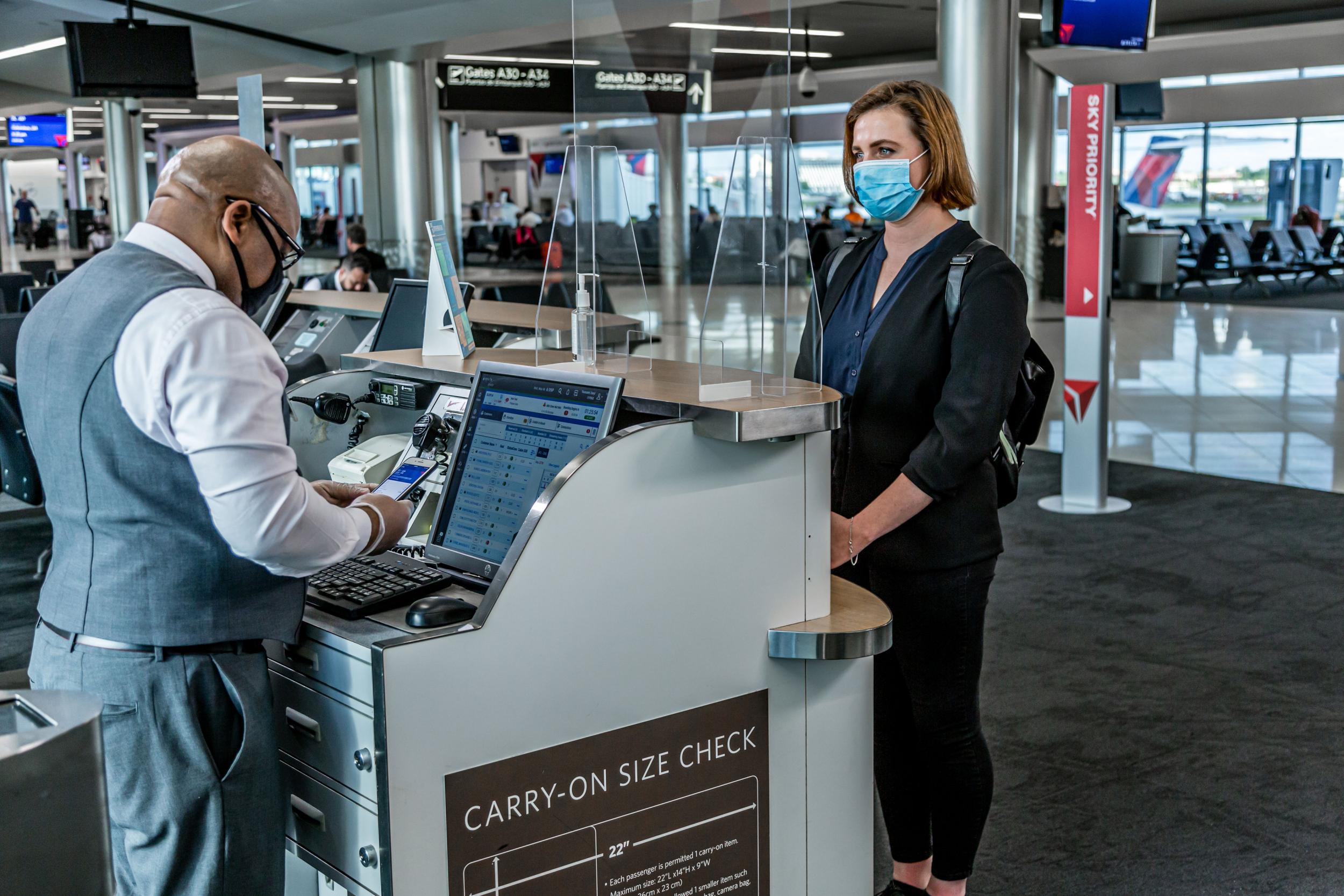
Delta has banned more than “100 people” from flying for refusing to wear a mask, according to the airline’s CEO.
Ed Bastian said that passengers who refused to comply with the carrier’s requirement that they wear face coverings at all times are being temporarily blacklisted.
“If you insist on not wearing your mask, we will insist that you don’t fly Delta,“ he told The Today Show last month.
Masks have been mandatory on Delta flights since 1 May.
The only people who are exempt are those with a relevant medical condition, something that must be established prior to the flight, during a pre-boarding process involving a consultation with a medical profession that can take up to an hour.
The airline warns passengers that ”any false claims of a disability or health condition to obtain an exemption from wearing a mask or face covering may result in the suspension of travel privileges on any Delta flight“.
The airline has temporarily stopped selling middle seats to better enable social distancing on board its flights.
As part of its stricter rules, Delta has also banned certain types of masks.
It recently updated its guidance to prohibit masks with a valve.
“Any mask with an exhaust valve is not approved as an acceptable face mask for customers travelling on any Delta operated flight,” says the policy.
This is because masks with a valve are designed to protect the wearer, not other people, as they filter what is being breathed in rather than out. They’re most commonly used in construction work or during wildfire season.
Created with Sketch.
Created with Sketch.
1/6 Using a T-shirt - Step 1
Cut a straight line across the width of the T-shirt (front and back) approximately 20cm from the bottom of the T-shirt.
Gov.uk
2/6 Steps 2 and 3
From a point 2cm below the top right-hand corner of the fabric, make a 15cm horizontal cut through both sides of the fabric that is parallel to the top of the rectangle. Cut down towards the bottom of the fabric until you reach approximately 2cm above the bottom edge. From here, make another 15cm cut that runs parallel to the bottom of the fabric to make a rectangle that can be discarded.
Gov.uk
3/6 Step 4
To make the ties, cut open the edge of the 2 long strips of fabric. Unfold the main piece of fabric and place over the mouth and the nose. The 4 strips act as ties to hold the cloth face covering in place and should be tied behind the head and around the neck.
Gov.uk
4/6 A sewn cloth face covering - Steps 1 and 2
Cut out two 25cm x 25cm squares of cotton fabric. Stack the 2 squares on top of each other. Fold over one side by 3/4 cm and hem, then repeat on the opposite side. Make 2 channels by folding the double layer of fabric over 1.5cm along each side and stitching this down.
Gov.uk
5/6 Step 3
Run a 20cm length of elastic (or string or cloth strip) through the wider hem on each side of the face covering. These will be the ear loops. Use a large needle to thread it through. Tie the ends tightly. If you only have string, you can make the ties longer and tie the covering behind your head.
Gov.uk
6/6 Step 4
Gently pull on the elastic so that the knots are tucked inside the hem. Gather the sides of the covering on the elastic and adjust so the covering fits your face. Then securely stitch the elastic in place to keep it from slipping. These elastic loops fit over the ears.
Gov.uk
1/6 Using a T-shirt - Step 1
Cut a straight line across the width of the T-shirt (front and back) approximately 20cm from the bottom of the T-shirt.
Gov.uk
2/6 Steps 2 and 3
From a point 2cm below the top right-hand corner of the fabric, make a 15cm horizontal cut through both sides of the fabric that is parallel to the top of the rectangle. Cut down towards the bottom of the fabric until you reach approximately 2cm above the bottom edge. From here, make another 15cm cut that runs parallel to the bottom of the fabric to make a rectangle that can be discarded.
Gov.uk
3/6 Step 4
To make the ties, cut open the edge of the 2 long strips of fabric. Unfold the main piece of fabric and place over the mouth and the nose. The 4 strips act as ties to hold the cloth face covering in place and should be tied behind the head and around the neck.
Gov.uk
4/6 A sewn cloth face covering - Steps 1 and 2
Cut out two 25cm x 25cm squares of cotton fabric. Stack the 2 squares on top of each other. Fold over one side by 3/4 cm and hem, then repeat on the opposite side. Make 2 channels by folding the double layer of fabric over 1.5cm along each side and stitching this down.
Gov.uk
5/6 Step 3
Run a 20cm length of elastic (or string or cloth strip) through the wider hem on each side of the face covering. These will be the ear loops. Use a large needle to thread it through. Tie the ends tightly. If you only have string, you can make the ties longer and tie the covering behind your head.
Gov.uk
6/6 Step 4
Gently pull on the elastic so that the knots are tucked inside the hem. Gather the sides of the covering on the elastic and adjust so the covering fits your face. Then securely stitch the elastic in place to keep it from slipping. These elastic loops fit over the ears.
Gov.uk
As early as May, the San Francisco Department of Public Health highlighted the issue, tweeting that masks “with the valves or openings on the front are NOT safe, and may actually propel your germs further.”
It referenced the city’s public health order, which stated: “Valves of that type permit droplet release from the mask, putting others at risk.”