


 Africana55 Radio

This website uses cookies so that we can provide you with the best user experience possible. Cookie information is stored in your browser and performs functions such as recognising you when you return to our website and helping our team to understand which sections of the website you find most interesting and useful.
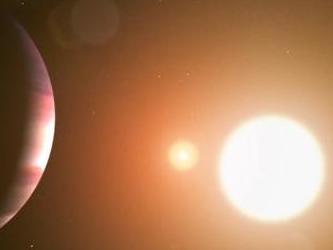
Nasa's newest planet-hunting telescope has found its first Earth-sized planet orbiting around two stars.
The world, known as TOI 1338 b, is in the habitable zone, which means that it orbits its suns at a distance that could allow it to support liquid water.
That, in turn, is thought to be a key ingredient for life, leading scientists to hope that the distant world could possible host aliens.
Nasa's TESS satellite was sent to space in the hope of spotting distant worlds as they move in front of their stars and block out the light. That makes it extra difficult to spot planets that orbit around two stars, making the discovery even more of a breakthrough.
The star system known as TOI 1338 is 1,300 light years away. It is made up of the newly discovered planet as well as its two suns, one of them slightly brighter than ours and the other cool and dim, which orbit around each other every 15 days.
Created with Sketch.
Created with Sketch.
1/10
Mystic Mountain, a pillar of gas and dust standing at three-light-years tall, bursting with jets of gas flom fledgling stars buried within, was captured by Nasa's Hubble Space Telelscope in February 2010
Nasa/ESA/STScI
2/10
The first ever selfie taken on an alien planet, captured by Nasa's Curiosity Rover in the early days of its mission to explore Mars in 2012
Nasa/JPL-Caltech/MSSS
3/10
Death of a star: This image from Nasa's Chandra X-ray telescope shows the supernova of Tycho, a star in our Milky Way galaxy
Nasa
4/10
Arrokoth, the most distant object ever explored, pictured here on 1 January 2019 by a camera on Nasa's New Horizons spaceraft at a distance of 4.1 billion miles from Earth
Getty
5/10
An image of the Large Magellanic Cloud galaxy seen in infrared light by the Herschel Space Observatory in January 2012. Regions of space such as this are where new stars are born from a mixture of elements and cosmic dust
Nasa
6/10
The first ever image of a black hole, captured by the Event Horizon telescope, as part of a global collaboration involving Nasa, and released on 10 April 2019. The image reveals the black hole at the centre of Messier 87, a massive galaxy in the nearby Virgo galaxy cluster. This black hole resides about 54 million light-years from Earth
Getty
7/10
Pluto, as pictured by Nasa's New Horizons spacecraft as it flew over the dwarf planet for the first time ever in July 2015
Nasa/APL/SwRI
8/10
A coronal mass ejection as seen by the Chandra Observatory in 2019. This is the first time that Chandra has detected this phenomenon from a star other than the Sun
Nasa
9/10
Dark, narrow, 100 meter-long streaks running downhill on the surface Mars were believed to be evidence of contemporary flowing water. It has since been suggested that they may instead be formed by flowing sand
Nasa/JPL/University of Arizona
10/10
Morning Aurora: Nasa astronaut Scott Kelly captured this photograph of the green lights of the aurora from the International Space Station in October 2015
Nasa/Scott Kelly
1/10
Mystic Mountain, a pillar of gas and dust standing at three-light-years tall, bursting with jets of gas flom fledgling stars buried within, was captured by Nasa's Hubble Space Telelscope in February 2010
Nasa/ESA/STScI
2/10
The first ever selfie taken on an alien planet, captured by Nasa's Curiosity Rover in the early days of its mission to explore Mars in 2012
Nasa/JPL-Caltech/MSSS
3/10
Death of a star: This image from Nasa's Chandra X-ray telescope shows the supernova of Tycho, a star in our Milky Way galaxy
Nasa
4/10
Arrokoth, the most distant object ever explored, pictured here on 1 January 2019 by a camera on Nasa's New Horizons spaceraft at a distance of 4.1 billion miles from Earth
Getty
5/10
An image of the Large Magellanic Cloud galaxy seen in infrared light by the Herschel Space Observatory in January 2012. Regions of space such as this are where new stars are born from a mixture of elements and cosmic dust
Nasa
6/10
The first ever image of a black hole, captured by the Event Horizon telescope, as part of a global collaboration involving Nasa, and released on 10 April 2019. The image reveals the black hole at the centre of Messier 87, a massive galaxy in the nearby Virgo galaxy cluster. This black hole resides about 54 million light-years from Earth
Getty
7/10
Pluto, as pictured by Nasa's New Horizons spacecraft as it flew over the dwarf planet for the first time ever in July 2015
Nasa/APL/SwRI
8/10
A coronal mass ejection as seen by the Chandra Observatory in 2019. This is the first time that Chandra has detected this phenomenon from a star other than the Sun
Nasa
9/10
Dark, narrow, 100 meter-long streaks running downhill on the surface Mars were believed to be evidence of contemporary flowing water. It has since been suggested that they may instead be formed by flowing sand
Nasa/JPL/University of Arizona
10/10
Morning Aurora: Nasa astronaut Scott Kelly captured this photograph of the green lights of the aurora from the International Space Station in October 2015
Nasa/Scott Kelly
The planet itself is almost seven times as big as Earth, or roughly somewhere between Neptune and Saturn.
The new TESS space telescope has four cameras on board, which are used to continually survey different patches of the sky. The aim is to spot when the stars it can see temporarily go dim, which could indicate that a planet has passed in front of them.
The dimming that would eventually be identified as TOI 1338 b was first spotted by an intern at Nasa named Wolf Cukier, who was looking through a series of candidates that had been uploaded to a citizen science project.
"I was looking through the data for everything the volunteers had flagged as an eclipsing binary, a system where two stars circle around each other and from our view eclipse each other every orbit," Cukier said.
"About three days into my internship, I saw a signal from a system called TOI 1338. At first I thought it was a stellar eclipse, but the timing was wrong. It turned out to be a planet."
Scientists have tried to use computers to spot such patterns, but they are made more difficult in binary star systems like TOI 1338. That meant that the work of those like Cukier was doubly important, to allow scientists to identify possible planets.
"These are the types of signals that algorithms really struggle with," said lead author Veselin Kostov, a research scientist at the SETI Institute and Goddard. "The human eye is extremely good at finding patterns in data, especially non-periodic patterns like those we see in transits from these systems."
Scientists have already examined the star system from the ground, which gave Kostov and his team historical data to use to understand the system and confirm the existence of the planet. While its orbit is stable, it changes in relation to us so that the dimming will not be visible for the eight years after November 2023.