


 Africana55 Radio

This website uses cookies so that we can provide you with the best user experience possible. Cookie information is stored in your browser and performs functions such as recognising you when you return to our website and helping our team to understand which sections of the website you find most interesting and useful.
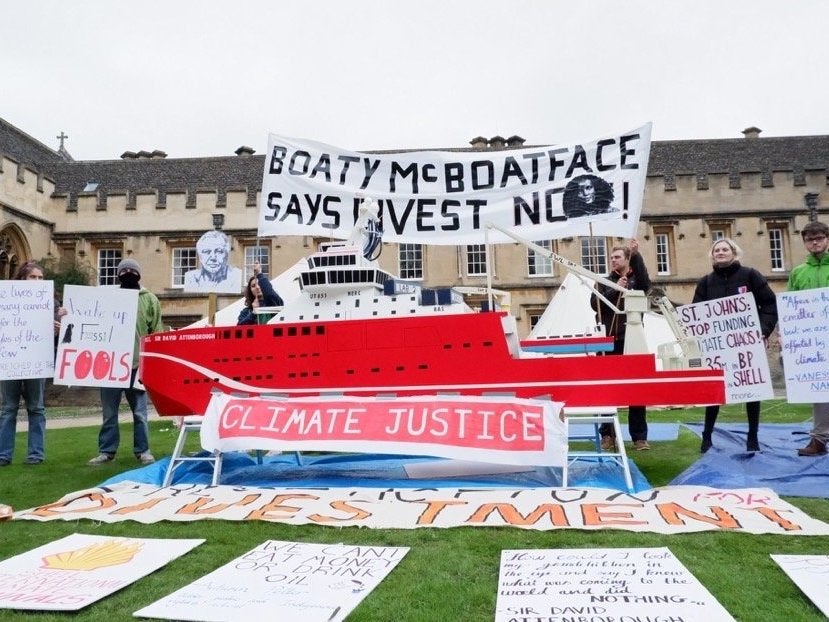
Alumni of the Oxford college attended by Tony Blair and Evan Davies are threatening to withhold donations unless it commits to selling shares in fossil fuel companies.
Hundreds of graduates have signed a letter to St John’s College urging bosses to cut all ties with fossil fuel firms after students camped out in the college quad to protest against investments.
The college, which is the wealthiest in Oxford, currently invests around £8m in BP and Shell.
A five-day student occupation, which ended on Sunday, attracted support from Oxford alumni around the world — including award-winning poet and writer Mark Abley.
But the group of graduates has accused college leaders of “dismissing” the action taken by students.
Created with Sketch.
Created with Sketch.
1/8 Davos 2019: David Attenborough issues stark warning about future of civilisation as he demands ‘practical solutions’ to combat climate change
Sir David Attenborough has issued a stark warning about climate change to business figures gathered in Davos, telling them that "what we do now...will profoundly affect the next few thousand years". On the eve of this year's World Economic Forum, the renowned naturalist told the audience that the worlds of business and politics should "get on with the practical solutions" needed to prevent environmental damage. "As a species we are expert problem solvers. But we've not yet applied ourselves to this problem with the focus it requires. "We can create a world with clean air and water, unlimited energy, and fish stocks that will sustain us well into the future. But to do that, we need a plan," he said. The broadcaster made his speech after receiving a Crystal Award, which is awarded by the forum to "exceptional cultural leaders".
AFP/Getty
2/8 At least 60% of wild coffee species face extinction triggered by climate change and disease
Two decades of research have revealed that 60 per cent of the world’s coffee species face extinction due to the combined threats of deforestation, disease and climate change. The wild strain of arabica, the most widely consumed coffee on the planet, is among those now recognised as endangered, raising concerns about its long-term survival. These results are worrying for the millions of farmers around the world who depend on the continued survival of coffee for their livelihoods. As conditions for coffee farming become tougher, scientists predict the industry will need to rely on wild varieties to develop more resilient strains
Alan Schaller
3/8 Warming Antarctic waters are speeding the rate at which glaciers are melting
The Antarctic ice sheet is losing six times as much ice each year as it was in the 1980s and the pace is accelerating, one of the most comprehensive studies of climate change effects on the continent has shown. More than half an inch has been added to global sea levels since 1979, but if current trends continue it will be responsible for metres more in future, the Nasa-funded study found. The international effort used aerial photos, satellite data and climate models dating back to the 1970s across18 Antarctic regions to get the most complete picture to date on the impacts of the changing climate. It found that between 1979 and 1990 Antarctica lost an average of 40 gigatonnes (40 billion tonnes) of its mass each year. Between 2009 and 2017 it lost an average 252 gigatonnes a year. This has added 3.6mm per decade to sea levels, or around 14mm since 1979, the study shows
Nasa/Getty
4/8 Greater Manchester to ban fracking, paving way for confrontation with government over controversial industry
Greater Manchester is to effectively ban fracking, raising the prospect of fresh confrontation with the government over the controversial industry. All of the region’s 10 councils are to implement planning policies which create a “presumption” against drilling for shale gas in their areas, Manchester mayor Andy Burnham has announced. Campaigners said the move was the latest sign that the tide was turning against fracking, which has been the subject of multiple legal battles across the country. Critics of fracking say it poses environmental and health risks. Drilling at the UK’s only operational fracking site, run by Cuadrilla in Lancashire, has repeatedly been halted due to earth tremors. But ministers support the industry and last year unveiled plans to accelerate the development of new drilling sites
Ross Wills
5/8 Japan confirms plan to resume commercial whaling in its waters from next year
Japan will resume commercial whaling next year for the first time in more than three decades, in a move that has provoked strong criticism from campaigners and the international community. Chief cabinet secretary Yoshihide Suga said his nation would leave the International Whaling Commission (IWC) to resume hunting the marine mammals in Japanese waters. However, he stated the activity would be limited to Japan’s territory and the 200 mile exclusive economic zone along its coasts. This means controversial “scientific” trips to Antarctica in which Japanese vessels killed hundreds of whales, as well as activity in the northwest Pacific, will stop in 2019
AP
6/8 COP24: Environmental groups criticise ‘morally unacceptable’ climate deal reached after major Poland summit
Diplomats from around the world have agreed a major climate deal after two weeks of United Nations talks in Poland. But climate campaigners warned the deal – effectively a set of rules for how to govern the 2015 Paris climate accord – agreed between almost 200 countries lacked ambition or a clear promise of enhanced climate action. Activists cautiously welcomed elements of the plan, saying “important progress” had been made on ensuring that efforts to tackle climate change by individual nations can be measured and compared. But environmental groups were also highly critical of the agreement, warning it lacked ambition and clarity on key issues, including financing for climate projects for developing countries. The COP24 deal, which is aimed at providing firm guidelines for countries on how to transparently report their greenhouse gas emissions and their efforts to reduce them, was confirmed on 15 December, after talks overran
Reuters
7/8 ‘Unprecedented changes’ needed to stop global warming as UN report reveals islands starting to vanish and coral reefs dying
Greenhouse gas emissions must be cut almost in half by 2030 to avert global environmental catastrophe, including the total loss of every coral reef, the disappearance of Arctic ice and the destruction of island communities, a landmark UN report has concluded. Drawing on more than 6,000 scientific studies and compiled over two years, the Intergovernmental Panel on Climate Change (IPCC) findings, released this morning, warn enormous and rapid changes to the way everyone on Earth eats, travels and produces energy need to be brought in immediately. Though the scientists behind the report said there is cause for optimism, they recognised the grim reality that nations are currently nowhere near on track to avert disaster
AFP/Getty
8/8 Africa’s three biggest elephant poaching cartels exposed using DNA from illegal ivory shipments
DNA taken from massive shipments of ivory has been used to identify the three largest wildlife trafficking gangs operating at the height of Africa’s elephant poaching epidemic. Ivory tends to be shipped around the world from African ports in bulk, and scientists have used genetic evidence gleaned from intercepted batches to reveal their origins. Led by Dr Samuel Wasser from the University of Washington, they traced a number of these shipments to three cartels operating out of Kenya, Uganda and Togo. Evidence collected by Dr Wasser has already helped convict ivory kingpin Feisal Mohamed Ali, and as his team joins the dots between shipments they plan to shore up the cases against more of the continent’s most prolific smugglers
Art Wolfe
1/8 Davos 2019: David Attenborough issues stark warning about future of civilisation as he demands ‘practical solutions’ to combat climate change
Sir David Attenborough has issued a stark warning about climate change to business figures gathered in Davos, telling them that "what we do now...will profoundly affect the next few thousand years". On the eve of this year's World Economic Forum, the renowned naturalist told the audience that the worlds of business and politics should "get on with the practical solutions" needed to prevent environmental damage. "As a species we are expert problem solvers. But we've not yet applied ourselves to this problem with the focus it requires. "We can create a world with clean air and water, unlimited energy, and fish stocks that will sustain us well into the future. But to do that, we need a plan," he said. The broadcaster made his speech after receiving a Crystal Award, which is awarded by the forum to "exceptional cultural leaders".
AFP/Getty
2/8 At least 60% of wild coffee species face extinction triggered by climate change and disease
Two decades of research have revealed that 60 per cent of the world’s coffee species face extinction due to the combined threats of deforestation, disease and climate change. The wild strain of arabica, the most widely consumed coffee on the planet, is among those now recognised as endangered, raising concerns about its long-term survival. These results are worrying for the millions of farmers around the world who depend on the continued survival of coffee for their livelihoods. As conditions for coffee farming become tougher, scientists predict the industry will need to rely on wild varieties to develop more resilient strains
Alan Schaller
3/8 Warming Antarctic waters are speeding the rate at which glaciers are melting
The Antarctic ice sheet is losing six times as much ice each year as it was in the 1980s and the pace is accelerating, one of the most comprehensive studies of climate change effects on the continent has shown. More than half an inch has been added to global sea levels since 1979, but if current trends continue it will be responsible for metres more in future, the Nasa-funded study found. The international effort used aerial photos, satellite data and climate models dating back to the 1970s across18 Antarctic regions to get the most complete picture to date on the impacts of the changing climate. It found that between 1979 and 1990 Antarctica lost an average of 40 gigatonnes (40 billion tonnes) of its mass each year. Between 2009 and 2017 it lost an average 252 gigatonnes a year. This has added 3.6mm per decade to sea levels, or around 14mm since 1979, the study shows
Nasa/Getty
4/8 Greater Manchester to ban fracking, paving way for confrontation with government over controversial industry
Greater Manchester is to effectively ban fracking, raising the prospect of fresh confrontation with the government over the controversial industry. All of the region’s 10 councils are to implement planning policies which create a “presumption” against drilling for shale gas in their areas, Manchester mayor Andy Burnham has announced. Campaigners said the move was the latest sign that the tide was turning against fracking, which has been the subject of multiple legal battles across the country. Critics of fracking say it poses environmental and health risks. Drilling at the UK’s only operational fracking site, run by Cuadrilla in Lancashire, has repeatedly been halted due to earth tremors. But ministers support the industry and last year unveiled plans to accelerate the development of new drilling sites
Ross Wills
5/8 Japan confirms plan to resume commercial whaling in its waters from next year
Japan will resume commercial whaling next year for the first time in more than three decades, in a move that has provoked strong criticism from campaigners and the international community. Chief cabinet secretary Yoshihide Suga said his nation would leave the International Whaling Commission (IWC) to resume hunting the marine mammals in Japanese waters. However, he stated the activity would be limited to Japan’s territory and the 200 mile exclusive economic zone along its coasts. This means controversial “scientific” trips to Antarctica in which Japanese vessels killed hundreds of whales, as well as activity in the northwest Pacific, will stop in 2019
AP
6/8 COP24: Environmental groups criticise ‘morally unacceptable’ climate deal reached after major Poland summit
Diplomats from around the world have agreed a major climate deal after two weeks of United Nations talks in Poland. But climate campaigners warned the deal – effectively a set of rules for how to govern the 2015 Paris climate accord – agreed between almost 200 countries lacked ambition or a clear promise of enhanced climate action. Activists cautiously welcomed elements of the plan, saying “important progress” had been made on ensuring that efforts to tackle climate change by individual nations can be measured and compared. But environmental groups were also highly critical of the agreement, warning it lacked ambition and clarity on key issues, including financing for climate projects for developing countries. The COP24 deal, which is aimed at providing firm guidelines for countries on how to transparently report their greenhouse gas emissions and their efforts to reduce them, was confirmed on 15 December, after talks overran
Reuters
7/8 ‘Unprecedented changes’ needed to stop global warming as UN report reveals islands starting to vanish and coral reefs dying
Greenhouse gas emissions must be cut almost in half by 2030 to avert global environmental catastrophe, including the total loss of every coral reef, the disappearance of Arctic ice and the destruction of island communities, a landmark UN report has concluded. Drawing on more than 6,000 scientific studies and compiled over two years, the Intergovernmental Panel on Climate Change (IPCC) findings, released this morning, warn enormous and rapid changes to the way everyone on Earth eats, travels and produces energy need to be brought in immediately. Though the scientists behind the report said there is cause for optimism, they recognised the grim reality that nations are currently nowhere near on track to avert disaster
AFP/Getty
8/8 Africa’s three biggest elephant poaching cartels exposed using DNA from illegal ivory shipments
DNA taken from massive shipments of ivory has been used to identify the three largest wildlife trafficking gangs operating at the height of Africa’s elephant poaching epidemic. Ivory tends to be shipped around the world from African ports in bulk, and scientists have used genetic evidence gleaned from intercepted batches to reveal their origins. Led by Dr Samuel Wasser from the University of Washington, they traced a number of these shipments to three cartels operating out of Kenya, Uganda and Togo. Evidence collected by Dr Wasser has already helped convict ivory kingpin Feisal Mohamed Ali, and as his team joins the dots between shipments they plan to shore up the cases against more of the continent’s most prolific smugglers
Art Wolfe
It comes after Professor Andrew Parker, principal bursar of the college, told students demanding divestment that he could instead arrange for the gas central heating to be switched off.
The letter from alumni, which has been sent to Professor Parker and the college’s president, says: “In light of your troubling response to this peaceful occupation and continued refusal to align your endowment with climate justice, as alumni and alumnae, we cannot in good faith donate to St John’s, the University of Oxford, or any college which has not made a divestment commitment at this time.”
Last month, an analysis revealed that almost all of Britain’s top universities have pledged to at least partially divest from fossil fuels following years of campaigning from students.
Oxford and Cambridge have committed to remove investments from coal and tar sands companies, but they are still subject to student-led campaigns over their links to the fossil fuel industry
Just last week, another Oxford college, Balliol College, agreed to reduce investments in fossil fuel companies “as far and as fast as is practicable” following increasing pressure from students.
Julia Peck, who launched the open letter on behalf of alumni, said: “I think this occupation will be a watershed moment. It comes at a really crucial time when student campaigners are actively taking divestment proposals to the highest decision-making bodies of the university.
“This is a moment where Oxford leadership have clearly seen the amount of public support among the students, the faculty and the alumni. This kind of thing has never happened at an Oxford college.
“Now the heat has really turned up on the colleges who have their own endowments. They can make just as strong a statement about aligning themselves as climate justice as can the university.”
A spokesperson for St John’s College said the college had received a lot of correspondence following the protests, adding that the views expressed “have been mixed and on both sides of the debate”.
They said: “We would like to assure you that, like many of our students, the president, bursar and fellows of St John’s are deeply concerned about climate change — indeed some directly work on aspects of it.
“The college is conscious of many calls for divestment. In response to this, we set up a working group in 2019 which is conducting a wide-ranging review of current policies, sustainable finance and ‘intentional’ investing — how trustees might reflect their charity’s aims and values in their investment policies.
“This work will, of course, continue and we expect to bring recommendations to the governing body by the end of the academic year.
“It is absolutely crucial in our view, that divestment does not become a divisive debate.”