


 Africana55 Radio

This website uses cookies so that we can provide you with the best user experience possible. Cookie information is stored in your browser and performs functions such as recognising you when you return to our website and helping our team to understand which sections of the website you find most interesting and useful.
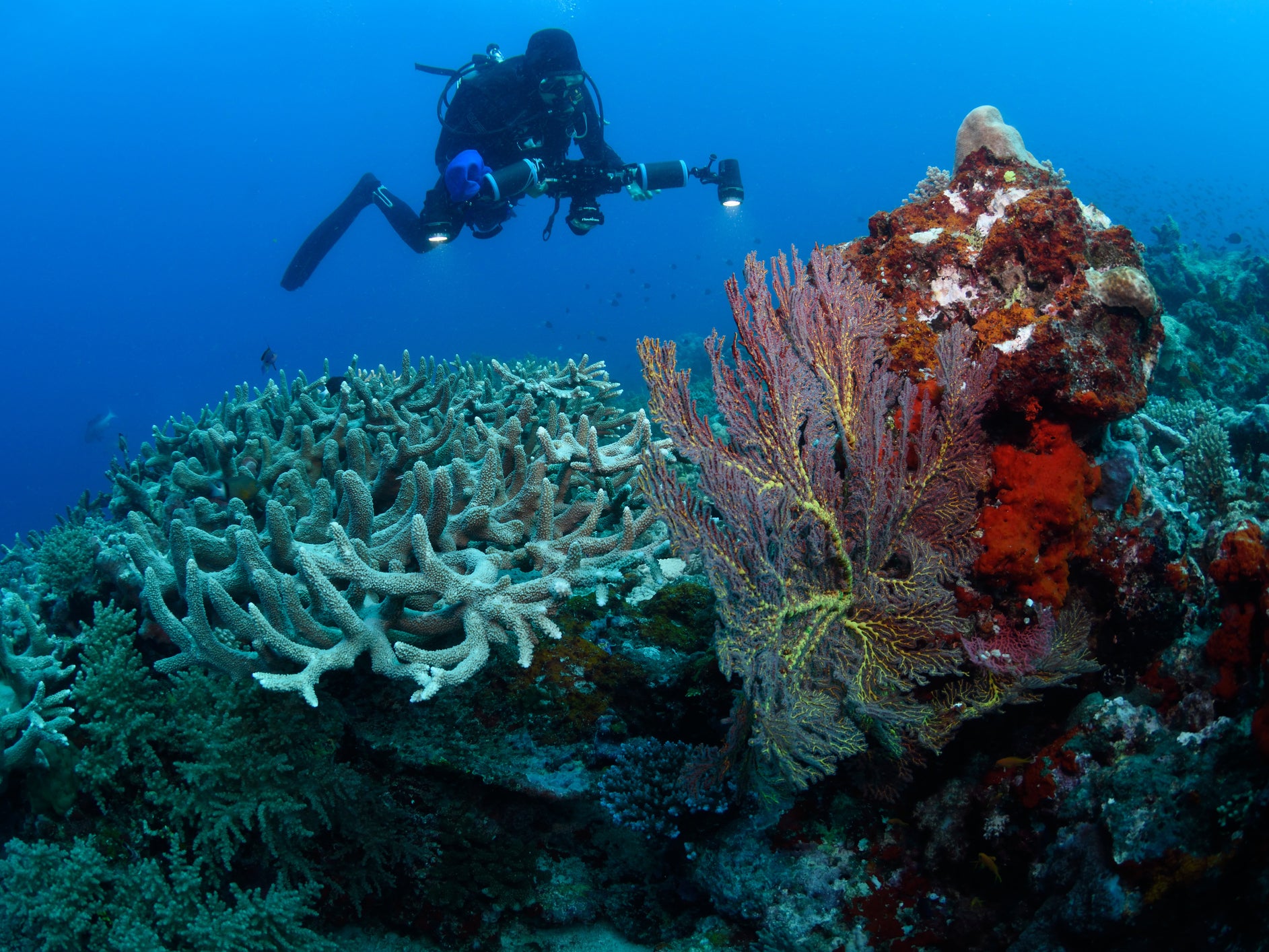
Australia’s Great Barrier Reef – the largest living structure in the world – is in crisis. The once vibrant marine ecosystem is in the grip of a “serious” bleaching event, the third such catastrophe in five years.
As the coral dies in the warming ocean, scientists in Australia are turning to experimental geo-engineering efforts to try and save what remains of the natural wonder.
Researchers have carried out an ambitious “cloud-brightening” experiment, which it is hoped could make existing clouds reflect more sunlight than normal, and therefore help keep the sea at cooler temperatures.
In a preliminary experiment, a scientific team used a cannon similar to a snow machine to blast microscopic droplets of sea water into the sky.
The water on the droplets then evaporates, leaving the tiny salt crystals high in the air, which serve as “seeds” water vapour can then cling to in order to help form brighter and more reflective clouds.
Created with Sketch.
Created with Sketch.
1/25
Masked Butterflyfish (Chaetodon semilarvatus) swimming over a bommie reef in the Egyptian Red Sea marine reserve of Ras Mohamed, off the southern tip of the Sinai peninsula
AFP/Getty
2/25
Rising sea temperatures cause corals to bleach (go white) and die
Getty/iStock
3/25
A giant clam is seen nestled among coral reefs at the Obhor coast, 30 kms north of the Red Sea city of Jeddah
AFP/Gett
4/25 Coral reef in seychelles that has degraded
After the reef has died they break up and become rubble. On this reef there is some regrowth of young corals so there is hope for recovery
Getty
5/25 Coral gardening
A rabbitfish in a net
H Goehlich
6/25
A school of fish and a sea can in a healthy coral reef off the coast of Isla Mujeres, Mexico
Getty/Lumix
7/25
Sky views of great barrier reef in Australia
Getty/iStock
8/25
A fish swims among coral reefs at the Obhor coast
AFP/Getty
9/25
Researchers from the Interuniversity Institute for Marine Sciences in the southern Israeli resort city Eilat monitor coral growth while scuba diving in the Red Sea
AFP/Getty
10/25 Coral gardening
A rope nursery
Nature Seychelles
11/25
Fish swimming off the coast of Egypt's Red Sea resort of Hurghada. The rebounding tourism sector is worrisome for the fragile marine ecosystem
AFP/Getty
12/25 Coral gardening
A parrotfish on the reef
C Reveret
13/25
Gorgonian sea fan on a a coral reef in the Egyptian Red Sea marine reserve of Ras Mohamed
AFP/Getty
14/25
A diver swims during a Great Barrier Reef experience on Lady Elliot Island, Australia
Getty/Tourism Queensland
15/25
Jessica Bellsworthy, a PhD student conducting research on the coral reefs of the Gulf of Eilat, holds a coral in an aquarium at the Interuniversity Institute for Marine Sciences in Eilat
AFP/Getty
16/25
Coral reefs in the water off the Obhor coast, 30 kms north of the Red Sea city of Jeddah in 2008
AFP/Getty
17/25
A diver photographs golden anthias (Pseudanthias aurulentus) on a coral reef in the Egyptian Red Sea marine reserve of Ras Mohamed
AFP/Getty
18/25
Getty/Lumix
19/25
AFP/Getty
20/25 Coral gardening
A damselfish
Sarah Frias-Torres
21/25
Divers swim past a coral reef in the Egyptian Red Sea marine reserve
AFP/Getty
22/25
A puffer fish hovering above coral in the Egyptian Red Sea marine reserve
AFP/Getty
23/25
Researchers from the Interuniversity Institute for Marine Sciences in the southern Israeli resort city Eilat monitor coral growth while scuba diving on June 12, 2017 in the Red Sea off Eilat. Global warming has in recent years caused colourful coral reefs to bleach and die around the world -- but not in the Gulf of Eilat, or Aqaba, part of the northern Red Sea. At the Interuniversity Institute for Marine Sciences in southern Israeli resort city Eilat, dozens of aquariums have been lined up in rows just off the Red Sea shore containing samples of local corals
AFP/Getty
24/25
AFP/Getty
25/25
fish swimming off the coast of Egypt's Red Sea resort of Hurghada
AFP/Getty
1/25
Masked Butterflyfish (Chaetodon semilarvatus) swimming over a bommie reef in the Egyptian Red Sea marine reserve of Ras Mohamed, off the southern tip of the Sinai peninsula
AFP/Getty
2/25
Rising sea temperatures cause corals to bleach (go white) and die
Getty/iStock
3/25
A giant clam is seen nestled among coral reefs at the Obhor coast, 30 kms north of the Red Sea city of Jeddah
AFP/Gett
4/25 Coral reef in seychelles that has degraded
After the reef has died they break up and become rubble. On this reef there is some regrowth of young corals so there is hope for recovery
Getty
5/25 Coral gardening
A rabbitfish in a net
H Goehlich
6/25
A school of fish and a sea can in a healthy coral reef off the coast of Isla Mujeres, Mexico
Getty/Lumix
7/25
Sky views of great barrier reef in Australia
Getty/iStock
8/25
A fish swims among coral reefs at the Obhor coast
AFP/Getty
9/25
Researchers from the Interuniversity Institute for Marine Sciences in the southern Israeli resort city Eilat monitor coral growth while scuba diving in the Red Sea
AFP/Getty
10/25 Coral gardening
A rope nursery
Nature Seychelles
11/25
Fish swimming off the coast of Egypt's Red Sea resort of Hurghada. The rebounding tourism sector is worrisome for the fragile marine ecosystem
AFP/Getty
12/25 Coral gardening
A parrotfish on the reef
C Reveret
13/25
Gorgonian sea fan on a a coral reef in the Egyptian Red Sea marine reserve of Ras Mohamed
AFP/Getty
14/25
A diver swims during a Great Barrier Reef experience on Lady Elliot Island, Australia
Getty/Tourism Queensland
15/25
Jessica Bellsworthy, a PhD student conducting research on the coral reefs of the Gulf of Eilat, holds a coral in an aquarium at the Interuniversity Institute for Marine Sciences in Eilat
AFP/Getty
16/25
Coral reefs in the water off the Obhor coast, 30 kms north of the Red Sea city of Jeddah in 2008
AFP/Getty
17/25
A diver photographs golden anthias (Pseudanthias aurulentus) on a coral reef in the Egyptian Red Sea marine reserve of Ras Mohamed
AFP/Getty
18/25
Getty/Lumix
19/25
AFP/Getty
20/25 Coral gardening
A damselfish
Sarah Frias-Torres
21/25
Divers swim past a coral reef in the Egyptian Red Sea marine reserve
AFP/Getty
22/25
A puffer fish hovering above coral in the Egyptian Red Sea marine reserve
AFP/Getty
23/25
Researchers from the Interuniversity Institute for Marine Sciences in the southern Israeli resort city Eilat monitor coral growth while scuba diving on June 12, 2017 in the Red Sea off Eilat. Global warming has in recent years caused colourful coral reefs to bleach and die around the world -- but not in the Gulf of Eilat, or Aqaba, part of the northern Red Sea. At the Interuniversity Institute for Marine Sciences in southern Israeli resort city Eilat, dozens of aquariums have been lined up in rows just off the Red Sea shore containing samples of local corals
AFP/Getty
24/25
AFP/Getty
25/25
fish swimming off the coast of Egypt's Red Sea resort of Hurghada
AFP/Getty
Results from the trial were “really, really encouraging”, the project’s lead scientist Dr Daniel Harrison from Southern Cross University said.
“All the research is theoretical... so this is an absolute world first to go out and actually try and take seawater and turn it into these cloud condensation nuclei,” he told AFP.
Coral bleaching occurs when healthy corals become stressed by rises in ocean temperatures. This causes them to expel algae which drains them of their vibrant colours, and many die.
Warming oceans due to climate breakdown from greenhouse gas emissions are driving ever higher sea temperatures, and coral has been killed on an unprecedented scale.
In 2016 alone, as much as half the corals of the Great Barrier Reef are believed to have been killed.
The 2016 bleaching event was worsened by a strong El Nino weather event, which caused ocean temperatures to rise even higher. But this year’s coral bleaching comes in a non-El Nino year, making it all the more concerning.
“Corals were bleaching all around us while we conducted our tests,” said Dr Harrison.
“This was both shocking and heartbreaking, in what should have been an ordinary non-El Nino non-bleaching year. It really emphasizes how little time we have for this research, reminding us of how important this work is.”
Last year, the Great Barrier Reef Marine Park Authority lowered its overall future outlook for the reef from “poor” to “very poor”, which it said was due to global warming and local pollution.
“Global action on climate change is critical,” the report said.
Since then, Australia has suffered another summer of extreme heatwaves, which has helped push the climate crisis up the agenda, though there is little sign of any major change of direction from the government.
Australia’s reliance on coal-fired power makes it one of the world’s largest carbon emitters per capita, and despite repeated warnings, successive Australian governments have failed to tackle emissions.
Current prime minister Scott Morrison, who once famously held a lump of coal aloft in parliament to demonstrate how his party planned to keep lights on and costs low, has seen his popularity sink to its lowest levels as his administration has failed to take concern about the environment seriously.
Last year Mr Morrison’s government produced a report saying greenhouse gas emissions had hit a seven-year high. Nonetheless, a huge new coal power plant was approved, and Mr Morrison refused to scale down the country’s coal industry saying any such moves would be “reckless” and “job destroying”.
In January this year 274 climate experts wrote an open letter to Mr Morrisson demanding the government reconsider its position on the climate crisis.
“Scientists have been warning policy makers for decades that climate change would worsen Australia’s fire risk, and yet those warnings have been ignored,” the letter read.
Despite the success of the cloud-brightening trial, the scientists have admitted it is only a means of buying time for the Great Barrier Reef.
In order to have a meaningful impact on the reef, a full-scale cloud-brightening experiment would need to be 10 times larger, requiring the use of several enormous barge-mounted turbines, Dr Harrison said.
But he said: “If it works as well as we hope then maybe we could reduce the bleaching stress by about 70 per cent... potentially nearly all of the mortality.”
However, he warned any effectiveness of the cloud-brightening technique would drop significantly as the ocean warms further.
Adding: “If we keep going on business-as-usual-type emission scenarios, then at most this technology can just buy a couple of extra decades before we see the complete loss of the reef,"