


 Africana55 Radio

This website uses cookies so that we can provide you with the best user experience possible. Cookie information is stored in your browser and performs functions such as recognising you when you return to our website and helping our team to understand which sections of the website you find most interesting and useful.
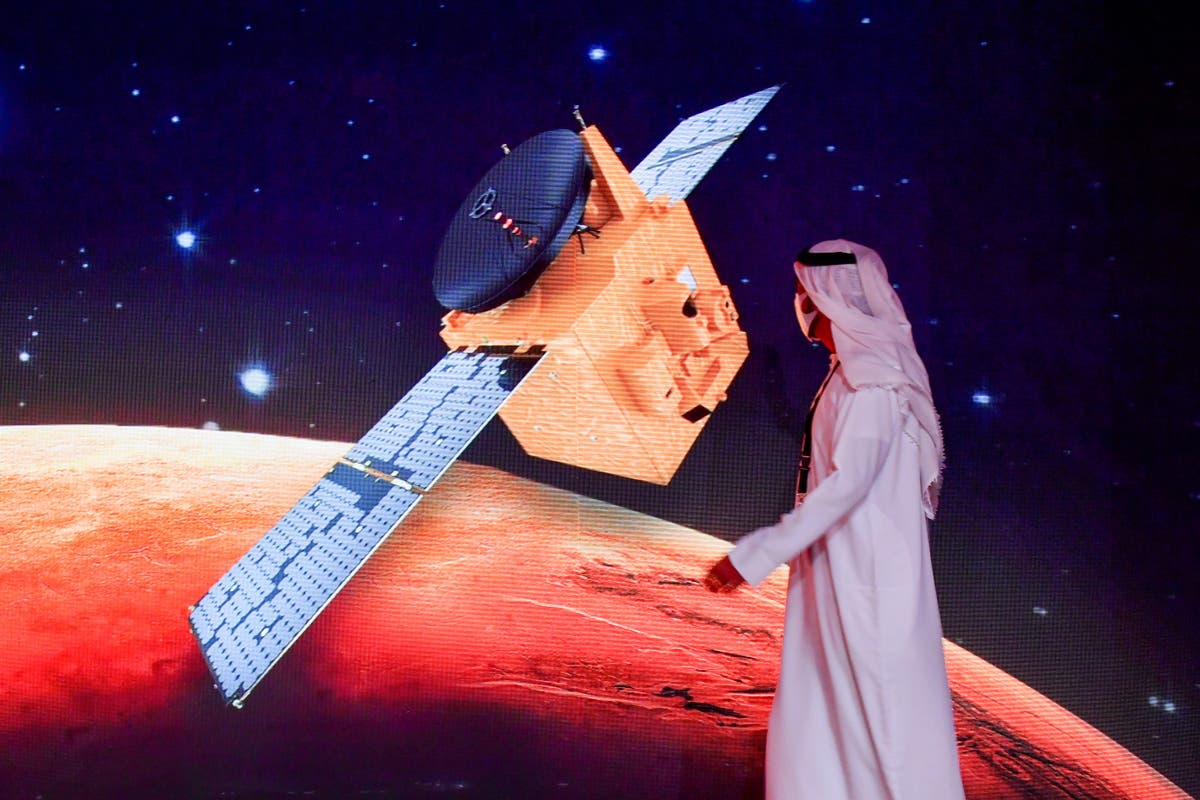
The Hope spacecraft has launched from the United Arab Emirates and is set to reach Mars, orbiting the Red Planet to study its climate.
The craft is currently travelling at over 120,000km/h (75,000mph), but a tense 30-minute period as it enters the planet's gravitational pull will dictate the success of the mission. The 27 minute-long manoeuvre will see the spaceship disappear behind the planet - unable to be monitored from the Earth.
The probe relies on its autonomous behaviour to overcome the 190 million kilometre gap in distance between the Earth and Mars; it takes 11 minutes for a radio command to reach the craft, far too long to be adequately controlled.
Should it prove successful, Hope will study how energy moves through the Martian atmosphere. It will track the movement of hydrogen and oxygen atoms at the top of the atmosphere, as well as lofted dust which has a significant effect on the planet's temperature.
Follow all the latest news here.
1612865146
Tracking the Hope Probe
"We're entering a very critical phase," said project director, Omran Sharaf. "It's a phase that basically defines whether we reach Mars, or not; and whether we'll be able to conduct our science, or not.
"If we go too slow, we crash on Mars; if we go too fast, we skip Mars," he told BBC News.
Adam Smith9 February 2021 10:05
1612866641
The Emirates Mars Mission “Hope Probe” is tasked to provide the first ever complete picture of the Martian atmosphere, with an infrared spectrometer, ultraviolet spectrometer, and exploration imager for high-resolution photos all on board the craft.
The infrared spectrometer measures the global distribution of dust, ice clouds, water vapours, and temperature profiles, while ultraviolet information is used to measure the abundance and variability of carbon monoxide and oxygen in the thermosphere.
Adam Smith9 February 2021 10:30
1612868441
The Emirates Mars Mission has cost $200m (£155.8m), according to minister for advanced sciences Sarah Amiri.
Adam Smith9 February 2021 11:00
1612870241
Visitors arriving at UAE airports will receive a "Martian Ink" stamp on their passports, made from volcanic basalt rocks which give Mars its red hue.
A message on the stamp reads: "You’ve arrived in the Emirates. The Emirates is arriving at Mars on 09.02.2021."
The rocks were collected from the Al Hajar Mountains and Sharjah’s Mleiha Desert by experts and gemologists, according to the Emirates News Agency.
"On 20th July, 2020, the world watched in excitement as Emirates Mars Mission’s Hope Probe blasted off towards Mars. Now, seven months later on 9th February, 2021, the Hope Probe is set to arrive to the Red Planet’s orbit - a major milestone for the UAE and for the Arab world that embodies hope, and conveys the ambition and motivation of the region’s people in overcoming the most pressing challenges to realise their dreams," Khaled Al Shehhi, Executive Director of Production and Digital Communication Sector at the UAE Government Media Office, said.
Adam Smith9 February 2021 11:30
1612872055
"Any image we got of Mars would be iconic but I just can't imagine what it's going to feel like to get that first full-disk image of Mars, once we're in orbit," Sarah Al Amiri, the Emirati minister of state for advanced technology and chair of the UAE Space Agency, told the BBC.
"And for me also, it's getting that science data down and having our science team start analysing it and finding artefacts that haven't been discovered before."
Adam Smith9 February 2021 12:00
1612873855
The most vital part of the Hope probe's mission is the half-hour window when it approaches Mars, which is just as difficult as a successful launch itself.
Almost half of the spacecraft's fuel will be needed to slow it down, as it drops from more than 75,185 miles per hour to 11,184 miles per hour, CNN reports.
"Less than half of the spacecraft that have been sent to Mars have actually made it successfully," said Pete Withnell, program manager for the mission at the University of Colorado Boulder's Laboratory for Atmospheric and Space Physics.
"But this is a highly practiced, highly simulated and highly analyzed event. I cannot imagine being better prepared than we are right now."
Adam Smith9 February 2021 12:30