


 Africana55 Radio

This website uses cookies so that we can provide you with the best user experience possible. Cookie information is stored in your browser and performs functions such as recognising you when you return to our website and helping our team to understand which sections of the website you find most interesting and useful.
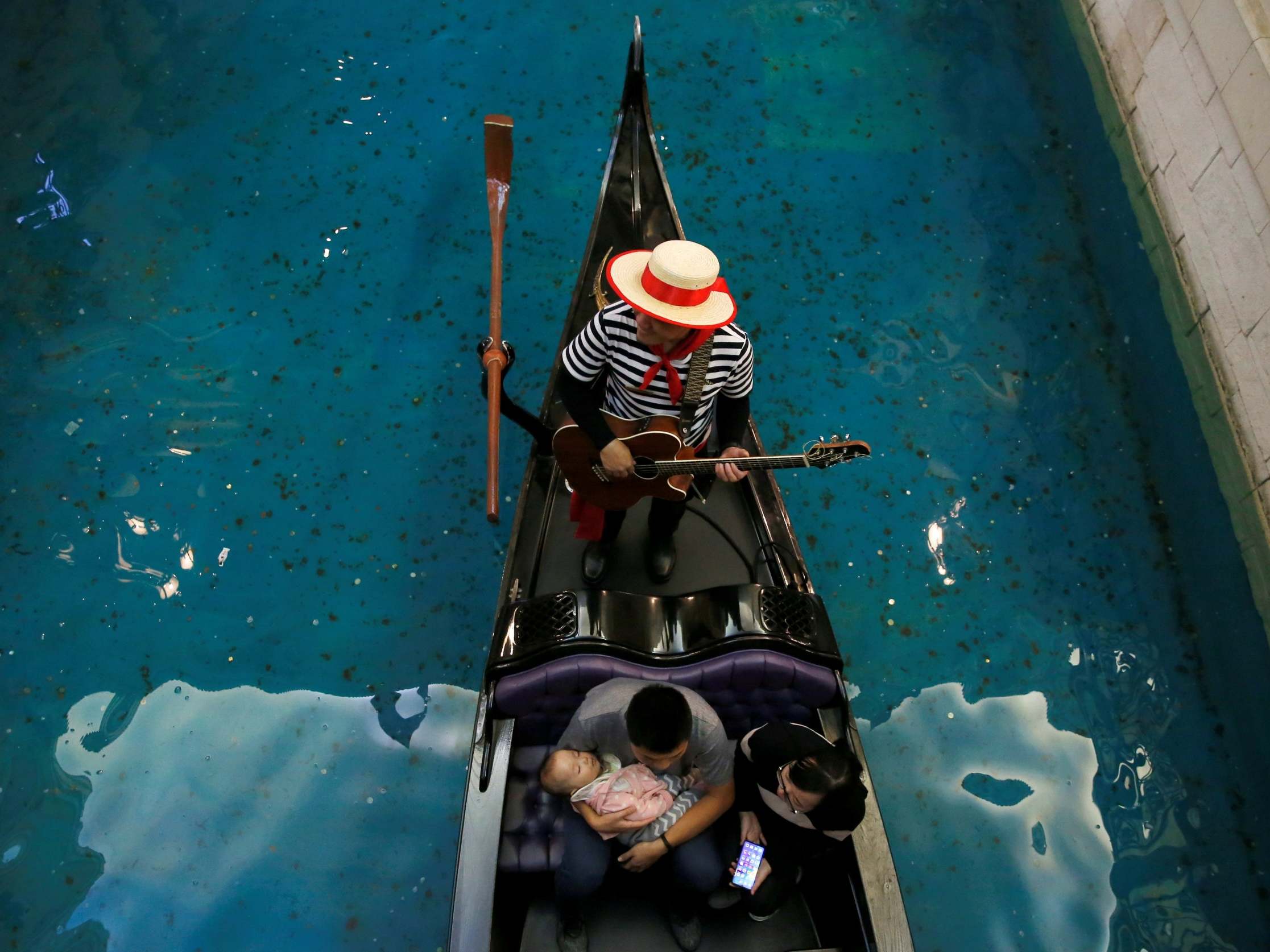
Venice’s gondolas have reduced the number of passengers they can carry, with gondoliers aiming the blame squarely at “overweight tourists”.
Previously, a gondola da nolo, which performs a classic tour of the Italian city’s famed canals, could take up to six people, while the bigger gondola da parade, used to take passengers across the Grand Canal, admitted up to 14.
These numbers have now been decreased to five and 12 respectively.
“Tourists are now overweight,” Raoul Roveratto, the president of the association of substitute gondoliers, told La Repubblica of the decision to lower capacity.
“From some countries, bombs load [on to the boats]. And when [the boat] is fully loaded, the hull sinks and water enters. Advancing with over half a tonne of meat on board is dangerous.”
Andrea Balbi, president of Venice’s gondoliers association, agreed with the sentiment, though he was less blunt.
He told the Guardian: “It’s true that compared to 10 or 15 years ago, tourists weigh a bit more.
“Unlike in a lift, where there’s a message that says ‘only six people or a maximum weight’, we don’t have scales to weigh people, and so we reduced the number of passengers.”
It’s not the only new measure to be introduced.
In a bid to further protect the profession from outsiders, gondoliers can now pass over their licence directly to their children without them having to take a theory exam that encompasses history and a working knowledge of foreign languages.
Now, all that’s necessary is proof that the next generation know how to row a gondola and have had at least four years’ experience on their family boat.
Created with Sketch.
Created with Sketch.
1/16
Gondoliers wait for customers in Venice, Italy, Friday, Feb. 28, 2020. Authorities in Italy decided to re-open schools and museums in some of the areas less hard-hit by the coronavirus outbreak in the country which has the most cases outside of Asia, as Italians on Friday yearned for a return to normal life even amid fears that the outbreak could plunge the country's economy into recession.
AP
2/16
Gondoliers wait for customers in Venice, Italy, Friday, Feb. 28, 2020. Authorities in Italy decided to re-open schools and museums in some of the areas less hard-hit by the coronavirus outbreak in the country which has the most cases outside of Asia, as Italians on Friday yearned for a return to normal life even amid fears that the outbreak could plunge the country's economy into recession.
AP
3/16
A man wearing a protective mask walks past the Ponte di Rialto (Rialto Bridge) in Venice, Italy, Friday, Feb. 28, 2020. Authorities in Italy decided to re-open schools and museums in some of the areas less hard-hit by the coronavirus outbreak in the country which has the most cases outside of Asia, as Italians on Friday yearned for a return to normal life even amid fears that the outbreak could plunge the country's economy into recession.
AP
4/16
A gondolier on the Grand Canal as the sun sets in Venice, Italy, Friday, Feb. 28, 2020. Authorities in Italy decided to re-open schools and museums in some of the areas less hard-hit by the coronavirus outbreak in the country which has the most cases outside of Asia, as Italians on Friday yearned for a return to normal life even amid fears that the outbreak could plunge the country's economy into recession.
AP
5/16
A local pulls a trolley as she leaves a street food market in Venice, Saturday, Feb. 29, 2020. A U.S. government advisory urging Americans to reconsider travel to Italy due to the spread of a new virus is the "final blow" to the nation's tourism industry, the head of Italy's hotel federation said Saturday. Venice, which was nearing recovery in the Carnival season following a tourist lull after record flooding in November, saw bookings drop immediately after regional officials canceled the final two days of celebrations this week, unprecedented in modern times.
AP
6/16
Locals wait for a mass at the barely empty San Salvador church in Venice, Sunday, March 1, 2020. A coughing Pope Francis told Italy, pilgrims gathered for the traditional Sunday blessing that he is canceling his participation at a week-long spiritual retreat in the Roman countryside because of a cold. It is the first time in his seven-year papacy that he has missed the spiritual exercises that he initiated early in his pontificate to mark the start of each Lenten season.
AP
7/16
Tourists wearing protective masks take photographs in Venice, Sunday, March 1, 2020. Italian tourism officials are worrying a new virus could do more damage to their industry than the Sept. 11 terror attacks as the country's confirmed cases surpassed 1,000.
AP
8/16
Tourists wearing protective masks look at their smartphones as they have a break at the St. Mark's square in Venice, Sunday, March 1, 2020. Italian tourism officials are worrying a new virus could do more damage to their industry than the Sept. 11 terror attacks as the country's confirmed cases surpassed 1,000.
AP
9/16
A couple stand at the Rialto bridge during a rainy day in Venice, Sunday, March 1, 2020. Italian tourism officials are worrying a new virus could do more damage to their industry than the Sept. 11 terror attacks as the country's confirmed cases surpassed 1,000.
AP
10/16
An empty canal is seen after the spread of coronavirus has caused a decline in the number of tourists in Venice, Italy, March 1, 2020.
REUTERS
11/16
An empty canal is seen after the spread of coronavirus has caused a decline in the number of tourists in Venice, Italy, March 1, 2020.
Reuters
12/16
An empty canal is seen after the spread of coronavirus has caused a decline in the number of tourists in Venice, Italy, March 1, 2020.
REUTERS
13/16
An empty canal is seen after the spread of coronavirus has caused a decline of tourists in Venice, Italy, March 1, 2020.
REUTERS
14/16
An empty water bus after the spread of coronavirus has caused a decline in the number of tourists in Venice, Italy, March 1, 2020.
REUTERS
15/16
Tourists shelter against the rain with umbrellas as they walk in the empty St. Mark's Square during a rainy day in Venice, Sunday, March 1, 2020. Italian tourism officials are worrying a new virus could do more damage to their industry than the Sept. 11 terror attacks.
AP
16/16
Gondolas are parked on a rainy day in Venice, Sunday, March 1, 2020. Italian tourism officials are worrying a new virus could do more damage to their industry than the Sept. 11 terror attacks.
AP
1/16
Gondoliers wait for customers in Venice, Italy, Friday, Feb. 28, 2020. Authorities in Italy decided to re-open schools and museums in some of the areas less hard-hit by the coronavirus outbreak in the country which has the most cases outside of Asia, as Italians on Friday yearned for a return to normal life even amid fears that the outbreak could plunge the country's economy into recession.
AP
2/16
Gondoliers wait for customers in Venice, Italy, Friday, Feb. 28, 2020. Authorities in Italy decided to re-open schools and museums in some of the areas less hard-hit by the coronavirus outbreak in the country which has the most cases outside of Asia, as Italians on Friday yearned for a return to normal life even amid fears that the outbreak could plunge the country's economy into recession.
AP
3/16
A man wearing a protective mask walks past the Ponte di Rialto (Rialto Bridge) in Venice, Italy, Friday, Feb. 28, 2020. Authorities in Italy decided to re-open schools and museums in some of the areas less hard-hit by the coronavirus outbreak in the country which has the most cases outside of Asia, as Italians on Friday yearned for a return to normal life even amid fears that the outbreak could plunge the country's economy into recession.
AP
4/16
A gondolier on the Grand Canal as the sun sets in Venice, Italy, Friday, Feb. 28, 2020. Authorities in Italy decided to re-open schools and museums in some of the areas less hard-hit by the coronavirus outbreak in the country which has the most cases outside of Asia, as Italians on Friday yearned for a return to normal life even amid fears that the outbreak could plunge the country's economy into recession.
AP
5/16
A local pulls a trolley as she leaves a street food market in Venice, Saturday, Feb. 29, 2020. A U.S. government advisory urging Americans to reconsider travel to Italy due to the spread of a new virus is the "final blow" to the nation's tourism industry, the head of Italy's hotel federation said Saturday. Venice, which was nearing recovery in the Carnival season following a tourist lull after record flooding in November, saw bookings drop immediately after regional officials canceled the final two days of celebrations this week, unprecedented in modern times.
AP
6/16
Locals wait for a mass at the barely empty San Salvador church in Venice, Sunday, March 1, 2020. A coughing Pope Francis told Italy, pilgrims gathered for the traditional Sunday blessing that he is canceling his participation at a week-long spiritual retreat in the Roman countryside because of a cold. It is the first time in his seven-year papacy that he has missed the spiritual exercises that he initiated early in his pontificate to mark the start of each Lenten season.
AP
7/16
Tourists wearing protective masks take photographs in Venice, Sunday, March 1, 2020. Italian tourism officials are worrying a new virus could do more damage to their industry than the Sept. 11 terror attacks as the country's confirmed cases surpassed 1,000.
AP
8/16
Tourists wearing protective masks look at their smartphones as they have a break at the St. Mark's square in Venice, Sunday, March 1, 2020. Italian tourism officials are worrying a new virus could do more damage to their industry than the Sept. 11 terror attacks as the country's confirmed cases surpassed 1,000.
AP
9/16
A couple stand at the Rialto bridge during a rainy day in Venice, Sunday, March 1, 2020. Italian tourism officials are worrying a new virus could do more damage to their industry than the Sept. 11 terror attacks as the country's confirmed cases surpassed 1,000.
AP
10/16
An empty canal is seen after the spread of coronavirus has caused a decline in the number of tourists in Venice, Italy, March 1, 2020.
REUTERS
11/16
An empty canal is seen after the spread of coronavirus has caused a decline in the number of tourists in Venice, Italy, March 1, 2020.
Reuters
12/16
An empty canal is seen after the spread of coronavirus has caused a decline in the number of tourists in Venice, Italy, March 1, 2020.
REUTERS
13/16
An empty canal is seen after the spread of coronavirus has caused a decline of tourists in Venice, Italy, March 1, 2020.
REUTERS
14/16
An empty water bus after the spread of coronavirus has caused a decline in the number of tourists in Venice, Italy, March 1, 2020.
REUTERS
15/16
Tourists shelter against the rain with umbrellas as they walk in the empty St. Mark's Square during a rainy day in Venice, Sunday, March 1, 2020. Italian tourism officials are worrying a new virus could do more damage to their industry than the Sept. 11 terror attacks.
AP
16/16
Gondolas are parked on a rainy day in Venice, Sunday, March 1, 2020. Italian tourism officials are worrying a new virus could do more damage to their industry than the Sept. 11 terror attacks.
AP
“It is about continuing a tradition,” said Balbi. “Who better than a gondolier can know the trade of a gondolier?”
There are 433 gondoliers operating on Venice’s waterways, with a private tour costing from €80-120.