


 Africana55 Radio

This website uses cookies so that we can provide you with the best user experience possible. Cookie information is stored in your browser and performs functions such as recognising you when you return to our website and helping our team to understand which sections of the website you find most interesting and useful.
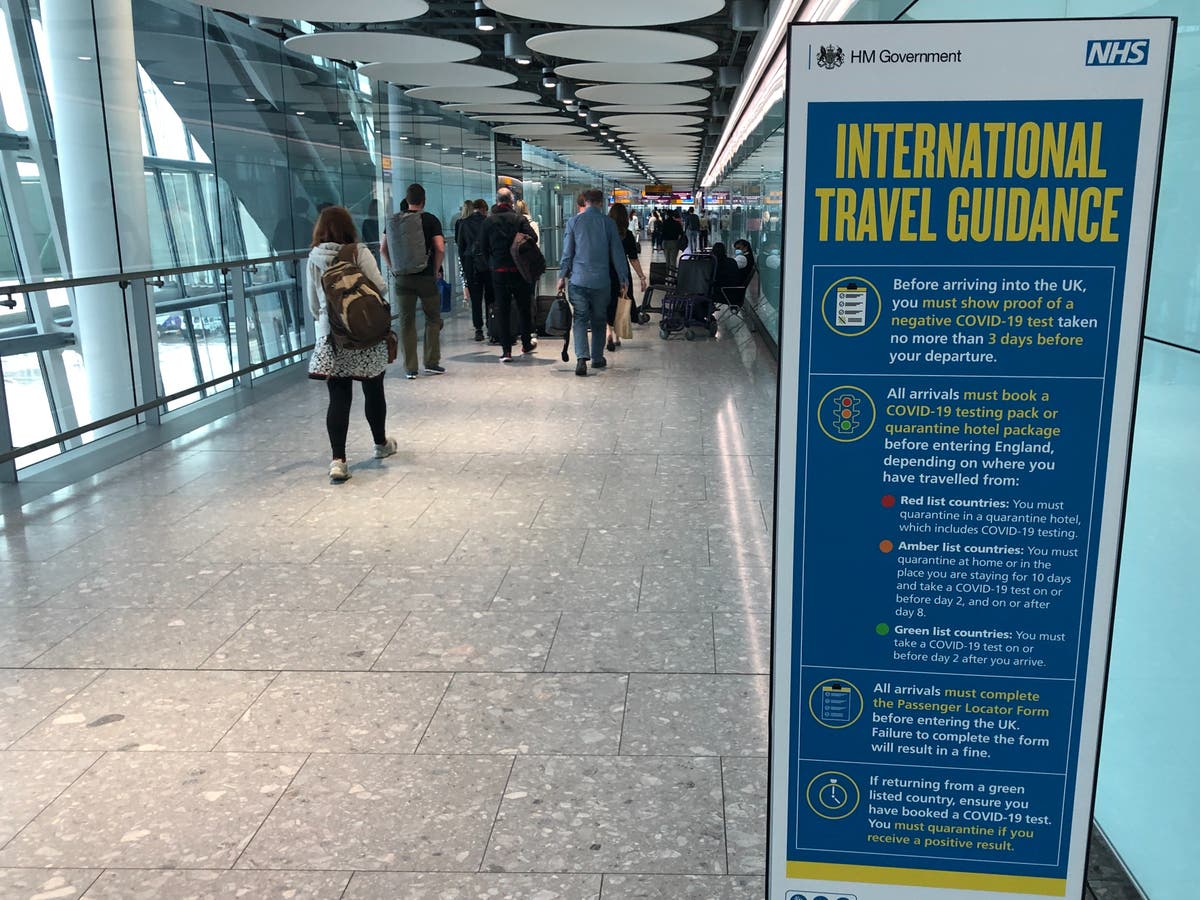
One month after travel testing rules were tightened to be even tougher than last summer, the prime minister has announced test requirements will be eased for fully vaccinated arrivals to England – reverting to the situation that prevailed for five weeks in late 2021.
The Welsh health minister has “reluctantly agreed” to adopt the same travel testing rules.
The Independent is seeking responses from the Scottish government and Northern Ireland executive.
The removal of the pre-departure test requirement will reduce cost and complexity for international arrivals to England and Wales, and increase confidence among prospective travellers.
In addition, the requirement for doubled jabbed arrivals to have a PCR test as their “day two” test and self-isolate until a negative result is received has been lifted.
The testing requirements for unvaccinated people will not change.
On top of this, many foreign countries are still imposing severe restrictions – often near-total bans – on British travellers.
These are the key questions and answers around travel in the coming weeks.
What’s the background?
As concern grew in medical and government circles about the Omicron variant of coronavirus, testing rules for travellers arriving in the UK were stepped up in late November and early December 2021 to try to “buy time” and limit the spread.
The UK brought in Europe’s most onerous testing rules, which currently apply to all international arrivals to the UK, except from Ireland.
Everyone aged 12 and over must take a pre-departure test on the day of leaving for the UK, or one of the two preceding days (from 48 hours before departure for Wales).
In addition, all travellers aged five and above (11 and above for Scotland) must book a post-arrival PCR test to be taken on the day of arrival or one of the two following days. Until they receive a negative result, they must remain in isolation.
A review of the travel restrictions was initially promised by the prime minister for 18 December, later changed to 20 December and finally to 5 January.
What is changing?
Boris Johnson has announced the testing regime for travellers to England is returning to the relatively low-cost, low-hassle state that prevailed between 24 October and 30 November.
Though the rule-change only applies to England and Wales at present, it is likely that the governments in Scotland and Northern Ireland will follow suit.
Fully vaccinated travellers arriving after 4am on Friday 7 January 2021 need not present a pre-departure test certificate to the airline, ferry company or train operator.
They will still need to present a passenger locator form. In order to complete this, the traveller must book a post-arrival (day two) test.
Self-isolation will no longer be required while waiting for a negative result.
From 4am on Sunday 9 January, double-jabbed travellers may take a faster, cheaper lateral flow test rather than a PCR, to be taken on the day of arrival or one of the two following days.
If the lateral flow is positive, the traveller must then take a free NHS PCR test.
How much cheaper will it be?
Removing the need for a pre-departure test will save anything from around £20 to $250 (£185) in some cases for travel from the US.
Post-arrival PCR tests currently cost around £50-£80. Lateral flow tests are around half the price.
While the degree of hassle in organising the test remains the same, a huge improvement from the traveller’s point of view is the end to the self-isolation rule.
Can’t I use an NHS lateral flow test, as I do for work?
No. NHS tests cannot be used for international travel. The post-arrival test must be privately obtained and properly certified.
Why is there a discrepancy between the changes in pre-departure and PCR tests?
The difference in timing is to allow testing companies to re-orient their offerings.
What if I am already self-isolating at the moment the rules change on Friday?
You will need to continue to self-isolate until you get a negative result.
What does the travel industry say?
The change is long overdue. The PCR test for arrivals was introduced on 30 November, together with the requirement to self-isolate.
On 7 December, the pre-departure test was brought in. The next day the health secretary, Sajid Javid, said that all travel restrictions could be scrapped “very soon”.
Some restrictions remain, and many people have been deterred from travelling because of the cost of tests or fears over testing positive.
During December, Manchester Airports Group – which includes Stansted and East Midlands airports – reported a one-third slump in travel.
Julia Lo Bue-Said, chief executive of the Advantage Travel Partnership, warned that sudden moves such as the overnight introduction of Omicron restrictions in November, could cause harm in future.
“Confidence is crucial now,” she said. “In order to recover from the decimating impact the pandemic has had on the travel industry and people we must start to see a consistent approach from government in terms of the future relaxation of rules given our highly vaccinated population.”
Is everyone else happy?
No. Scotland’s health secretary, Humza Yousaf, criticised Boris Johnson’s government for announcing eased travel testing rules before all four UK nations had agreed to changes.
Speaking on BBC Good Morning Scotland, Mr Yousaf said: “Although we’re engaged in conversations with the UK government, it’s a source of frustration that if the UK government unilaterally decides to move in a certain direction, we end up with potentially a double whammy if we don’t align.
“Our aviation sector, which has undoubtedly been significantly affected throughout the course of this pandemic, get further hit. Also, we don’t end up realising any public health benefit if we have to put measures in place because ultimately a number of people may well travel from English airports if that is seen to be easier or cheaper.”
Mr Yousaf said MSPs will be told about any changes on Thursday afternoon.
“It’s obviously important that we update parliament first and foremost,” he said.
The Welsh health minister, Eluned Morgan, said she had “reluctantly agreed” to align with England’s changes. But she warned: “We are concerned at the speed at which the UK government is re-opening international travel, given on-going concerns of importing new variants and adding additional pressure to our health services.”
Why is there a date discrepancy between removing the pre-departure test and downgrading the post-arrival PCR?
To allow testing firms a couple of extra days to change their procedures.
Can I get a refund for tests I’ve booked but now don’t need?
That all depends on your provider’s terms. If your tests are non-refundable, at least you can still use the post-arrival PCR after the rules change. There is no need to self-isolate while you wait for a result.
The Independent has always advocated booking tests as late as possible to avoid paying for unnecessary or inappropriate tests.
I have recovered from Covid-19 and worry about false positives. Can I get an exemption from post-arrival testing?
No, but the downgrading from PCR to lateral flow should reduce the risk of false positives.
What are the rules for unvaccinated travellers?
Nothing changes. Travellers must take a pre-departure test two days ahead. You must also book PCR tests for days two and eight and self-isolate for 10 days (reduced to five in England if you take a “test to release” halfway through).
When will things change again?
That rather depends on further variants – and the government’s response to them.
In October, the transport secretary, Grant Shapps, said: “We are accelerating towards a future where travel continues to reopen safely and remains open for good.
“With more than eight in 10 people now fully vaccinated, we are able to take these steps to lower the cost of testing and help the sector to continue in its recovery.”
In December he told Christopher Hope of the Telegraph that pre-departure tests would not return because to do so could “kill off the travel sector again”.
But the rules then reverted to where they were in summer 2021, but with the added twist of self-isolation.
What happens if I contract Covid-19 abroad?
You must immediately notify the local health authority and follow their instructions for isolation, which could be at your cost. Some travel insurance policies will cover the expenses involved.
Travel firms will generally be flexible about moving bookings for people who test positive ahead of their flight/ferry/train and allow postponements without additional fees.