


 Africana55 Radio

This website uses cookies so that we can provide you with the best user experience possible. Cookie information is stored in your browser and performs functions such as recognising you when you return to our website and helping our team to understand which sections of the website you find most interesting and useful.
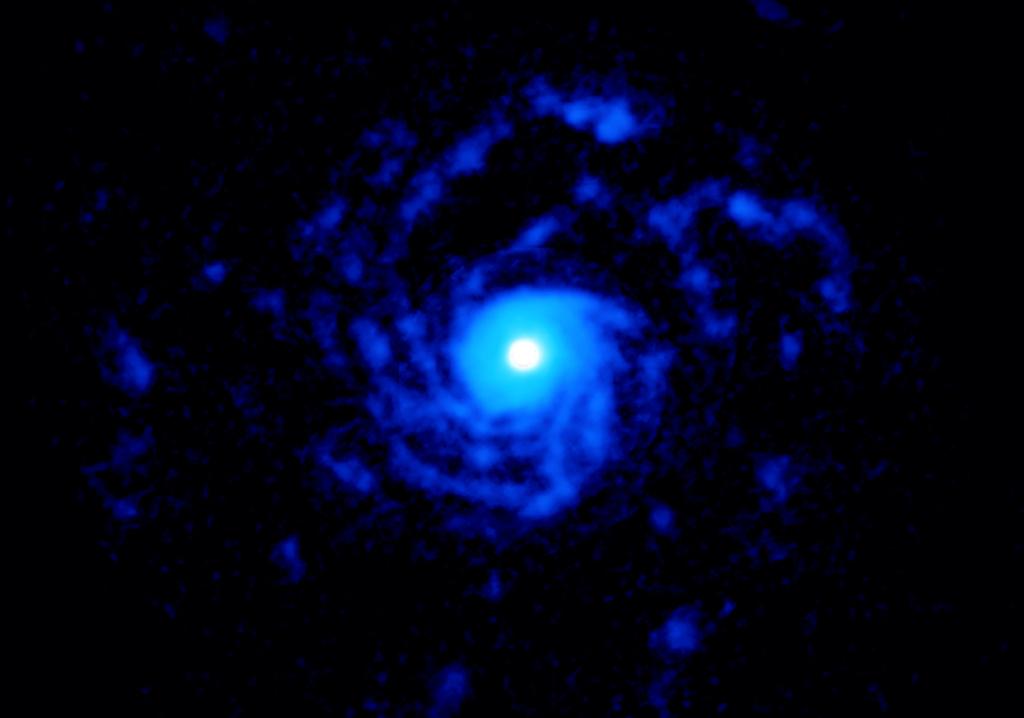
Mysterious, huge spiral structures, extending out of a young star, have been spotted by astronomers.
The "complex set of spiral arms" reaches out 1,000 times the distance between the Earth and the Sun, and could shed new light on how planets are born.
The unexplained spirals were seen coming out of a young variable star, known as RU Lupi, which is thought to be producing new worlds, and has become known as a "planet factory" as a result.
Most images of those planet-forming discs have shown them as a neat collection of gas and dust, with rings and gaps that suggest new planets are being born there. When astronomers first looked at RU Lupi's collection of dust, it looked the same, with a relatively neat organisation that appeared to be forming new worlds.
But studies of the gas rather than the dust in the disc that surrounds it appears to show that the process of forming those planets is much more complex, and less neatly arranged, than previously thought. The complicated web of gas looks something like a miniature galaxy, researchers said.
Astronomers were encouraged to look at the gas rather than the dust after they noticed hints of carbon monoxide, or CO, extending beyond the disc. When they re-examined it, they spotted the spiralling structures of gas – which makes up much more of such a protoplanetary disc than dust does.
“We discovered a complex set of spiral arms in carbon monoxide (CO) emission extending to nearly 1,000 astronomical units from the young star RU Lup, which has previously been found to exhibit signs of ongoing planet formation via concentric dust gaps in its protoplanetary disk,” said Jane Huang, who led the research, in a statement.
“CO emission reveals complex structures in the planet-formation environment that are invisible in dust observations alone.”
Usually, the discs that surround a star and give rise to new worlds are shown in neat, swirling circles around their sun. But the new study suggests there are other kinds of planet-forming environments that could be much messier than those images might suggest, the authors said.
“The planet-forming environment can be much more complex and chaotic than implied by the numerous, well-known images of concentric ringed protoplanetary disks mapped in millimeter continuum emission,” said Huang.
Created with Sketch.
Created with Sketch.
1/10
Mystic Mountain, a pillar of gas and dust standing at three-light-years tall, bursting with jets of gas from fledgling stars buried within, was captured by Nasa's Hubble Space Telescope in February 2010
Nasa/ESA/STScI
2/10
The first ever selfie taken on an alien planet, captured by Nasa's Curiosity Rover in the early days of its mission to explore Mars in 2012
Nasa/JPL-Caltech/MSSS
3/10
Death of a star: This image from Nasa's Chandra X-ray telescope shows the supernova of Tycho, a star in our Milky Way galaxy
Nasa
4/10
Arrokoth, the most distant object ever explored, pictured here on 1 January 2019 by a camera on Nasa's New Horizons spaceraft at a distance of 4.1 billion miles from Earth
Getty
5/10
An image of the Large Magellanic Cloud galaxy seen in infrared light by the Herschel Space Observatory in January 2012. Regions of space such as this are where new stars are born from a mixture of elements and cosmic dust
Nasa
6/10
The first ever image of a black hole, captured by the Event Horizon telescope, as part of a global collaboration involving Nasa, and released on 10 April 2019. The image reveals the black hole at the centre of Messier 87, a massive galaxy in the nearby Virgo galaxy cluster. This black hole resides about 54 million light-years from Earth
Getty
7/10
Pluto, as pictured by Nasa's New Horizons spacecraft as it flew over the dwarf planet for the first time ever in July 2015
Nasa/APL/SwRI
8/10
A coronal mass ejection as seen by the Chandra Observatory in 2019. This is the first time that Chandra has detected this phenomenon from a star other than the Sun
Nasa
9/10
Dark, narrow, 100 meter-long streaks running downhill on the surface Mars were believed to be evidence of contemporary flowing water. It has since been suggested that they may instead be formed by flowing sand
Nasa/JPL/University of Arizona
10/10
Morning Aurora: Nasa astronaut Scott Kelly captured this photograph of the green lights of the aurora from the International Space Station in October 2015
Nasa/Scott Kelly
1/10
Mystic Mountain, a pillar of gas and dust standing at three-light-years tall, bursting with jets of gas from fledgling stars buried within, was captured by Nasa's Hubble Space Telescope in February 2010
Nasa/ESA/STScI
2/10
The first ever selfie taken on an alien planet, captured by Nasa's Curiosity Rover in the early days of its mission to explore Mars in 2012
Nasa/JPL-Caltech/MSSS
3/10
Death of a star: This image from Nasa's Chandra X-ray telescope shows the supernova of Tycho, a star in our Milky Way galaxy
Nasa
4/10
Arrokoth, the most distant object ever explored, pictured here on 1 January 2019 by a camera on Nasa's New Horizons spaceraft at a distance of 4.1 billion miles from Earth
Getty
5/10
An image of the Large Magellanic Cloud galaxy seen in infrared light by the Herschel Space Observatory in January 2012. Regions of space such as this are where new stars are born from a mixture of elements and cosmic dust
Nasa
6/10
The first ever image of a black hole, captured by the Event Horizon telescope, as part of a global collaboration involving Nasa, and released on 10 April 2019. The image reveals the black hole at the centre of Messier 87, a massive galaxy in the nearby Virgo galaxy cluster. This black hole resides about 54 million light-years from Earth
Getty
7/10
Pluto, as pictured by Nasa's New Horizons spacecraft as it flew over the dwarf planet for the first time ever in July 2015
Nasa/APL/SwRI
8/10
A coronal mass ejection as seen by the Chandra Observatory in 2019. This is the first time that Chandra has detected this phenomenon from a star other than the Sun
Nasa
9/10
Dark, narrow, 100 meter-long streaks running downhill on the surface Mars were believed to be evidence of contemporary flowing water. It has since been suggested that they may instead be formed by flowing sand
Nasa/JPL/University of Arizona
10/10
Morning Aurora: Nasa astronaut Scott Kelly captured this photograph of the green lights of the aurora from the International Space Station in October 2015
Nasa/Scott Kelly
“The fact that we observed this spiral structure in the gas after a deep observation suggests that we have likely not seen the full diversity and complexity of planet-forming environments. We may have missed much of the gas structures in other disks.”
Researchers have proposed a range of possibilities to explain both the unusual structures and the strange behaviour of the star: that the disc is so massive it is collapsing under its own gravity, that it is interacting with another star, or that interstellar material is being pulled along the arms. But those explanations are incomplete and scientists now hope to find more of the unusual "planet factories" to understand the processes behind the formation better.
“None of these scenarios completely explain what we have observed,” said Sean Andrews, who worked on the study alongside Huang at the Center for Astrophysics, Harvard & Smithsonian.
“There might be unknown processes happening during planet formation that we have not yet accounted for in our models. We will only learn what they are if we find other disks out there that look like RU Lup.”