


 Africana55 Radio


This website uses cookies so that we can provide you with the best user experience possible. Cookie information is stored in your browser and performs functions such as recognising you when you return to our website and helping our team to understand which sections of the website you find most interesting and useful.

Want to bookmark your favourite articles and stories to read or reference later? Start your Independent Membership today.
Already a member? Log in
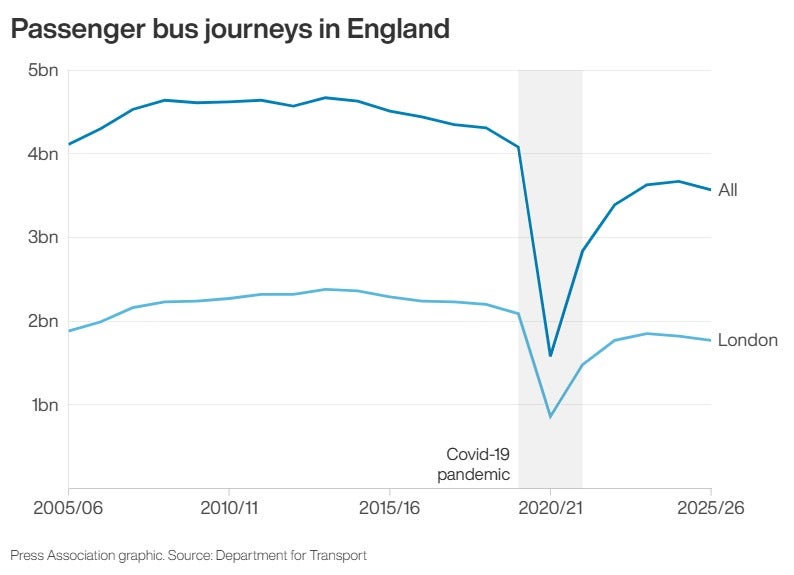
The number of journeys taken on local bus services in England fell by 3% in the year ending March 31, according to a Department for Transport (DfT) report.
The DfT said the drop was the first decline since the pandemic, following three consecutive years of recovery.
A total of 3.6 billion passenger journeys were made over the year, split evenly between 1.8 billion in London and 1.8 billion outside the capital.
The figures show bus travel recovered to 90% of pre-pandemic levels in the year ending March 31 2025, before falling to 88% in the following 12 months, the DfT said.
For comparison, 4.07 billion passenger journeys were made in the year ending March 2020, which was largely before the coronavirus crisis.
That figure was itself down from 4.67 billion in 2013/2014.
The latest data follows the introduction of a £3 fare cap for single bus journeys in England at the start of 2025, which replaced a previous £2 cap.
This summer, Prime Minister Andy Burnham announced the £2 cap would be reinstated from January next year as part of efforts to tackle the cost-of-living crisis.
Graham Vidler, chief executive of the Confederation of Passenger Transport, said it was “no surprise” that the £3 cap had “dented passenger numbers” in the latest figures.
Separate figures published by the Office for National Statistics (ONS) show average bus fares in the first three months of 2026 were nearly seven times the level of the same period in 1987.
Train fares over the same span were around five-and-a-half times their 1987 equivalent, while motoring costs were around three-and-a-half times as high.
The ONS data is based on the retail prices index.
A DfT spokesperson said: “We want more people choosing the bus, which is why we’re doing everything we can to make services cheaper, accessible, more reliable and easier to use.
“From keeping fares down through our £2 bus fare cap which starts from January, free 24/7 travel fares for disabled passengers, to giving local leaders more control over their networks so they can operate services that work for their communities – we’re backing better buses that people want to choose for their everyday travel.”