


 Africana55 Radio

This website uses cookies so that we can provide you with the best user experience possible. Cookie information is stored in your browser and performs functions such as recognising you when you return to our website and helping our team to understand which sections of the website you find most interesting and useful.
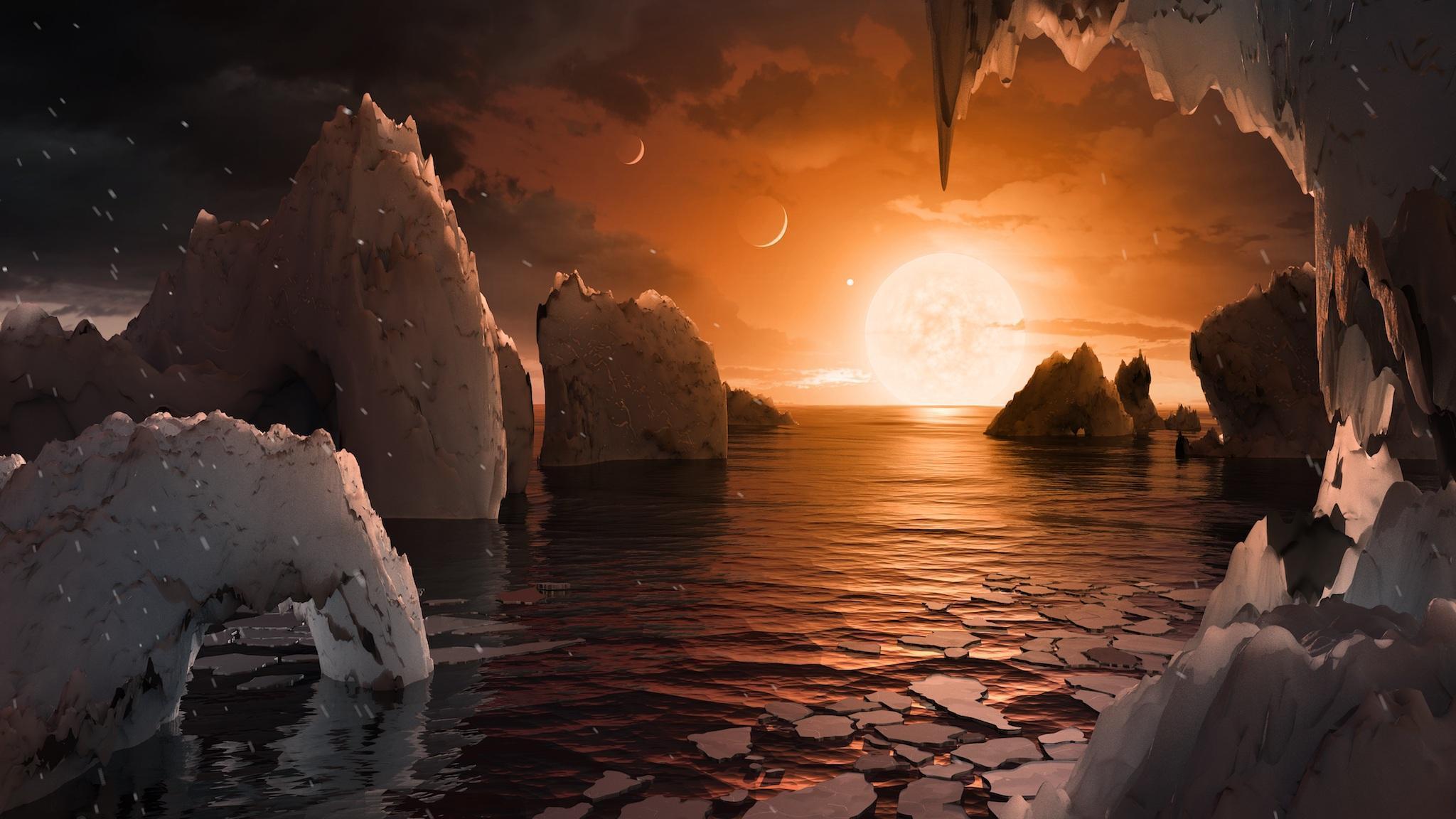
Other solar systems could have large numbers of planets that are home to alien life, a new study has found.
The research suggests that other parts of the universe could be host to numerous planets that are habitable, unlike our solar system, where just one of the worlds has the right conditions for life to thrive.
Scientists looking for life elsewhere in the universe regularly search for planets in the "habitable zone", which are distant enough from their star that the water would not immediately be evaporated away, but close enough that it would not freeze.
Researchers think that finding planets at that specific distance from their star, which is also known as the Goldilocks zone, is the best hope for finding alien life elsewhere in the universe.
The new study was prompted by looking at a famous, relatively nearby planetary system – known as Trappist-1 – which has at least three planets in its habitable zone.
"This made me wonder about the maximum number of habitable planets it's possible for a star to have, and why our star only has one," astrobiologist Stephen Kane from UC Riverside, who led the study published in the Astronomical Journal this week, said. "It didn't seem fair!"
To understand how many habitable planets a solar system might be able to support, researchers create a model that allowed them to simulate planets of different sizes orbiting their stars. It accounted for the way that those planets would interact with each other as they orbited around their star, stretching over a theoretical time of millions of years.
They found that a star like our Sun could support as many as six planets, each of them with liquid water and the conditions to be habitable. Other kinds of stars could support a full seven.
If there are more than that, the planets would move too close to each other, disturbing their orbits.
The research also helped illuminate the reason our planet has a relatively paltry one habitable planet, and the conditions that would change that. Part of our problem appears to be that the planets of our solar system move around in an oval shape – if their path is more regular and circular, they better minimise contact so that they can have more stable orbits.
Created with Sketch.
Created with Sketch.
1/10
Mystic Mountain, a pillar of gas and dust standing at three-light-years tall, bursting with jets of gas from fledgling stars buried within, was captured by Nasa's Hubble Space Telescope in February 2010
Nasa/ESA/STScI
2/10
The first ever selfie taken on an alien planet, captured by Nasa's Curiosity Rover in the early days of its mission to explore Mars in 2012
Nasa/JPL-Caltech/MSSS
3/10
Death of a star: This image from Nasa's Chandra X-ray telescope shows the supernova of Tycho, a star in our Milky Way galaxy
Nasa
4/10
Arrokoth, the most distant object ever explored, pictured here on 1 January 2019 by a camera on Nasa's New Horizons spaceraft at a distance of 4.1 billion miles from Earth
Getty
5/10
An image of the Large Magellanic Cloud galaxy seen in infrared light by the Herschel Space Observatory in January 2012. Regions of space such as this are where new stars are born from a mixture of elements and cosmic dust
Nasa
6/10
The first ever image of a black hole, captured by the Event Horizon telescope, as part of a global collaboration involving Nasa, and released on 10 April 2019. The image reveals the black hole at the centre of Messier 87, a massive galaxy in the nearby Virgo galaxy cluster. This black hole resides about 54 million light-years from Earth
Getty
7/10
Pluto, as pictured by Nasa's New Horizons spacecraft as it flew over the dwarf planet for the first time ever in July 2015
Nasa/APL/SwRI
8/10
A coronal mass ejection as seen by the Chandra Observatory in 2019. This is the first time that Chandra has detected this phenomenon from a star other than the Sun
Nasa
9/10
Dark, narrow, 100 meter-long streaks running downhill on the surface Mars were believed to be evidence of contemporary flowing water. It has since been suggested that they may instead be formed by flowing sand
Nasa/JPL/University of Arizona
10/10
Morning Aurora: Nasa astronaut Scott Kelly captured this photograph of the green lights of the aurora from the International Space Station in October 2015
Nasa/Scott Kelly
1/10
Mystic Mountain, a pillar of gas and dust standing at three-light-years tall, bursting with jets of gas from fledgling stars buried within, was captured by Nasa's Hubble Space Telescope in February 2010
Nasa/ESA/STScI
2/10
The first ever selfie taken on an alien planet, captured by Nasa's Curiosity Rover in the early days of its mission to explore Mars in 2012
Nasa/JPL-Caltech/MSSS
3/10
Death of a star: This image from Nasa's Chandra X-ray telescope shows the supernova of Tycho, a star in our Milky Way galaxy
Nasa
4/10
Arrokoth, the most distant object ever explored, pictured here on 1 January 2019 by a camera on Nasa's New Horizons spaceraft at a distance of 4.1 billion miles from Earth
Getty
5/10
An image of the Large Magellanic Cloud galaxy seen in infrared light by the Herschel Space Observatory in January 2012. Regions of space such as this are where new stars are born from a mixture of elements and cosmic dust
Nasa
6/10
The first ever image of a black hole, captured by the Event Horizon telescope, as part of a global collaboration involving Nasa, and released on 10 April 2019. The image reveals the black hole at the centre of Messier 87, a massive galaxy in the nearby Virgo galaxy cluster. This black hole resides about 54 million light-years from Earth
Getty
7/10
Pluto, as pictured by Nasa's New Horizons spacecraft as it flew over the dwarf planet for the first time ever in July 2015
Nasa/APL/SwRI
8/10
A coronal mass ejection as seen by the Chandra Observatory in 2019. This is the first time that Chandra has detected this phenomenon from a star other than the Sun
Nasa
9/10
Dark, narrow, 100 meter-long streaks running downhill on the surface Mars were believed to be evidence of contemporary flowing water. It has since been suggested that they may instead be formed by flowing sand
Nasa/JPL/University of Arizona
10/10
Morning Aurora: Nasa astronaut Scott Kelly captured this photograph of the green lights of the aurora from the International Space Station in October 2015
Nasa/Scott Kelly
Jupiter might also deserve some of the blame for making our solar system so uninhabitable, too. It is so large – at two-and-half-times the mass of the rest of the solar system's planet combined – that it hogs the space and disturbs everything around it, the study suggests.
"It has a big effect on the habitability of our solar system because it's massive and disturbs other orbits," Kane said.
The research could now help identify other solar systems that could be worth exploring for potential life. That could inform research by Nasa telescopes, such as the Jet Propulsion Laboratory's Habitable Exoplanet Observatory, which is looking through the universe in an attempt to find which worlds could have the right conditions to be a home.