


 Africana55 Radio

This website uses cookies so that we can provide you with the best user experience possible. Cookie information is stored in your browser and performs functions such as recognising you when you return to our website and helping our team to understand which sections of the website you find most interesting and useful.
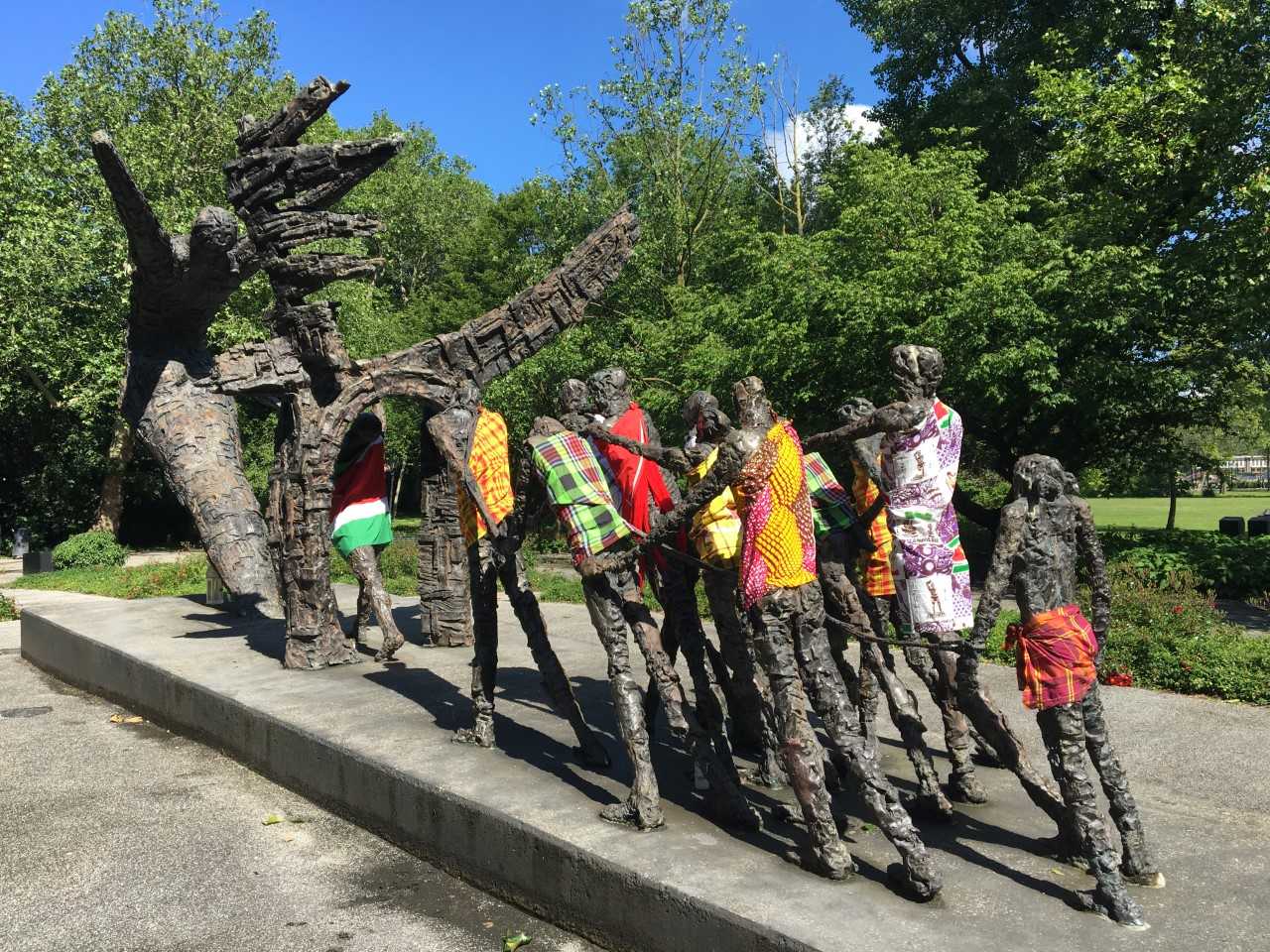
On the war monument looming over our tour group, a sculpture of a muscular man with African features appears to stride towards us; to our right is the former stock exchange where the spoils of his ancestors’ unpaid labour fattened the purses of 17th-century investors. Amsterdam’s Dam Square – tourist hotspot and gateway to the Red Light District – is revealing itself in a whole new light. “We’re looking closer with a different lens,” explains our guide Jennifer Tosch, founder of the Black Heritage Tour, the first excursion of its kind in the city.
“Not enough African history is included in the national memory,” continues Jennifer, a US national with Surinamese heritage, who has lived in the Netherlands since 2012. “I started this tour as an intervention. And because my family, who have been here for three generations, still didn’t feel like they belonged.”
But change is afoot. Black Lives Matter demonstrations across the Netherlands, in response to the killing of George Floyd in Minnesota in May, are demanding that the country do better. In June, Prime Minister Mark Rutte finally acknowledged that racism is a problem in the Netherlands and admitted to changing his views on the use of blackface at the country’s controversial Black Peter celebrations – a practice he had previously defended.
This July, the rhythmic, colourful festival of Keti Koti (meaning ‘broken chains’), an annual commemoration of the legal emancipation from Dutch slavery (1863) in Suriname and the former colonies in the Dutch Antilles, was also expected to be an important turning point. At the festival in Amsterdam’s Oosterpark, where a monument to slavery has stood since 2002, the municipality was to officially apologise for the Netherlands’ role in the slave trade.
With the pandemic putting paid to all mass gatherings, that apology is still pending, and it is once again the cultural sector – and the activists within it – who are most effectively raising awareness of the debt the Netherlands owes to its former captives. Slavery accounted for an estimated 40 per cent of the country’s economic growth during the 18th century, with around one fifth of shipped goods originating from slave plantations in the Americas.
To make this history more explicit, Jennifer has us continue our tour by boat, weaving through the canals of the Red Light District, where racial divisions are still evident in the huddle of windows around the Old Church occupied exclusively by black sex workers. We pass warehouses, once stocked with exotic spices from the colonies, and the former residences of merchants, whose elaborately decorated gables depict the enslaved alongside their produce – for a long time emblems of Dutch affluence and pride.
The tour has added poignancy today as our group includes refugees from Eritrea and Algeria. ‘’Our society may make you feel you don’t belong here,” Jennifer says. “But you are part of the story from the very beginning.” The canal district, we learn, has been multicultural for hundreds of years, with inter-racial marriages recorded as far back as 1593.
In fact, once you start looking for it, Amsterdam’s black history is hard to miss. We spot the yawning red mouths of gapers (a stone or wooden figurehead often depicting a Moor, Muslim or North African) over pharmacies, tiny pills on their tongues; ebony-coloured Moors on gables and heraldry; and a memorial stone outside the mayor’s house – once home to the Director of the controversial West India Company and Society of Suriname – decrying slavery and the slave trade as ‘crimes against humanity’.
A desire to make amends now permeates throughout Amsterdam. A museum of slavery is in the planning and streets in the new Centrumeiland district are to be named after abolition campaigners. Until recently, the glorification of the Dutch Golden Age (in the 1600s), when the city was the wealthiest in Europe, has been the focus of much of its cultural tourism. But it was no Golden Age for those sold into slavery, and the Amsterdam Museum made headlines last year when it announced it would be dropping the term.
When we pass the Van Loon Museum, one of the city’s most lavish canal houses, Jennifer has our skipper loop back to be sure the group takes it in. Here too, the sinister story behind the mansion’s grand façade was recently made public in an in-house exhibition, On the Surinamese Canals, which revealed how the Van Loons – investors in Surinamese plantations and co-founders of the Dutch East India Company (VOC) – owed their prosperity to the toil and tears of black-skinned men and women thousands of miles away.
Created with Sketch.
Created with Sketch.
1/21
An aerial photo made with a drone shows a large group gathered in Union Park to protest the arrest of George Floyd, who later died in police custody, in Chicago, Illinois
EPA
2/21
A large group marching and chanting in Chicago, Illinois
EPA/Tannen Maury
3/21
Protesters gather along the steps of the Philadelphia Art Museum and Eakins Oval during a protest
AP
4/21
Demonstrators try to block a freeway during a protest against the death in Minneapolis police custody of George Floyd, in the Manhattan borough of New York City, New York
REUTERS
5/21
Thousands of demonstrators march across the Golden Gate Bridge in San Francisco, California
REUTERS
6/21
Demonstrators gather at Black Lives Matter Plaza in Washington
REUTERS
7/21
Demonstrators march down Flatbush Avenue toward the Manhattan Bridge chanting slogans
REUTERS
8/21
Protesters take part in a demonstration to protest in support of the George Floyd protests in the United States, and also to commemorate a similar circumstance in France when Adama Traore, a 24-year-old Frenchman was killed in 2016 by police, during an rally in Champ de Mars next to the Eiffel Tower in Paris
EPA
9/21
Demonstrators attend a protest in Berlin, Germany
FABRIZIO BENSCH/REUTERS
10/21
Demonstrators protest against the death in Minneapolis police custody of George Floyd, in Sydney
RON SHAMGAR via REUTERS
11/21
Demonstrators attend a Black Lives Matter protest to express solidarity with US protestors in Sydney
AFP via Getty Images
12/21
People take part in a Black Lives Matter protest rally in Manchester Piccadilly Gardens, UK
PA
13/21
People wearing masks hold placards during a protest march over the alleged police abuse of a Turkish man, in echoes of a Black Lives Matter protest, following the death of George Floyd who died in police custody in Minneapolis, in Tokyo
REUTERS/Issei Kato
14/21
Demonstrators attend a protest against police brutality in Frankfurt
REUTERS
15/21
Demonstrators attend a protest against police brutality at Alexanderplatz in Berlin, Germany
REUTERS
16/21
People stand in silence for eight minutes and 46 seconds in tribute to George Floyd during a protest against racism and police brutality in Frankfurt am Main, Germany
Getty Images
17/21
Thousands of people demonstrate in Cologne, Germany
AP
18/21
Demonstrators hold placards as they attend a protest march to the US Embassy in London
AFP via Getty Images
19/21
Demonstrators cross the River Thames via Vauxhall Bridge as they march to protest outside the US Embassy in London
AFP via Getty Images
20/21
Demonstrators gather for a protest against racism and police violence in Lisbon
AP
21/21
Boxer Anthony Joshua is seen on crutches with demonstrators in Watford, Britain
REUTERS
1/21
An aerial photo made with a drone shows a large group gathered in Union Park to protest the arrest of George Floyd, who later died in police custody, in Chicago, Illinois
EPA
2/21
A large group marching and chanting in Chicago, Illinois
EPA/Tannen Maury
3/21
Protesters gather along the steps of the Philadelphia Art Museum and Eakins Oval during a protest
AP
4/21
Demonstrators try to block a freeway during a protest against the death in Minneapolis police custody of George Floyd, in the Manhattan borough of New York City, New York
REUTERS
5/21
Thousands of demonstrators march across the Golden Gate Bridge in San Francisco, California
REUTERS
6/21
Demonstrators gather at Black Lives Matter Plaza in Washington
REUTERS
7/21
Demonstrators march down Flatbush Avenue toward the Manhattan Bridge chanting slogans
REUTERS
8/21
Protesters take part in a demonstration to protest in support of the George Floyd protests in the United States, and also to commemorate a similar circumstance in France when Adama Traore, a 24-year-old Frenchman was killed in 2016 by police, during an rally in Champ de Mars next to the Eiffel Tower in Paris
EPA
9/21
Demonstrators attend a protest in Berlin, Germany
FABRIZIO BENSCH/REUTERS
10/21
Demonstrators protest against the death in Minneapolis police custody of George Floyd, in Sydney
RON SHAMGAR via REUTERS
11/21
Demonstrators attend a Black Lives Matter protest to express solidarity with US protestors in Sydney
AFP via Getty Images
12/21
People take part in a Black Lives Matter protest rally in Manchester Piccadilly Gardens, UK
PA
13/21
People wearing masks hold placards during a protest march over the alleged police abuse of a Turkish man, in echoes of a Black Lives Matter protest, following the death of George Floyd who died in police custody in Minneapolis, in Tokyo
REUTERS/Issei Kato
14/21
Demonstrators attend a protest against police brutality in Frankfurt
REUTERS
15/21
Demonstrators attend a protest against police brutality at Alexanderplatz in Berlin, Germany
REUTERS
16/21
People stand in silence for eight minutes and 46 seconds in tribute to George Floyd during a protest against racism and police brutality in Frankfurt am Main, Germany
Getty Images
17/21
Thousands of people demonstrate in Cologne, Germany
AP
18/21
Demonstrators hold placards as they attend a protest march to the US Embassy in London
AFP via Getty Images
19/21
Demonstrators cross the River Thames via Vauxhall Bridge as they march to protest outside the US Embassy in London
AFP via Getty Images
20/21
Demonstrators gather for a protest against racism and police violence in Lisbon
AP
21/21
Boxer Anthony Joshua is seen on crutches with demonstrators in Watford, Britain
REUTERS
The launch in March of Musea Bekennen Kleur (Museums Acknowledge Colour), a collaboration between Dutch art institutions to promote diversity and inclusion, promises to continue introducing visitors to neglected narratives, painting people of colour back into the Netherlands’ complex history.
Stephanie Archangel, co-curator of the Rijksmuseum’s forthcoming Slavery exhibition and of the Rembrandt House Museum’s current Black in Rembrandt’s Time, has been part of this shift in the arts scene. “I think it’s moved on from a more aesthetic kind of exhibition, more art-historical, to this social-historical movement,” she says. “More people are standing up and saying we have the right to tell our own story and not just have our stories be told.”
Back on the boat, the scenery offers ample examples to bring the city’s black history alive. A replica VOC ship in the harbour; a Smart Shop with a gable stone depicting tobacco rollers; even the Botanical Gardens, whose 300-year-old giant cycad was brought here from the Eastern Cape by the Dutch East India company: all tell of an African story to those willing to listen.
Black history as a means of rediscovering a destination is for everyone, says Jennifer. “I don’t want this tour to be alternative. It should be mainstream. Everybody needs to know about this.”
Travel essentials
A Black Heritage Tour in Amsterdam costs from €50pp for a walking tour and from €60pp for a boat tour.
Black in Rembrandt’s Time at the Rembrandt House Museum runs until 6 September 2020. Slavery at the Rijksmuseum runs from 12 February 2021 to 30 May 2021.