


 Africana55 Radio

This website uses cookies so that we can provide you with the best user experience possible. Cookie information is stored in your browser and performs functions such as recognising you when you return to our website and helping our team to understand which sections of the website you find most interesting and useful.

Want to bookmark your favourite articles and stories to read or reference later? Start your Independent Membership today.
Already a member? Log in
Edinburgh and Cornwall are among the large tourist destinations that support a tourist tax on overnight visitors, despite most Britons opposing the idea.
The government announced this year that England will follow the lead of many destinations worldwide, including Scotland and Wales, and give mayors and local leaders powers to introduce a tourist tax on overnight stays.
Not everyone is sold on the idea. A new YouGov poll found that 51 per cent of Britons would oppose a tourist tax, while 37 per cent would support one.
Yet the poll revealed that some destinations across the UK are in favour of the overnight levy.
Two-thirds of Edinburgh’s residents (67 per cent) support a tourist tax, compared with just 24 per cent who are opposed. In July, Edinburgh became the first destination in Britain to introduce the tax, charging a five per cent fee on top of accommodation prices.
It is currently the only destination in Britain with a statutory tourist tax, although Manchester and Liverpool have nightly fee charges run by independent not-for-profits rather than a local authority.
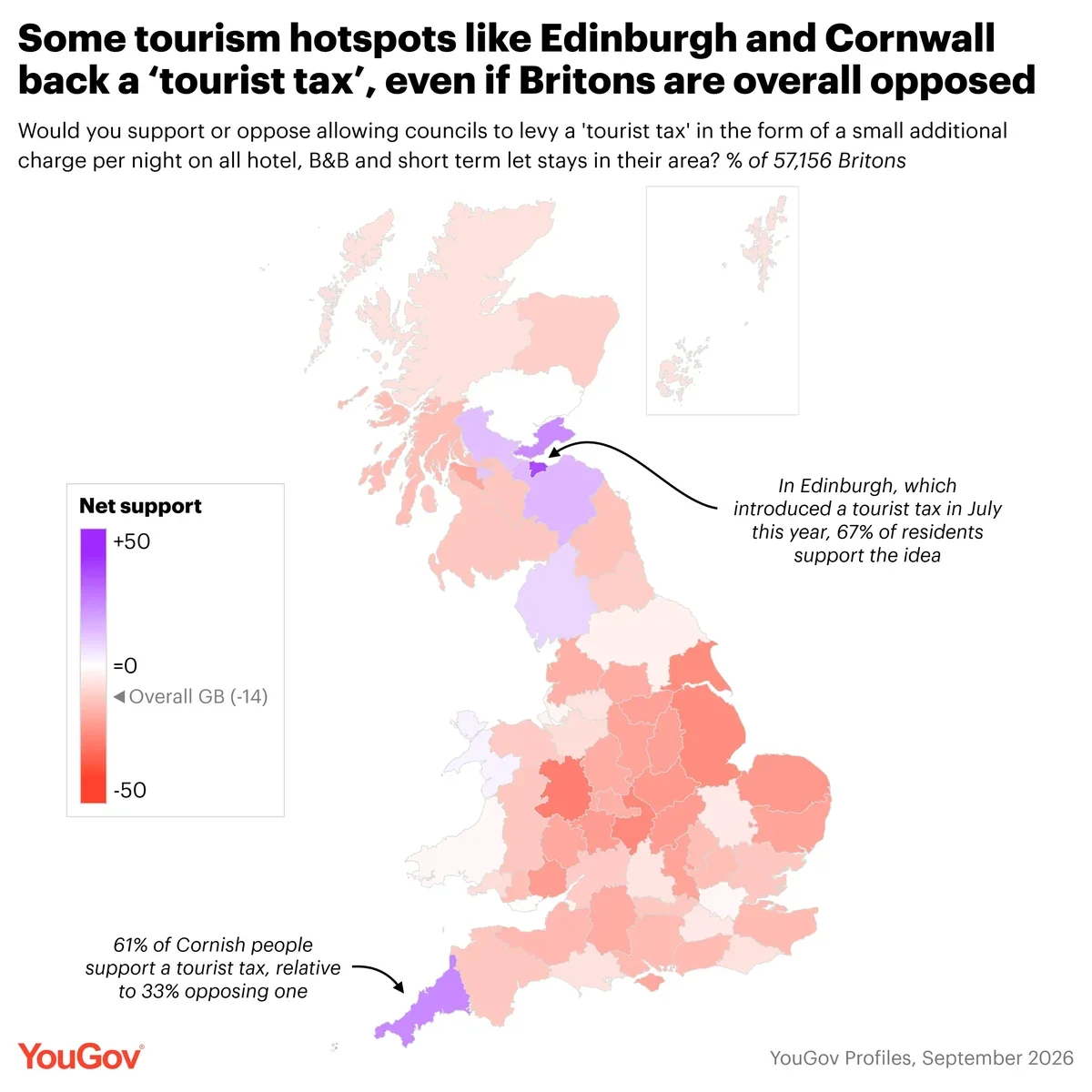
There is also a clear majority in favour of the idea in Cornwall, with 61 per cent showing support.
Under government proposals, the only areas of England that will be able to introduce a tourist tax are Mayoral Strategic Authorities and Foundation Strategic Authorities. Cornwall is currently in the process of becoming a Foundation Strategic Authority.
Other areas of the UK have the support of at least half of their residents, including Fife with 57 per cent and 51-52 per cent in Cumbria.
Glasgow is set to follow suit and become the next destination to introduce a tourist tax, with a five per cent overnight accommodation levy from 25 January 2027. However, the YouGov poll states that Glaswegians are backing local authorities being granted powers to levy a tourist tax by a margin of 48 per cent to 34 per cent.
Other areas of the country also appear to be divided on the question, with similar numbers on either side of the argument for and against a tourist tax.
This includes Bristol, Cambridgeshire, London, Merseyside, North Yorkshire, Tayside, and the coastal Welsh counties of Dyfed, Gwynedd and South Glamorgan, where 40-46 per cent support the idea and 42-48 per cent are opposed.
Opposition to a tourist tax is highest in the East Riding of Yorkshire, Lincolnshire, Norfolk, Shropshire and Warwickshire, where around six in ten (59-61 per cent) are against the idea.
Majorities in Somerset (55 per cent), the Isle of Wight (54 per cent) and Devon (52 per cent) are also against such a tax.
The YouGov poll also revealed some interesting divides within destinations. For example, the City of York, whose economy is heavily supported by tourists, has a majority support for the tax, while enthusiasm is much lower in the rest of the county of North Yorkshire.
This does not mean that all areas with a high visitor footfall welcome the idea, with levels of support in traditional seaside towns like Blackpool, Eastbourne and Torbay sitting around the 40 per cent mark.
Read more: UK tourist tax – where will it be introduced and how much will it cost?