


 Africana55 Radio

This website uses cookies so that we can provide you with the best user experience possible. Cookie information is stored in your browser and performs functions such as recognising you when you return to our website and helping our team to understand which sections of the website you find most interesting and useful.
The Independent’s hotel recommendations are unbiased, independent advice you can trust. On some occasions, we earn revenue if you click the links and book, but we never allow this to affect our coverage.
Strolling down elegant boulevards, dining in atmospheric brasseries and admiring world-class art can be heaven when you’re keeping the company of adults in Paris. Add children to the mix and those joys quickly become a “why do we have to walk?” whinge, an “I’m not eating that!” whine and a “why are we looking at boring pictures?” moan.
How, then, do you “do” Paris – its art, architecture and food – without breaking the bank, and in a way that makes every member of the family happy? The answer lies in the lesser-known attractions.
When it comes to art, the Musee d’Orsay, the Orangerie and the Louvre are all free to under-18s, and their timed-entry tickets will help you beat the queues.
But my nine-year-old daughter and six-year-old son were unlikely to appreciate the Mona Lisa from behind a crowd of iPhone-wielding tourists, or gaze enchantedly at Monet’s water lilies for more than three seconds.
Created with Sketch.
Created with Sketch.
1/11 Grand prize winner and 1st place: Cities
"Upernavik is a fishing village on a tiny island in west Greenland. Historically, Greenlandic buildings were painted different colors to indicate different functions, from red storefronts to blue fishermen’s homes—a useful distinction when the landscape is blanketed in snow. This photo was taken during my three-month, personal photo project to present life in Greenland."
Chu Weimin
2/11 1st place: Nature
"A gorgeous griffon vulture is seen soaring the skies in Monfrague National Park in Spain. How can anyone say vultures bring bad omens when looking at such tenderness in this griffon vulture's eyes? Vultures are important members of the environment, as they take care of recycling dead matter. Vultures are noble and majestic animals—kings of the skies. When looking at them flying, we should feel humbled and admire them."
Tamara Blazquez Haik
3/11 2nd place: Cities
"There are four runways at San Francisco's International Airport (SFO). This is a rare look at the approach end of runways 28 left and right. I had dreams of documenting the motion at SFO and arranged permission to fly directly overhead. What a windy day it was. Winds at SFO were 35-45 miles per hour, which meant a bumpy flight, and it was much harder to control the plane while photographing. The flight was challenging, but it was also so thrilling that I couldn't sleep for several days afterward."
Jassen Todorov
4/11 Honourable mention: People
"I captured this layered moment during sunrise along the banks of the Yamuna River in Delhi, India. This boy was thinking silently, and visitors were enjoying the loud musical chirping of thousands of seagulls. The early morning golden light from the east mixed with the western blue light, creating an ethereal atmosphere. I am a regular visitor here and have photographed this place for the past three years. Now, many national and international photographers have begun visiting too."
Navin Vatsa
5/11 Honourable mention: Nature
"A herd of ibex in Switzerland’s Bernese Oberland cross a ridge above Lake Brienz. Their powerful and impressive horns show who the king of the Alps are. Ibex are ideally adapted to live at dizzying heights. The continuing ridge path and the rising fog show the natural habitat of these animals. After a few hours of observing the animals, I spotted the ibex herd on one side of the ridge. Several ibex stopped at the transition to view the world around them."
Jonas Schafer
6/11 3rd place: People
"Every year on the feast of Saint Anthony the ceremony of the purification of animals, called Las Luminarias, is celebrated in Spain. In the province of Avila, horses and horsemen jump over bonfires in the ritual that has been maintained since the 18th century. The animals are not hurt, and it is a ritual that is repeated every year. To make the photo, I moved from Seville to San Bartolomé de Pinares because I am very interested in photographing ancestral rites."
Jose Antonio Zamora
7/11 2nd place: People
"This photo was taken at a public park at Choi Hung House in Hong Kong. When I visited during the afternoon, it was very crowded with many young people taking pictures and playing basketball. But when I visited at sunrise, it was quiet and a different place. The area is designated for neighborhood residents in the early morning, and there was a sacred atmosphere. I felt divinity when I saw an old man doing tai chi in the sun."
Yoshiki Fujiwara
8/11 3rd place: Nature
"Dusky dolphins often travel together in great numbers in the deep canyons of the Kaikoura, New Zealand in search of food. They glide through the ocean effortlessly, coming up only to breathe. Dusky dolphins are fast and will often keep pace with a speeding boat. I waited on the bow of the boat as the Dusky dolphin almost broke through the surface. Their elegance and streamlined bodies are built for speed and maneuverability—accentuated by the smooth, clear water of the New Zealand coastline."
Scott Portelli
9/11 2nd place: Nature
"What happens before a wave breaks? That question has been my assignment this past year. On this particular day, I decided to shoot the sunset on the east side of Oahu, Hawaii. About 100 photographers were out in the morning, but I had the evening to myself. The textures from the trade winds created subtle colors from the west and blended well using my 100mm lens. I had to look into my viewfinder while this wave was breaking. Not an easy task when a wave is about to crush you."
Danny Sepkowski
10/11 1st place: People
"Actors prepare for an evening opera performance in Licheng County, China. I spent the whole day with these actors from makeup to stage. I’m a freelance photographer, and the series “Cave Life" is a long-term project of mine. In China's Loess Plateau, local residents dig holes in the loess layer to create cave living spaces, known as yaodongs, and use the heat preservation properties to survive cold winters. This series mainly records the life, entertainment, belief, labor, and other daily scenes of the people living in the caves."
Huaifeng Li
11/11 3rd place: Cities
"People pray on the street in Dhaka, Bangladesh during Ijtema. Bishwa Ijtema is one of the major Islamic religious gatherings which is observed annually in Dhaka and millions of Muslims visit during this time. Dedicated prayer grounds are not large enough to handle this huge number of people, so large numbers of people come to Tongi, the main street of Dhaka. All the ground transportation and pedestrian crossings are suspended during that time."
Sandipani Chattopadhyay
1/11 Grand prize winner and 1st place: Cities
"Upernavik is a fishing village on a tiny island in west Greenland. Historically, Greenlandic buildings were painted different colors to indicate different functions, from red storefronts to blue fishermen’s homes—a useful distinction when the landscape is blanketed in snow. This photo was taken during my three-month, personal photo project to present life in Greenland."
Chu Weimin
2/11 1st place: Nature
"A gorgeous griffon vulture is seen soaring the skies in Monfrague National Park in Spain. How can anyone say vultures bring bad omens when looking at such tenderness in this griffon vulture's eyes? Vultures are important members of the environment, as they take care of recycling dead matter. Vultures are noble and majestic animals—kings of the skies. When looking at them flying, we should feel humbled and admire them."
Tamara Blazquez Haik
3/11 2nd place: Cities
"There are four runways at San Francisco's International Airport (SFO). This is a rare look at the approach end of runways 28 left and right. I had dreams of documenting the motion at SFO and arranged permission to fly directly overhead. What a windy day it was. Winds at SFO were 35-45 miles per hour, which meant a bumpy flight, and it was much harder to control the plane while photographing. The flight was challenging, but it was also so thrilling that I couldn't sleep for several days afterward."
Jassen Todorov
4/11 Honourable mention: People
"I captured this layered moment during sunrise along the banks of the Yamuna River in Delhi, India. This boy was thinking silently, and visitors were enjoying the loud musical chirping of thousands of seagulls. The early morning golden light from the east mixed with the western blue light, creating an ethereal atmosphere. I am a regular visitor here and have photographed this place for the past three years. Now, many national and international photographers have begun visiting too."
Navin Vatsa
5/11 Honourable mention: Nature
"A herd of ibex in Switzerland’s Bernese Oberland cross a ridge above Lake Brienz. Their powerful and impressive horns show who the king of the Alps are. Ibex are ideally adapted to live at dizzying heights. The continuing ridge path and the rising fog show the natural habitat of these animals. After a few hours of observing the animals, I spotted the ibex herd on one side of the ridge. Several ibex stopped at the transition to view the world around them."
Jonas Schafer
6/11 3rd place: People
"Every year on the feast of Saint Anthony the ceremony of the purification of animals, called Las Luminarias, is celebrated in Spain. In the province of Avila, horses and horsemen jump over bonfires in the ritual that has been maintained since the 18th century. The animals are not hurt, and it is a ritual that is repeated every year. To make the photo, I moved from Seville to San Bartolomé de Pinares because I am very interested in photographing ancestral rites."
Jose Antonio Zamora
7/11 2nd place: People
"This photo was taken at a public park at Choi Hung House in Hong Kong. When I visited during the afternoon, it was very crowded with many young people taking pictures and playing basketball. But when I visited at sunrise, it was quiet and a different place. The area is designated for neighborhood residents in the early morning, and there was a sacred atmosphere. I felt divinity when I saw an old man doing tai chi in the sun."
Yoshiki Fujiwara
8/11 3rd place: Nature
"Dusky dolphins often travel together in great numbers in the deep canyons of the Kaikoura, New Zealand in search of food. They glide through the ocean effortlessly, coming up only to breathe. Dusky dolphins are fast and will often keep pace with a speeding boat. I waited on the bow of the boat as the Dusky dolphin almost broke through the surface. Their elegance and streamlined bodies are built for speed and maneuverability—accentuated by the smooth, clear water of the New Zealand coastline."
Scott Portelli
9/11 2nd place: Nature
"What happens before a wave breaks? That question has been my assignment this past year. On this particular day, I decided to shoot the sunset on the east side of Oahu, Hawaii. About 100 photographers were out in the morning, but I had the evening to myself. The textures from the trade winds created subtle colors from the west and blended well using my 100mm lens. I had to look into my viewfinder while this wave was breaking. Not an easy task when a wave is about to crush you."
Danny Sepkowski
10/11 1st place: People
"Actors prepare for an evening opera performance in Licheng County, China. I spent the whole day with these actors from makeup to stage. I’m a freelance photographer, and the series “Cave Life" is a long-term project of mine. In China's Loess Plateau, local residents dig holes in the loess layer to create cave living spaces, known as yaodongs, and use the heat preservation properties to survive cold winters. This series mainly records the life, entertainment, belief, labor, and other daily scenes of the people living in the caves."
Huaifeng Li
11/11 3rd place: Cities
"People pray on the street in Dhaka, Bangladesh during Ijtema. Bishwa Ijtema is one of the major Islamic religious gatherings which is observed annually in Dhaka and millions of Muslims visit during this time. Dedicated prayer grounds are not large enough to handle this huge number of people, so large numbers of people come to Tongi, the main street of Dhaka. All the ground transportation and pedestrian crossings are suspended during that time."
Sandipani Chattopadhyay
Thankfully, a different kind of arty experience awaited us in the 11th arrondissement, at the Atelier des Lumieres.
This vast warehouse, a former iron foundry, first opened in April 2018, and showcases art with an impressive son-et-lumiere (sound and light) show across its 10-metre walls.
When we visited this dark and magical space, Van Gogh’s Sunflowers towered above us, projected on to the walls in full technicolour. Over the next 45 minutes, we sat on the floor, mesmerised by giant versions of the Dutch artist’s legendary works while elements of the paintings moved in time with the jazz-music soundtrack. It was followed by another film celebrating Van Gogh’s admiration of Japanese art, which had us gazing, wide-eyed, at an animated version of Hokusai’s The Great Wave as it rolled to the soundtrack of Claude Debussy’s La Mer; giant, beady-eyed fish jumping in the waves. What made it even more special was the fact that the children could touch the artwork – the lights danced on their hands as they reached out to the walls to touch them.
In summer, the Jardin des Plantes is a haven for children: fountains, gardens and paths to run around, and a small zoo with orangutans, snakes, birds and insects. The garden is a different story in the winter drizzle, though.
Thankfully, there’s as much to explore inside the Galeries d’Evolution, where exhibits tell the story of Earth’s animal kingdom. The ground floor is all about life in the oceans and there we learn how the narwhal (with the help of an impressive life-size model) inspired legends of unicorns; we giggle at films of penguins’ hilarious antics; and learn how coral is formed. Up a level, and we get close to the parade of taxidermied animals from the African plains. Elsewhere, we see how different the animals living in South America are.
The galerie itself is impressive, too: dating from 1889, it still has its original glass roof, which spans 1,000 sq m and casts gentle light into the enormous space. Additional effects add to the drama and, as we stand at the top of the three floors of balconies, the sound of a simulated storm fills the hall with the boom of thunder and patter of rain.
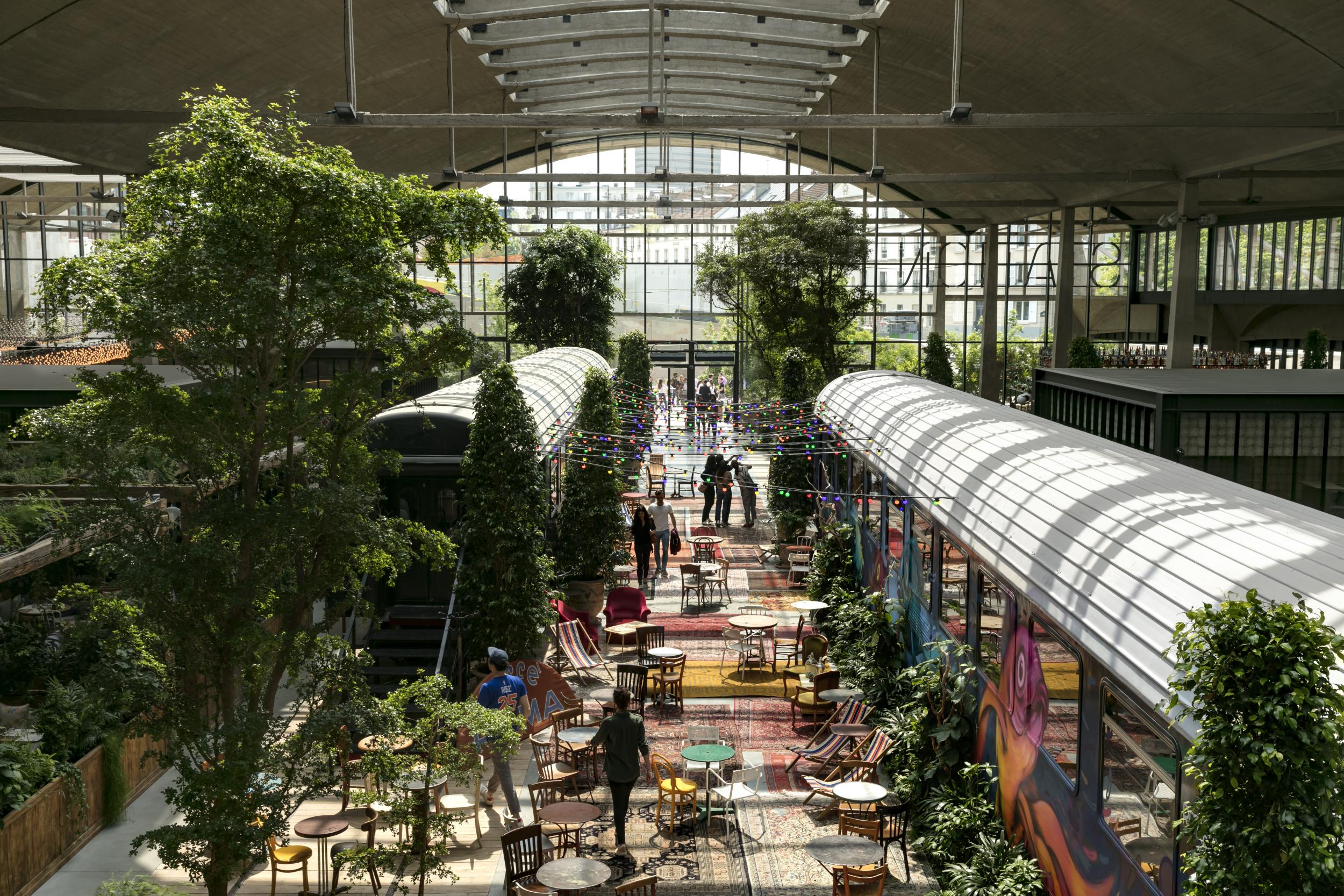
A 20-minute walk away (we risked the whinging) is La Felicita. It’s tagged as the biggest restaurant in Europe, but the immense glass-roofed warehouse (it covers 4,500 sq m) is more a food hall than a restaurant. With a variety of freshly prepared foods from different counters, it offers families the holy grail of serving something for everyone. So while the kids each munched on a burger, my husband and I tucked into crunchy poke bowls served in the train carriage that’s parked in the centre of the hall. I resisted a drink from the oh-so-Instagrammable bar – where five decks of bottle shelves tower above the mixologists below – but I vowed to return sans enfants for that.
Over the weekend, the kids murmured the “D” word a few times, testament to the fact that, for the under-10s, Paris is synonymous with Disney. In a bid to distract from it, we went over to the Bois de Boulogne, the huge wood and parkland on the western edge of the city where the Jardin d’Acclimatation offers fairground rides with a good old-fashioned vibe. The attraction dates from 1860, when it was a zoo for animals to acclimatise to the chilly Parisian weather after being kidnapped from the colonies. These days, the animal magic comes in the form of donkey rides and the aviary for exotic birds – but it’s the fairground rides that proved most popular.
The park costs €5 (£4.30, and €2.50/£2.15 for kids) to get into, with a book of ride vouchers at an additional cost.
Given that it was a chilly winter day, queues were either short or non-existent. We whirled around on the flying chairs, zipped up and down on the rollercoasters, and the kids bumped each other on the dodgems. Elsewhere, we tried our luck at the shooting galleries and duck-fishing, and won vouchers for surprisingly decent prizes. The park was immaculate, the rides smart – beautifully designed with a hint of steampunk, having been refurbished in summer 2018 – and the staff were friendly. Not a princess was to be seen but, after that afternoon, Disney wasn’t mentioned again, while the whinges and moans were pleasantly absent too.
Travel essentials
Getting there
Eurostar has tickets to Paris from London from £29 each way.
Staying there
Mama Shelter East, in the 10th arrondissement, has 170 rooms with B&B doubles from €95. A B&B family room costs from €219. Mama Shelter West opened in December 2019 in the 15th arrondissement. It has its own bar-restaurant and is close to two Metro stations.
Hotel Gavarni in the 16th arrondissement is another great family option and is a short walk to Trocadero and Passy Metro stations. The Eiffel Suite has a great view of the rooftops and the Eiffel Tower. Room-only doubles from €160 with Sawdays, family rooms from €400.